
All cinemas in France which screen Yes from Wednesday September 17 receive a message from the director asking them to keep the sound of the scenes at the beginning of the film at a very high level. These scenes take place during a party which immediately plunges into a disorganized hysteria, saturated with testosterone and thunderous exhibitionism.
There stands out a large olibrius which both concentrates the excesses of all the participants and seems to experience the discomfort that apparently inspires in no one else the ostentatious and aggressive vulgarity of the revelers.
His name is Y. With his partner on stage and in life, Jasmine, he is there both as a participant and as an artist. Y., a talented musician, young father and paid actor, is broke and ready to make any compromises to get by.
Navigating according to his financial interests, his disgusts and his impulses, Y. circulates in several circles of current Israeli society. A polichinelle jazzman who is both disgusted and complicit, he appears to be happy and aware of the obscenity of the world in which he tries to make a place for himself, while despising it, and to which he will submit.
Yes, which was the last great moment of the 2025 Cannes Film Festival (at the Filmmakers’ Fortnight) is a long cry of fury and shame from the Israeli Nadav Lapid about his country. Having opened with a frenetic sequence, already overloaded with erotic and violent exhibition, it also immediately features the IDF officers who add to this pandemonium, which exudes money and shenanigans, the ugliness of their idea of music and dance.
The acquiescence of an entire society
The first part of the film proclaims the cruelty of the upstarts and traffickers in power, but shown in the supposedly most open and tolerant part of Israeli society, the one whose center is Tel Aviv and not Jerusalem or the settlements. Where a humanist, secular and progressive version of the country claimed to flourish, where the director grew up and lived. The character wanders around the city for a long time, aimlessly, speaking empty and flat aphorisms to his baby.
And it is, a political position of incredible radicalism under the trappings of a grand guignol, the irrevocable condemnation of those who say they live in a democracy when it crushes, massacres and plunders without end.
A long journey then takes place across the country, undertaken by Y., a name reduced to a letter which evokes Kafka’s K. and which was already the name of the main character in Nadav Lapid’s previous film, Ahed’s Knee. Left quoting Pierrot the Foolthe disoriented musician finds among others his former companion, witness to his hopes, his wanderings and his past denials. Lucid on his own account, he comments on his journey with a biting irony which ultimately justifies nothing, liberates nothing.
This picaresque journey will lead Y. to the hill from where the Israelis “came to have a family picnic while watching the bombs fall” on Palestinian schools and hospitals.
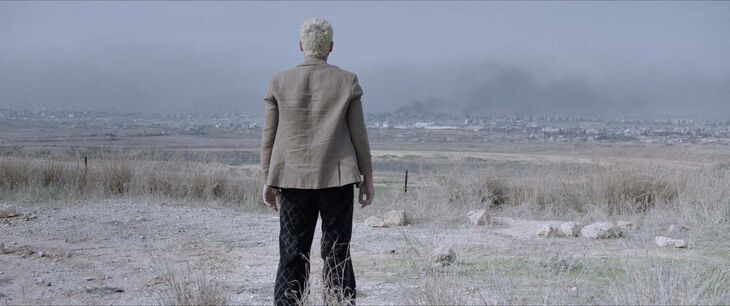
If the film had hitherto played in the register of the stylized grotesque, with puppet characters, each carrying to the extreme the defects of a society rotten by arrogant opulence, this existential indecency is at this moment, almost at the center of the film, as if struck by the documentary. What the metaphorical Y. is looking at is indeed the IDF crushing the Palestinians.
A third part will show Y. agreeing to compose the fascist anthem calling for the destruction of the Gaza Strip (a song which was actually written and performed by a children’s choir after October 7). The “yes” of the title then becomes explicitly that of submission to the injunctions of the powerful, on the part of an artist whose talent and unease we have previously been able to see.
This acquiescence, as shown by the film, is not just that of a character, even metaphorical, but that of an entire society. Through him, it is not only the war criminal Benjamin Netanyahu and his clique, nor the elite covered in jewels and morgue of which we have seen some examples, but the Israelis as a community who are designated as guilty of the worst.
Yes is thus a descent into hell where the most atrocious realism, that of the genocide in progress, mixes with nightmarish madness, forms of burlesque and the power of incarnation of the performers, starting with Ariel Bronz and Efrat Dor, very impressive in the main roles.
Filmed on location, in his country where the filmmaker The Teacher (2014) and Synonyms (2019) felt in territory “enemy”as he declared during the presentation of the film in Cannes, Yes pushes and worries with unusual energy, seeking to make his voice heard, despite the din of bombings and propaganda.
A book in echo, another film in memory
Nadav Lapid’s message to the projectionists about the sound volume at the start of the film is reproduced on the back cover of a book by Morgan Pokée devoted to the filmmaker (Nadav Lapid – Description of a fight), published on September 15 by Éditions de l’œil. In this book, in addition to numerous documents and testimonies, there is a long interview with the director.
He says in particular, about the pivotal scene on the hill which dominates the Gaza Strip: “When you film a kissing scene on the hill outside Gaza, you wonder how many people will be dead by the end of the day of filming. And there are still people, prudes and one-eyed people, for whom this kiss in front of Gaza is in the worst taste!”
The title of Morgan Pokée’s book takes the title of Chris Marker’s film devoted to Israel in 1960, Description of a fight. This film was, at the time, blind to what Israel’s reality already was, but very sensitive to the moral injunction of which this country, despite the catastrophe of the Nakba from which it was born, claimed to embody.
The “fight” mentioned by the title then consisted of remaining faithful to this moral image. “The whole history of Israel has risen in advance against a force which is only force, a power which is only power”then believed he could affirm Chris Marker, who would later prohibit this film from being screened.
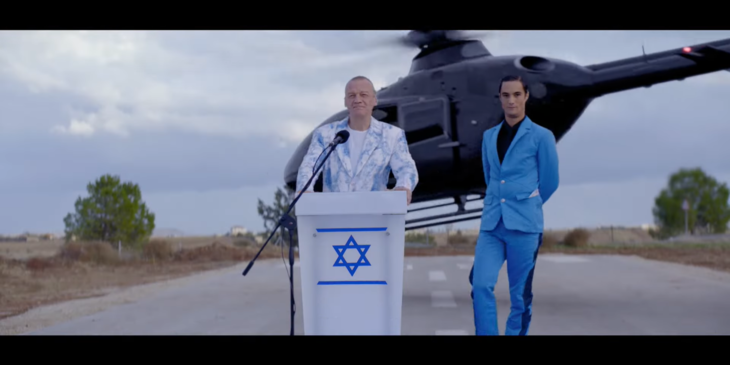
The fight of Nadav Lapid, who was an IDF soldier and member of the Israeli intelligence services, who therefore knows what he is talking about, is to show that Israel is not, has never been, this ethical nation whose status it claimed.
Even if it takes the current genocide for this to end up, little by little, appearing before the eyes of the world, what this filmmaker does, with an incredibly inventive cinematic vigor doped with anger, is completely singular. And it is the sensation of the contemporary, immediate dimension of the film that is striking, especially due to the staging saturated with signals.
“Shooting a film about a country at war, in a country at war, during this war, it’s… It’s funny to talk about distance. There is only the present. I don’t know if this is something missing in the film or not. No prospects. Nothing is relative. Every day is the last day of the world. Every day is the worst”declares Nadav Lapid, referring to the manufacture of Yesin the book dedicated to him.
Since October 7 and the methodical crushing of the Palestinians, there have been a significant number of films on the situation in the Gaza Strip and others which evoke what is also happening in the West Bank. To date, there has been no film about Israel, about the country and the people who commit these crimes. In this, as much as by the electric singularity of a furious staging, Yes
occupies a unique and necessary place.

