
Contrary to what is often said, cinema is not a time machine. It is a device that makes it possible to relate different times and temporalities. Thus go two “anachronistic” films that come out in theaters this Wednesday, September 3. Each in his own way, one rather fiction and the other rather documentary of assembly, they concern a bygone era, the situation of the Palestinians who live in Israel before the genocide in Gaza begins and what was the movement of the theology of the Liberation in Latin America in the years 1970-2000.
If they can be said to be “anachronistic”, it is positively, not being – with the testimonies of the past, but dynamic incentives to perceive what exists in the present from what happened before, and how these situations of another era are enlightening for today. Thanks to the lively energy and the formal inventiveness of their realization, both are carrying a load that is both emotional and reflexive that increases the relationship to historical chronologies which, in a particular way for each, cross them.
“Chronicles of Haifa – Palestinian stories”, by Scandar Copti
The second feature film by the Palestinian filmmaker born in Israel Scandar Copti could be a variation around a story as he performs and above all tells about everywhere and at all times. A story of family conflicts, between generations, between relationships with traditions and modernity, between members of communities who cannot or do not want to cohabit.
A young woman hides from her family her romantic relationship outside the patriarchal standards in force. Her brother has a love story with a woman from another community. Their parents behave according to conformist standards that are held for archaic and attacks on freedoms in the West; The father and the mother each playing a predefined, inherited and which intends to reproduce. Except that…
Except that of course, in the big city in the north of Israel (Haifa), everything is reconfigured by specific operations, marked by traditionalism in force in Palestinians including urbanized and working in “modern” sectors, by insidious or violent demonstrations of apartheid imposed by Israeli Jews on Israeli Arabs, by Zionist recruitment, including very small children.
The success of Chronicles of Haifacomposed of several chapters which adopt the point of view of its different protagonists, is due to its way of maintaining in tension what is a “universal” canvas and the highlighting of specifically located mechanisms and behaviors. And it is due to a kind of permanent tone, momentum which is both that of the bodies, that of the faces frequently filmed in close -up and that of the camera very often in motion.
This accompanies in a mode which often seems that of a news report of “romantic” situations, constantly mobilizing the questioning as to the way in which these major narrative and emotional springs are part of both the particular conditions of the oppression of the Palestinians in Israel and contradict them.
Made before the start of the genocide in progress for almost two years, the destruction at least visibility of the West Bank and the disproportionate worsening of persecution towards the Palestinians who live in Israel, Chronicles of Haifa has the merit of contributing, since a particular situation that the title designates, to undo the mechanics of propaganda which seeks to make believe that it all started on October 7, 2023.
Dated and located, the story to a few characters told by Scandar Copti thus contributes to countering interested myopies, subjectively inscribing the tragedy in progress in the context of a long history of oppression and injustice.

“The Gospel of the Revolution”, by François-Xavier Drouet
It was an epic of bravery and terror, on the scale of a continent, which we have all the more lost the memory that it was very little told. Neither ignored nor forgotten, the immense history deployed under the general name of theology of the liberation is far from occupying in the collective imaginations the place which should return to it.
Inscribed in particular contexts, beyond what the mobilizations of Christians had in common, in the name of their faith, against extreme injustice imposed on hundreds of millions of humans by American omnipotence and dictatorships, in the service of large local fortunes, this political and human adventure still remains to be told.
And this is what the film of François-Xavier Drouet, who finds the energy of an inspired narration, contributes to the film-Photos, filmed archives, posters, newspapers-and testimonies, accompanied by the director in the first person’s journey in the footsteps of these events and the destiny of those who participated in it,
Organized in four parts, each dedicated to one of the countries which was significantly linked to the implementation of the theology of liberation and, always, the theater of a bloody repression of the religious and religious and lay people engaged in their way of implementing the message of Jesus, this aptly named Gospel of the Revolution Curve the main stages that this movement experienced in Brazil, Mexico, Salvador and Nicaragua.
Devaluated and marginalized, the concrete implementation of the commitment of Catholics-as much as such-in Latin American social struggles, until the use of armed struggle and, in Nicaragua, to the capture of power in 1979, was largely documented by the media in their time, especially after the putsch in Chile in 1973.
But these traces have long lost their visibility in the common perception of what was played then. The brutal restoration of the power of the church in the service of the order-and those who make him reign for their profit-by John Paul II, then Benoît XVI, is for many. Who remembers Karol Wojtyła consumed by the crowd to Managua after having reprimanded Ernesto Cardenal, priest, poet and resistant (and who will later become an opponent of Daniel Ortega, the head of the Sandinian Nicaraguan Revolution, when he will turn into a dictator)?
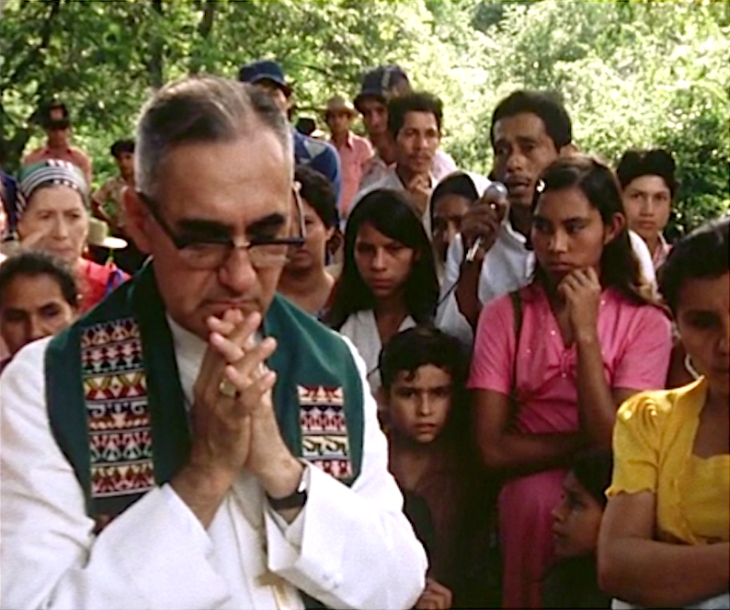
Vintage recordings, in the countryside, the jungles, the village churches, the factories as in the cathedral where the Archbishop Hélder cated to Recife (until it is expelled by the Brazilian dictatorship), like the one where the Archbishop óscar Romero in the Salvadorian capital was. whose causes have not disappeared. They make sensitive vibrations, emotions, the inflection of voices, the fire of looks, the elegance of individual and collective gestures.
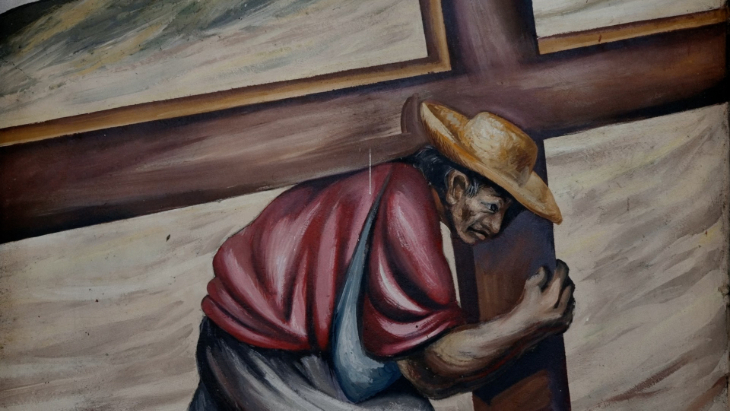
This sensitive dimension is relayed and amplified by the generous use of two major vectors of popular forms of resistance, especially in Latin America, songs and murals. These forms of expression offer the film an emotional dynamic which participates in its inscription inseparably in time of the events mentioned and in ours.
Made during the lifetime of Pope Francis, who was in some respects representative and heir to the theology of the Liberation, and who will have worked to reduce some of the injustices that the Vatican had inflicted on his representatives, the film is released after the death of the Argentinian Pope and while a part of what he tried to implement is called into question. A circumstance which underlines only the better how much everything that has been played out of fruitful and memorable since the end of the era of Latin American dictatorships is fragile and intensifies the necessary character of the proposal of François-Xavier Drouet.

