
A 2,800-year-old tomb, nearly 1,000 cannabis seeds and remains of human hair have allowed an international team of archaeologists to make an exceptional discovery in Siberia. Researchers have found chemical evidence that suggests that the ancient Scythians already used this plant for its psychoactive effects during the 8th century BC.
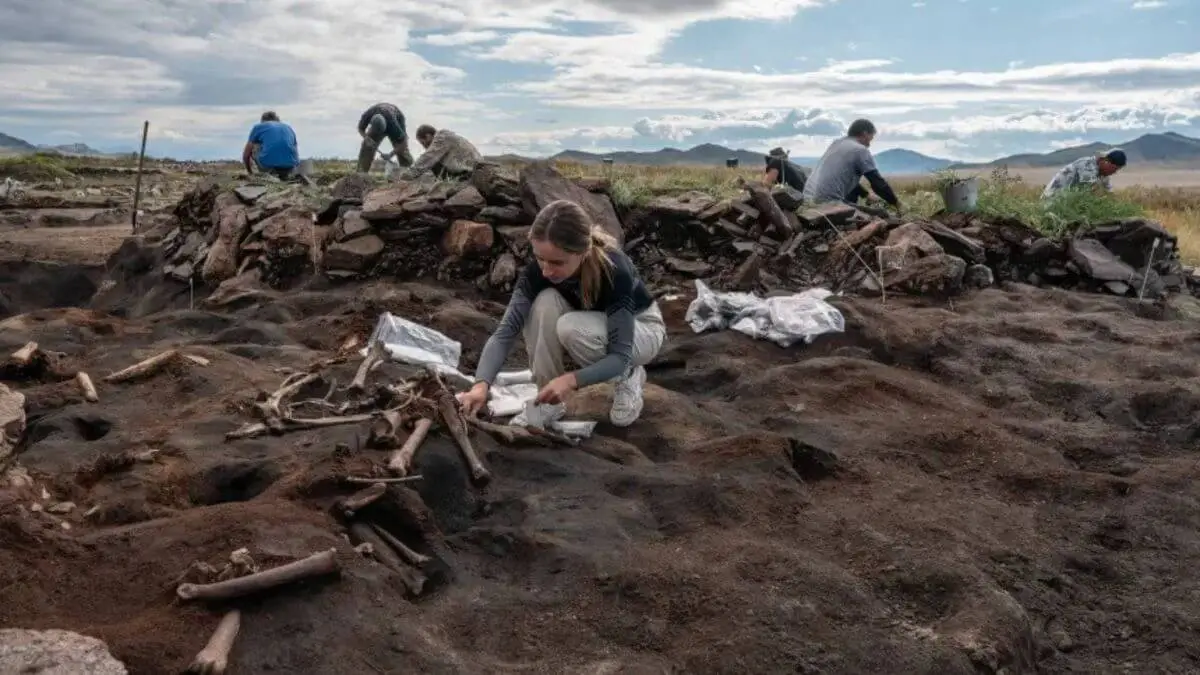
The discovery occurred in Tunnug 1, a monumental burial site located in the Russian republic of Tuva, south of Siberia. There, among human remains and numerous sacrificed horses, scientists discovered extraordinarily preserved cannabis seeds. However, the most surprising thing appeared when they analyzed the hair recovered from the burial chamber: some samples contained chemical signals compatible with compounds derived from this plant.
The investigation, led by archaeologist Gino Casparifrom the University of Bern and the Max Planck Institute for Geoanthropology, has been published in the scientific journal Science. Their results offer what the authors consider the oldest known directly dated archaeological evidence of the use of cannabis for intoxicating purposes.
A princely tomb from 2,800 years ago hid a secret
To understand the importance of this discovery we must go to the Uyuk Valley, a region of Siberia where numerous burials belonging to the first civilizations are preserved. scythian societies. These people, known for their skills as horsemen and warriors, dominated large territories of the Eurasian steppes during the first millennium BC.
Tunnug 1 was a princely burial site that housed human remains, funerary objects and evidence of complex ceremonies. Archaeologists have documented dozens of sacrificed horses and scattered human bones that could be related to ritual practices.
Among these materials, approximately 1,000 cannabis seeds appeared. The researchers selected six specimens to analyze them using radiocarbon, a technique that allowed them to locate their deposit at the beginning of the 8th century BC. C., about 2,800 years ago.
Although the discovery was extraordinary, the seeds alone did not demonstrate psychoactive consumption. Cannabis was also used in ancient times to obtain fibers, oils and foods. The most revealing evidence would come from the analysis of human remains.
Human hair reveals the most surprising clue
The scientists analyzed hair samples preserved in the burial chamber using high-resolution mass spectrometry techniques. The results showed signals compatible with cannabinol (CBN) and other weaker ones compatible with tetrahydrocannabinol (THC), mainly responsible for the psychoactive effects of cannabis.
CBN can form when THC oxidizes and degrades over time. Therefore, its presence in ancient samples constitutes a relevant clue about possible exposure to plant compounds.
The combination of seeds and chemical traces in human hair is especially important because it links the physical presence of cannabis to the buried people. However, the analyzes cannot determine whether the plant was smoked, inhaled through vapors or ingested. They also do not reveal the amount consumed or completely rule out possible contamination of the hair during their stay in the tomb.
This discovery recalls a well-known story by the Greek historian Herodotus. In the 5th century BC. C., described how the Scythians threw hemp on hot stones inside felt-covered structures, generating vapors that produced enthusiasm among the participants. Although the testimony is suggestive, it does not prove that exactly the same ritual was practiced in Tunnug 1.
Why the combination matters more than each piece alone
If seeds and hair are looked at separately, each has obvious limits. What makes the interpretation solid is that both pieces of evidence coincide in the same space and at the same time. The seeds say the plant was present; hair suggests that some people were exposed to its compounds. This convergence reinforces the hypothesis of intentional, possibly intoxicating use, more than either of the two tests alone would do.
Still, this does not mean that we have a reconstructed ritual scene. The exact function of cannabis—ritual, medicinal, social, or a mixture of everything—remains open, and the possible contamination of hair samples, already noted, is a limit that invites caution before accepting the interpretation as closed.
What relationship did cannabis have with sacrifices?
The presence of numerous sacrificed horses has led researchers to propose that cannabis may have played some role in the funeral ceremonies. The possibility has even been suggested that it was used to tranquilize people destined for possible human sacrifice.
However, this last interpretation remains speculative. There is no evidence to show that the individuals analyzed were sacrificed or that they received cannabis for that purpose.
The scientists’ next step will be to study the DNA preserved in the seeds. Its excellent state of preservation could provide information about the domestication of cannabis, its geographical expansion and the characteristics of the varieties used almost three millennia ago.
What Tunnug 1 does reveal is that the relationship between human beings and the psychoactive properties of cannabis is much older than some of the archaeological evidence known until now could demonstrate.
References:
-
Gino Caspari, Timur Sadykov, Daria Fomicheva, Jegor Blochin, Dominic Armbruster, Oliver Happel, Natalia Ryabogina, Kseniia Boxleitner, Robert Spengler. Direct evidence for psychoactive cannabis use 2800 years ago. Science2026; 394 (6824): 649 DOI: 10.1126/science.aeg3800
-
Photo credits: T. Wallace & G. Caspari/Frozen Corpses Golden Treasures