
Imagine a small bead of clay still soft, shaped by fingers that pressed the surface without thinking about what they left behind. Millennia later, that involuntary mark survives. A recent study has identified prehistoric fingerprints on prehistoric ornaments and has cautiously estimated that several belong to children or adolescents. The question is not only who made these objects, but what we can and cannot reconstruct from a trace that their authors never wanted to sign.
What exactly was found (and what these objects are not)
It is worth clarifying this from the beginning to avoid a common misunderstanding: we are not talking about cave paintings or art on the walls of a cave. It is about 142 unfired Natufian clay ornamentsincluding beads and pendants, which could be part of a person’s ornamentation. The set includes complete objects and fragments, each counted as one piece.
These ornaments come from five Natufian sites in Israel – Salibiya I, el-Wad Terrace, Nahal Oren, Hayonim Terrace/Cave and Eynan-Mallaha – and are located between 15,000 and 11,650 calibrated years before the present. That figure is not calendar years: it is a chronology measured backwards from the present, the interval that research associates with the Natufian communities. The Natufians are especially interesting because they lived in a transitional stage, the Epipaleolithic, between the hunter-gatherer groups and the first communities that began to settle and, later, to cultivate.
Why a footprint says more than a finished account
The great novelty is that the clay allows us to observe an intermediate phase of production: the moment when the material was still soft. A finished account informs form and technique. A fingerprint in clay also preserves a bodily trace of the person who handled it, something that normally disappears or is altered with use.
In total, the team recognized fingerprints directly on six ornaments. Of those marks, five were cautiously attributed to children or adolescents and one to an adult. It is a small number, and the researchers themselves treat it as such: six pieces with legible prints do not allow us to affirm that the children made all the ornaments, or even most of them. What they demonstrate is more limited and still revealing: at least some children in prehistory had direct access to clay and touched it while it was modeled.
How to estimate the age of a footprint from millennia ago
This is where prudence matters most. Papillary ridges—those lines that form our footprints—do not function as a prehistoric identity document. To estimate age, the study measured the average distance between the ridges in each prehistoric fingerprint and compared these values with reference tables obtained from current populations, based on a well-documented principle in biology: in the smallest children the ridges are thinner and progressively widen as the body grows. This contrast allows each print to be placed within an approximate age range, never an exact figure.
The procedure allows us to propose broad categories – childhood, adolescence or adulthood – but It does not identify a specific person or establish their exact age. This does not mean that the method is worthless; means it delivers age groups, not names. Furthermore, as this is a comparison with modern samples, the margin of error is considerable: the width of the ridges varies between individuals and depends on biological and environmental factors and the state of conservation of the piece, which is why the authors themselves warn that the estimates should be read as indicative approximations and not as precise dating.
What the traces allow us to affirm: that hands of different ages—including those of children or adolescents—touched the clay while it was still soft, and that it is possible to roughly estimate an age range from the width of the ridges.
What the fingerprints DO NOT let you know: the identity of the person who left them, their exact age, whether there was a deliberate teaching, how many people were involved in each piece or what relationship they had with each other.
What the footprints suggest and what we only imagine
Here begins the most tempting and also the most slippery part. Having a child touch clay invites you to imagine scenes. For example, a child observing an adult, helping, imitating their gestures or practicing with their own hands. They are plausible and human scenarios. But it is important to separate what we see from what we deduce.
Traces are compatible with several situations: collaboration between ages, learning by observation, imitation or occasional, perhaps even playful, participation. None of these interpretations are directly proven by the brands. We do not know if there was deliberate teaching, if the children made ornaments for themselves or if they were simply nearby when the clay was worked. The traces do not reconstruct a specific scene nor do they say how many people were involved in each piece. The strongest conclusion is modest and, therefore, solid: young individuals manipulated some of these objects.
Shapes inspired by plants: another clue with its limits
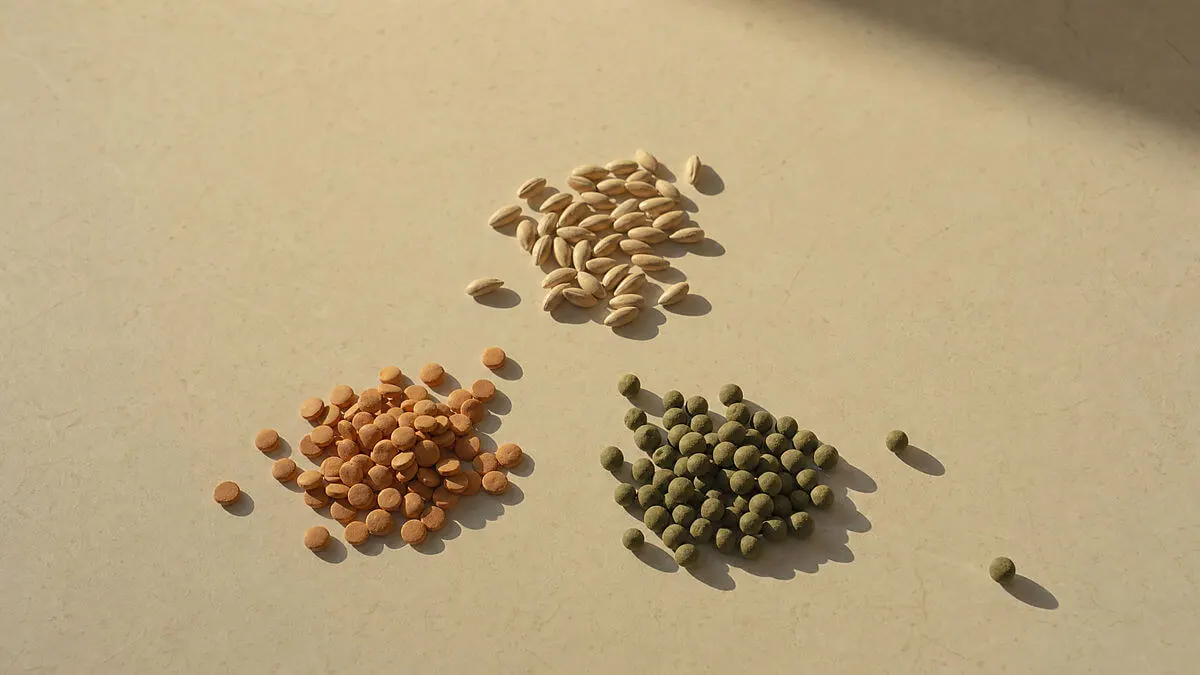
The whole is not uniform. They distinguished themselves 19 shapes different from ornaments, and some were interpreted as possible stylizations of recognizable plant elements, including barley, lentils and peas. It is suggestive to think that those who modeled these beads were inspired by the plants in their environment, at a historical moment in which the relationship with these vegetables was changing.
Still, similarity does not equal intention. A lentil-like shape may respond to the geometry of the modeling or to deformations that occurred during thousands of years of conservation, not necessarily for the purpose of representing the plant. The formal diversity does indicate that these ornaments did not have a single function, but their meaning—everyday use, social identity, exchange, or something else—is not deduced from their form alone.
What remains open
The appeal of this discovery lies, in large part, in what we do not know. We cannot recover names, relationships, or social relationships from the ridges of a footprint. We cannot confirm whether the children were learning, playing or collaborating, nor can we confirm that they made most of the pieces. What we do have is an unusual window into an everyday gesture: small fingers pressing soft clay, in a community that began to settle more than eleven millennia ago.
Perhaps the most valuable thing about this type of traces is precisely their involuntary nature. Nobody thought of leaving them, and that is why they come to us without interpretive embellishments. They force us to carefully distinguish between what the evidence shows and what our imagination completes.