
A few drops of lemon juice are enough for a cut apple to last longer and look good. But the popular explanation—that the acid “turns off” the reaction—simplifies the apple’s oxidation process, finer than it seems.
Why does a freshly cut apple begin to turn brown in minutes, while another, sprinkled with lemon, resists significantly longer? The trick is true, but the phrase that usually accompanies it—”lemon stops oxidation”—leaves out the most interesting part. What happens inside the fruit is not a simple contact with air, but a chain of reactions in which oxygen is only one of the participants.
Cutting an apple is breaking a chemical order
An intact plant cell functions as a highly organized warehouse: it keeps compounds separated that, if mixed, would react. In the pulp of the apple, a family of compounds called polyphenols and an enzyme capable of oxidizing them, polyphenol oxidase (PPO), whose active center contains copper.
While the fruit is whole, those reactants do not match. The knife breaks that order: when cutting, cellular barriers are destroyed and polyphenols, PPO and oxygen from the air come into contact. This loss of compartmentalization gives the starting signal to the so-called enzymatic browningas described by Charles E. Deutch in a review titled “Browning and the biochemistry of fruit-cutting”published in 2018 in Biochemistry and Molecular Biology Education (vol. 46, no. 4, pp. 391-397).
The biology of the fruit basically uses physical separation as a chemical strategy: as long as the cell walls hold, the reaction cannot begin.
Hence, a bruised or chopped apple darkens faster than an intact one, even if no one has cut it: the blow also breaks cells inside and sets the same enzymatic machinery in motion without the need for a single visible cut.
From oxygen to brown: a chain, not a step
Here it is convenient to undo a widespread misunderstanding. The brown color does not appear suddenly as soon as the PPO touches the oxygen. What the enzyme actually does is catalyze the oxidation of polyphenols and produce very reactive intermediate molecules, the quinonespresent in the fruit as soon as the reaction begins. These quinones then combine with each other and with other components of the cell, progressively forming polymers of larger size and more intense color.
In other words: PPO initiates the transformation, but the final brown tone is the accumulated result of several subsequent reactions. This is detailed in the review by Andrew Tilley and his team, “Enzymatic browning in fruits and vegetables: mechanisms and control”published in 2023 in Current Research in Food Science (vol. 6, art. 100432), which emphasizes that a good part of the coloration comes from reactions that occur after the direct action of the enzyme. Therefore, explaining it only as “the apple oxidizes upon contact with air” falls short: “brown” is not a single substance, but the end product of a small biochemical assembly line. That cut brown apple that we see on the table is, in reality, a photograph of a process that continues to advance.
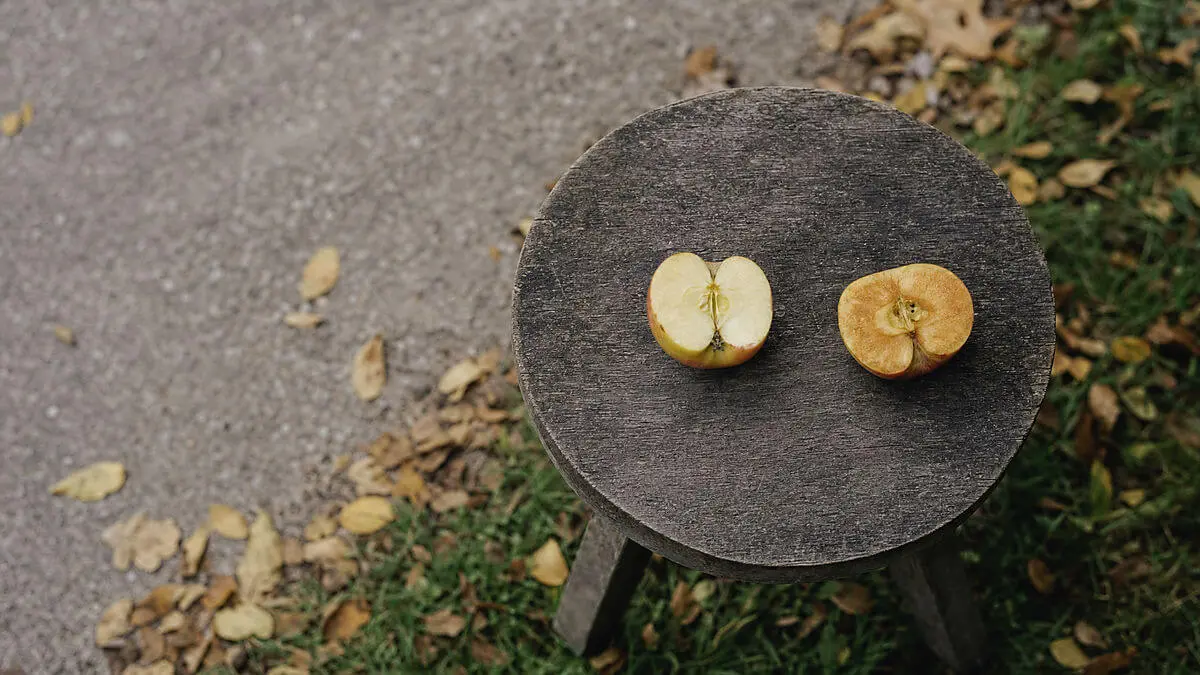
This distinction matters. If color depends on chain reactions, any intervention that stops just one of those links can slow down the visible result without needing to stop the entire sequence. It is also the reason that the tone is not stable: a cut can go from pale yellow to amber and then to a dark brown as those subsequent reactions progress, because what we see is not a fixed state, but a photograph of a process that continues to progress while the fruit is exposed.
Lemon acts in two different ways (and it is advisable not to confuse them)
And here comes the lemon. Its effect is usually summarized in a single sentence, but in reality it combines mechanisms that act on different protagonists of the reaction: the enzyme that sets it in motion, the antioxidants that intercept its products and the pH of the medium, which modulates the enzymatic activity. Separating them helps to understand why it works… and why it doesn’t work forever.
The first mechanism is antioxidant. Lemon juice is rich in ascorbic acid —vitamin C—, which acts as a reducing agent. It can reconvert certain quinones to forms less likely to produce pigments, so that the appearance of color is delayed. The key is in that verb: delay. As the review by Tilley et al points out, when ascorbic acid is consumed or oxidized, browning can resume. Vitamin C does not neutralize the reaction permanently; rather it buys time by intercepting intermediaries.
The second mechanism acts directly on the enzyme: lemon juice lowers the pH of the tissue, and this change in environment can reduce the activity of PPO, the same enzyme that starts the whole process. A study by Janovitz-Klapp, Richard, Goupy and Nicolas, “Inhibition studies on apple polyphenol oxidase”published in 1990 in the Journal of Agricultural and Food Chemistry (vol. 38, no. 4, pp. 926-931), analyzed how pH modified the inhibition of apple polyphenol oxidase. Their results support that acidity influences enzymatic activity, but do not allow us to affirm that a few drops of lemon “completely deactivate” the enzyme.
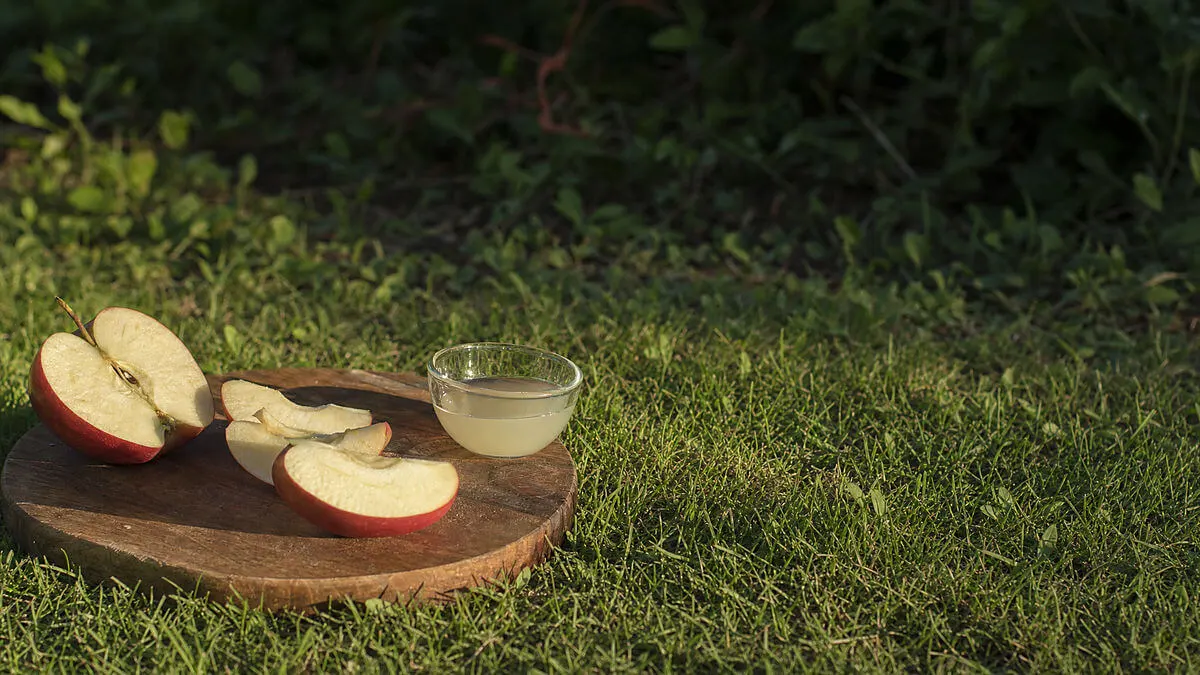
It is an important nuance. The image of the lemon as a switch that turns off the reaction is convenient, but inaccurate. It is more accurate to think of it as an intervention on two different positions in the same assembly line: vitamin C neutralizes oxidative intermediates, while the pH hinders the functioning of the enzyme that sets it in motion. Two different brakes, not one off button. And that also explains why other homemade tricks partially work: submerging the segments in water or covering them with film limits the available oxygen, another of the essential ingredients of the reaction.
Not all apples behave the same
There is also a factor that the kitchen trick usually ignores: variety. Not all apples brown at the same speed or with the same intensity. The cultivars differ in the amount and type of polyphenols, in the activity of their PPO, in their acidity and in other components that modulate the reaction, as stated in the Deutch review.
A work by Serra and his team, “Enzymatic browning kinetics of fresh-cut apple cultivars”published in 2021 in Foods (vol. 10, no. 9, art. 2142), compared the browning of 14 cultivars, evaluating them after cutting, after one hour and after 24 hours. He found noticeable differences: Granny Smith and Cripps Pink darkened relatively little, while Fiesta and Mondial Gala darkened markedly. It is worth emphasizing that these times belong to the experimental design and do not constitute a universal rule: they are a photograph of that trial, not a stopwatch applicable to any apple in the fruit store.
Something similar happens with treatments. A study by Shrestha et al. “Effect of ascorbic and citric acid treatments on browning of fresh-cut apples”also published in Foods (2020, vol. 9, no. 8, art. 1053), tested solutions of 1% ascorbic acid and citric acid on Golden Delicious and Elstar apples, with observations at 0, 30 and 60 minutes. The response depended on the cultivar and the treatment applied. That is why no laboratory concentration or duration can simply be translated into a universal recommendation for homemade lemon juice.
We could see it as a combination of “hardware” and “software”. The variety sets the hardware—how many substrates there are, how much enzyme, what starting acidity—while the temperature, maturity, exposed surface, available oxygen and how the lemon juice is distributed act as software that adjusts the final result. Change any of those conditions and change the time it takes for the brown to appear. A freshly picked apple, very cold and with the surface well covered in juice, does not react the same as a ripe slice, at room temperature and exposed to air for hours.
What is not yet known (and what should not be stated)
This everyday phenomenon retains several open fringes that the best scientific dissemination should not overlook. Far from being a trivial process, enzymatic browning continues to be the subject of study precisely because of the number of reactions that come into play.
The first is temporary. The available sources do not set a universal time during which a few drops of lemon will keep any variety of apple unchanged. Efficacy depends on too many variables—variety, maturity, amount applied, coverage, temperature and available oxygen—to be summed up in one number. That is why it is more honest to say that lemon “delays” or “slows down” browning than to say that it “keeps fresh” the fruit for a guaranteed period.
The second is functional. It is tempting to say that the apple produces these dark pigments “on purpose” to seal the wound against bacteria and fungi. Oxidation products can influence how the damaged surface behaves, but the sources gathered here do not allow us to attribute a simple or universal biological purpose to browning. To affirm this would be to close something that the investigation still qualifies.
In the end, the answer to the question at the beginning does not fit into a single word. “Oxidation” is just the headline of a story with three chapters: what triggers the reaction, what makes the color and what can stop it. The lemon intervenes on the third twice, but it does not rewrite the chemistry of the fruit. The next time you squeeze a few drops onto a slice, you’ll be performing a little applied biochemistry experiment whose outcome literally depends on the apple in front of you.