
A cup falls or rests on the table; a cat is alive or dead. Everyday reality seems to obey exclusive dilemmas, while, on tiny scales, a quantum system can be found in a superposition: a coexistence of outcomes which continues until some contact with the outside allows them to be differentiated.
This apparent contradiction inspired Erwin Schrödinger’s famous cat in 1935. The physicist conceived an animal whose fate depended on a quantum event to show how disconcerting it would be to translate those principles into the everyday environment. His feline was not intended to represent a feasible experiment, but rather to raise a question that remains open: How far can a superposition be expanded without losing its quantum character?
Now we can narrow down the problem more precisely. Perhaps there is no intrinsic border where physical reality begins to obey different laws; perhaps the effects characteristic of the microscopic domain simply become extremely fragile at higher scales.
In any case, to examine this hypothesis, we must make progressively larger “cats” and verify that they continue to be genuinely quantum.
What really is a Schrödinger’s cat made of light
Here there are no animals or organisms suspended between life and death. The protagonist is a state of light. In quantum opticsthis can adopt what is called a coherent state, a configuration that resembles in certain aspects the light of a laser and allows its amplitude and phase to be precisely characterized. The cat arises by coupling two sufficiently distinguishable configurations of this type without transforming them into a mere statistical mixture.
In the experiment, those two variants of the light pulse become entangled with the polarization of another photon. “Entanglement” means that both elements constitute a joint quantum entity: it is not enough to individually attribute an independent state to each one. Horizontal polarization is correlated with a branch of the field; the vertical, with the other.
Let’s visualize an unusual coin that presents both sides simultaneously and, in addition, each one is linked to a different melody.. Enlarging this Schrödinger’s cat does not simply consist of adding photons. It is important to further distance the two branches without breaking the coherence necessary to integrate them into a single superposition.
The cat arises by coupling two configurations that resemble the light of a laser and allow its amplitude and phase to be precisely characterized, distinguishable without transforming them into a mere statistical mixture.
Why quantum weirdness is disappearing around us
The main adversary has a name: decoherence. A perfectly isolated system can retain links between quantum alternatives. As soon as it interacts with its environment, some of the information about those branches escapes. out. Collisions, radiation, vibrations or losses are enough to weaken that delicate connection.
Let’s think of two musicians who play notes with impeccable synchronization. As long as no one disturbs the compass, the correspondence between both waves retains its clarity. Let’s introduce noise, delays and multiple interferences: it will soon be unfeasible to sustain that coordination. The analogy does not reproduce all of the physics, but it illustrates the essential vulnerability.
For this reason, we do not see cups distributed with the naked eye between the table and the floor. Ordinary bodies exchange enormous amounts of data with everything around them. There is no need to assume that quantum mechanics suddenly turns off.
Collisions, radiation, vibrations or losses are enough to weaken that delicate connection.
Decoherence allows us to understand how its strangest manifestations can become inaccessible with extraordinary speed.
Rydberg atoms to build a quantum switch
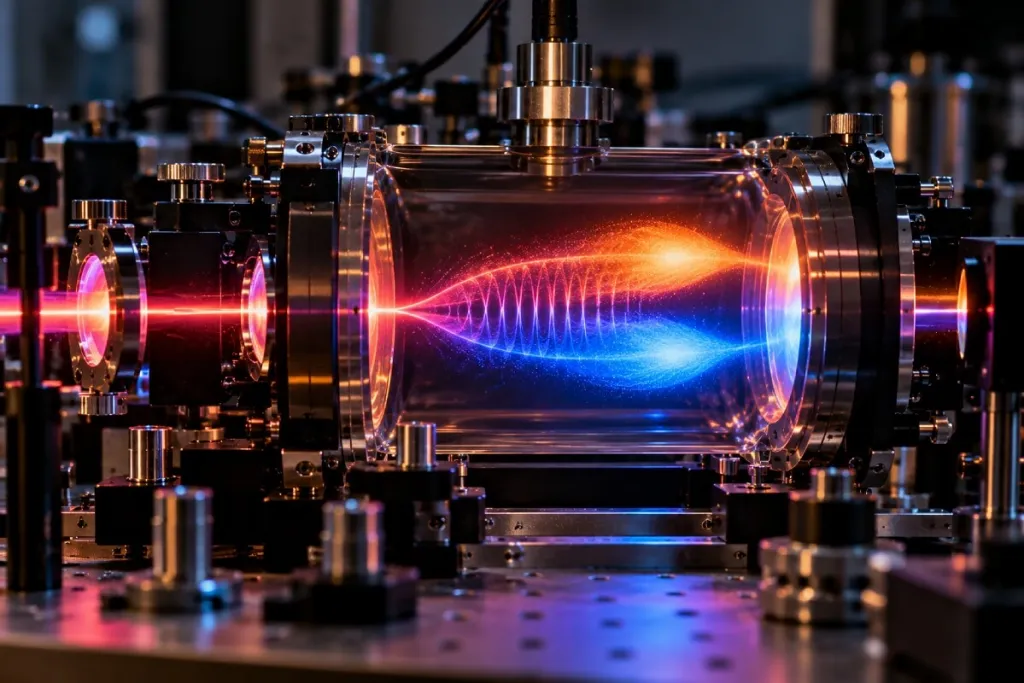
As we read in the study, published as preprint On arXiv, Hendrik Hegels and his colleagues at the Max Planck Institute for Quantum Optics turned to a peculiar tool: Rydberg atoms inside an optical cavity.
An atom is called that when one of its electrons reaches a very high energy level. In such a situation, it acquires exaggerated properties and can interact with enormous intensity with other excited atoms in its environment, whose electrons have also received energy and jumped to higher levels.
The cavity, formed to confine and control light, strengthens the coupling between photons and matter. The authors integrated this scenario with electromagnetically induced Rydberg transparency, a technique that serves to manipulate light propagation through atomic states adjusted with lasers.
The sequence works like a switch governed by a quantum alternative. First, a control photon arrives. Depending on its polarization, one branch is stored as Rydberg excitation in the atomic ensemble and the other traverses an alternative path. Then, a second pulse of light, on which the control photon will act. When reflected in the cavity, it undergoes a phase change conditioned by what happened before. Finally, the initial photon is recovered.
Thus, two stories that would classically be irreconcilable continue to be linked. The procedure provides precisely the sought-after ingredient: two coherent states of the pulse luminous linked to the two polarizations of the control photon.
Depending on the polarization of each photon, one branch is stored as Rydberg excitation and the other traverses an alternative path; A second pulse of light enters, is reflected in the cavity, undergoes a conditioned phase change and the initial photon is recovered.
The optical cat reaches a record size
Here is the discovery. The team produced entangled hybrid states with an effective size of α² = 2.4, a record for this class of optical cats.
This value does not express physical dimensions, but rather quantifies how far apart the two light configurations that form the superposition are. The larger it is, the more distinguishable both branches are and, in that sense, the larger Schrödinger’s cat is.
Therefore, 2.4 should not be interpreted as if it were 2.4 times greater than another and, in particular, take into account that orn previous study based on a single atom inside a cavity only had reached 1.4 and that, furthermore, traditional methods with non-linear means had remained at 0.8 for comparable hybrid states.
They produced entangled hybrid states with an effective size of α² = 2.4, which does not express physical dimensions, but rather quantifies how far apart the two light configurations that form the superposition are.
This value does not express physical dimensions, but rather quantifies how separated the two light configurations that form the superposition are.
The improvement comes, above all, from better controlling decoherence. In the previous record, photons lost during formation could carry clues about which path the system had taken. The Rydberg platform reduces this leak of clues, although it does not eliminate it.
How to verify that the cat is still quantum
Having two disparate lighting projects would not be enough. A classic mix could also contain sometimes one, and sometimes the other. It had to be proven that the quantum relationship subsisted between both.
For this, it was used quantum tomography. The idea is reminiscent of a scanner that recomposes a volume by bringing together many partial views. The scientists repeatedly recorded different magnitudes of the polarization and light field, and then pooled that data to mathematically reconstruct the final state.
One of the derived representations is the Wigner function, a map in the so-called phase space. We do not need to master that geometry to understand the decisive signal: some regions took on negative values, something impossible within an ordinary classical description of the field. The authors also assessed fidelity to theoretical reference states and the negativity of entanglement.
The measurements indicated that the non-classical character survived even in larger cases. The achievement, therefore, is not only to move the branches further apart, but to do so without completely erasing what makes their union a Schrödinger’s cat.
The achievement is not only to move the branches further away and increase the size of Schrödinger’s cat, but to do so without completely erasing what makes it such: its quantum nature.
The older Schrödinger’s cat gets, the more difficult it is to keep him
The experiment also exhibits its own limit. Photon loss during preparation remains the dominant imperfection. The statistical adjustment places the effective coefficient associated with that decrease around 20.2 percent.
They also appear other obstacles: he broadening due to interaction time, he incomplete Rydberg lock, he pulse self-lock bright and he laser phase noise. Each one deteriorates the intended operation in a different way. The authors detail technical modifications capable of mitigating these difficulties, such as prolonging the duration of the light pulse or reducing certain sources of instability.
That opens the option of achieving larger optical cats in the future, but it is still a prospect. The article demonstrates what has been achieved with the current device; the later dimensions pertain to what the platform could achieve if those constraints were relaxed.
Have you found the border between two worlds?
No. It would be excessive to interpret this record as the discovery of a universal line between quantum and everyday physics. The parameter used measures a specific category of hybrid optical states and is not used to classify with a single rule all the superpositions obtained in different laboratories.
The manuscript, dated September 23, 2026 and deposited on arXiv, is also a preprintwhich implies that has not yet undergone peer review by a scientific journal. Their conclusions should be read with caution and wait for them to be confirmed or denied, but the study looks very promising.
Your main interest is elsewhere. Each controlled increase allows us to investigate to what extent a superposition can expand while retaining verifiable signals of coherence, entanglement and non-classicality, that is, quantum.
It would be excessive to interpret this record as the discovery of a universal line between quantum and everyday physics.
This search transforms a philosophical paradox into a question that can be subjected to measurements.
Perhaps there have never been two separate worlds
Let’s go back to the cup. Nothing indicates that it obeys background laws different from those that operate on a photon. The decisive difference may lie in the enormous number of interactions that an everyday object maintains with its environment, capable of dispersing information and quickly hiding quantum relationships.
The value of progress consists precisely in narrow that mystery through experimental evidence. It doesn’t bring a cup closer to a superposition visible tomorrow, but it does extend the territory where we know the physical world exhibits behaviors that, for a long time, seemed reserved for its tiniest components.
That’s why these Schrödinger cats matter beyond the record. Every time superposition survives on a larger scale, the space for conceiving a simple division between a strange microscopic reality and a familiar macroscopic one diminishes.. Perhaps the real question is not where the quantum world ends, but how the world we perceive every day emerges from it.