
The history of spin has been shaped through the contributions of different physicists throughout history. Spin is a physical property of quantum fields and is responsible for the magnetism of matter, which is why it is the basis of many technological applications that promise more efficiency and greater storage capacity.
The word “spin” means spin in English. Therefore, many people imagine that the electron is a small sphere that rotates on itself when they think about its spin. This image is incorrect for many reasons. One of them is that applying a complete 360 degree rotation to an electron does not recover its original state; a full 720 degree double rotation is needed to achieve this. To understand it, Dirac proposed to imagine the electron as two concentric spheres connected by a belt. The electron would be the inner sphere and the outer sphere represents infinity. By rotating the inner sphere 360 degrees, the belt is twisted and a second 360 degree rotation is needed to undo the twist, while at the same time the Dirac belt makes one revolution around the inner sphere during the process.
The behavior of the electron under rotations is counterintuitive. Some physicists have proposed imagining the electron as flow lines of a field in the shape of a Moebius strip, a surface that has only one side. The electron state would be a point on the surface of the tape. Rotating 360 degrees covers half the surface of the tape and ends at a point on the other “face” of the tape; To return to the starting point, you must continue traveling along the surface until you make another complete turn and reach 720 degrees. This analogy does not please many physicists, since reality is much simpler to understand.
Spin is a physical property of quantum fields, which their particles inherit. The electron field has two components (called left and right); the electron is a quantum excitation in each of these two components. Applying a 360-degree spatial rotation to the electron requires applying it to both components of its field; In this process, the excitations in the left and right components are exchanged with each other. Therefore, to recover the initial state of the electron field, a second 360-degree rotation must be applied, accompanied by a new exchange between the components.
The history of electron spin
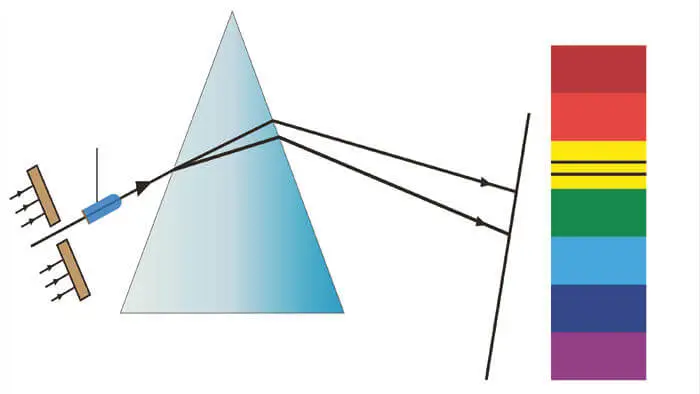
Atomic physics was born when trying to understand the spectra of atoms. Gases emit light when heated and this light is a mixture of a few well-defined colors, called spectral lines. In 1896, Zeeman observed that an external magnetic field split the spectral lines in sodium; To explain this, Lorentz proposed that atoms contained charged particles (later called electrons) that moved in closed orbits and behaved like small magnets with a magnetic moment; Both ended up receiving the Nobel Prize in Physics in 1902.
The Zeeman effect had no explanation in the early atomic models of Bohr and Sommerfeld. In them, electrons are bound to the nucleus in states called orbitals that have a discretized (quantized) energy. Atomic spectra are due to transitions (jumps) of electrons between orbitals. In 1922, Stern and Gerlach managed to measure the magnetic moment of the electron, which turned out to be half of the Bohr magneton (its value for an atom according to his atomic model). Sommerfeld, Landé and Pauli tried to explain the Zeeman effect as a rotation of the orbitals of the outermost electrons with respect to the innermost ones. But this idea did not fit with Stern and Gerlach’s measure. Everything pointed to a new intrinsic property of the electron.
In 1925, Uhlenbeck and Goudsmit, and Kronig explained the Zeeman effect by assuming that the electron was a point charge that rotated on itself, so it would have intrinsic angular momentum; Furthermore, since it is a rotating electric charge, it would behave like a small magnet. This is how the electron spin was born, which inspired the Pauli exclusion principle with which it was possible to understand the periodic table of the elements. Physicists like Lorentz had serious doubts, because the spin speed of the electron would exceed the speed of light in a vacuum. To avoid this, in 1926, Pauli mathematized spin by resorting to a spin in an internal abstract space, described by two-component matrices. Thomas observed that spin had units of angular momentum inducing a relativistic precession effect in the electron.
The nature of spin was clarified by Dirac, who introduced in 1928 his relativistic quantum equation for the electron, which generalized the Pauli matrices to matrices of four components, two of them for the electron and another two for a hypothetical particle identical to the electron but with a positive charge. In 1932, Anderson discovered it in cosmic rays and named it positron, the first antimatter particle. Spin had been explained as a relativistic quantum effect that disappeared in the classical limit, but its ultimate origin was still unknown.
The quantum field of the electron
The solution wave function of the non-relativistic Schrödinger equation is interpreted as the probability of locating the position of an electron in an atom. But this idea cannot be applied to the relativistic Dirac equation; the wave function with four components is not a probability distribution, as it leads to negative probabilities. In 1932, Dirac proposed interpreting it as a quantum field; The solutions to its equation would be quantum operators of creation and annihilation of electrons and positrons. Fock, in 1933, and Furry and Oppenheimer, in 1934, developed this idea in analogy with the quantization of the electromagnetic field. The probabilistic interpretation was assigned to a quantum operator that counts the number of particles, the difference between the number of electrons and the number of positrons (hence it can be a negative number, although its probability is well defined).
For decades, the quantum field of the electron was considered a mathematical object that helped perform calculations; It was thought that only particles had physical reality. But after the birth of quantum electrodynamics (QED), in 1949, which described the interactions between electrons, positrons and photons through quantum fields, the idea was born that the fundamental physical object was not particles, but fields. This idea was not accepted until the standard model of particle physics was born in 1973, which describes all fundamental interactions, except gravitation, with quantum field theories with different spins: zero spin (Higgs), one-half spin (electrons, neutrinos and quarks) and unit spin (photons, weak bosons and gluons).
The irreducible spin
The ultimate origin of spin is the relationship between quantum fields and spacetime. The mathematical formulation of this idea was developed by Wigner in 1939 within the framework of the theory of group representations. A set of geometric transformations forms a symmetry group when two consecutive ones can be applied to obtain a new one and all can be inverted to undo them. In the special theory of relativity, spacetime transformations are rotations and specular reflections in space, and changes in relative velocity called boosts (which are analogous to “rotations” in time), which constitute the Lorentz group; When the translations in space are added, the Poincaré group is obtained.
Wigner showed that the origin of spin is the irreducible representations of the Poincaré group (where irreducible means that the representation cannot be decomposed into simpler ones).
Particles are not point objects, but excitations of a quantum field located in a certain volume of space (with a size given by their de Broglie wavelength). Therefore, when space rotates, these excitations rotate with it. Furthermore, the quantum field of a particle can have several components: the Higgs field has one, but the field of the electron and a quark has two, and the field of the weak W and Z bosons has three. When a rotation in space is applied to the quantum field of a particle, all its components will rotate simultaneously as a single entity.

The most characteristic property of quantum physics is linearity; The states of a quantum system can be combined by weighted addition to give rise to new physical states, quantum superpositions. For quantum fields it is necessary to use linear representations in the form of vectors and for geometric transformations matrices that multiply (“transform”) said vectors. In the Lorentz group representations, the number of components of these vectors is determined by the spin s of the field using the simple formula 2 s + 1. A field with only one component has spin zero (s = 0); one with two components, spin one half (s = 1/2); one with three components, unit spin (s = 1), and so on.
The irreducible representations of the Lorentz group are characterized by two Casimir parameters. One discrete, the spin of the field, and another continuous, the mass of the field. This last parameter is interpreted as the minimum energy necessary to excite the particle-like state of the field (if the energy used is greater, the rest of the energy will be kinetic). For massless particles with non-zero spin, the physical components can be two in a three-dimensional space; These components are transversal to the movement of the particle at the speed of light in a vacuum. Thus, the photon and gluons, with spin one, have two components, just like the hypothetical graviton, which has spin two, or a theoretical massless neutrino that has spin one half.
Particles in fields with integer spin are called bosons and those in fields with half-integer spin are called fermions. The components of the boson fields are called polarizations; This name is inspired by the polarization of light, which is due at the quantum level to the fact that the photon has two components. In fermion fields the term chiralities is preferred. The electron and quarks of spin s = 1/2 have two chiralities, left-handed and right-handed (or left and right, or −1/2 and +1/2). The hypothetical gravitino with spin s = 3/2 has four chiralities, which are usually referred to as −3/2, −1/2, +1/2 and +3/2. The standard model is chiral because the weak interaction only affects the left components of the fermions and the right components of the antifermions.
So, in essence, spin is just a number that allows us to count the number of components of a relativistic quantum field. A number to which a physical magnitude is associated with units of angular momentum and which allows a magnetic moment to be associated with the electron.
Spin-based technologies
Spin is responsible for the magnetism of matter, which is why it is the basis of many technological applications. Like modern high storage capacity hard drives. They were made possible thanks to new magnetic sensors based on the giant magnetoresistance discovered in 1988 by Grünberg and Fert (Nobel Prize in Physics in 2007). This quantum effect is observed in thin films that alternate ferromagnetic and non-magnetic layers. Electrical resistance is low when the spins point in the same direction and high when they point in opposite directions.
One emerging technology is spintronics, which uses electron spin to develop new electronic devices. This technology promises more energy efficiency and more information storage density. In addition, it has applications in future quantum computers. It has not yet reached the mass market, but it is expected that in the coming decades all mobile phones will include spintronic devices.
