
“When Charlotte Corday’s head had fallen under the fatal knife, the executor, showing her to the people, dared to apply two bellows to him. The cheeks were covered with redness that struck all eyes. ” This observation, reported by a witness to the execution, on July 17, 1793 on the Place de la Concorde (Paris), frozen the blood of the spectators. Usually, the cheeks of corpses do not blush. However, those of the murderer of Jean-Paul Marat did it. Could it be the manifestation of a form of anger, pain or shame? In other words, the mark of lucidity?
At the end of the 18th centurye A century, scientists were convinced that the brain is the seat of thought and soul. Nothing surprising, they argue, that the heads separated from the trunk can still briefly demonstrate a cognitive activity. Several macabre observations go in this direction: winks, facial spasms, post-mortem grimaces … Revolutionary terror shows the thousands of the horrible grin that twist the faces of “shortcuts”. It is even said that two rival deputies, condemned suddenly, would have continued their headache in the baskets of the guillotine, one of the beheadities having bit the head of the other!
Of course, there are some scholars to breach these hasty conclusions. To hear them, facial contractions and other post-mortem convulsions would only be nervous reflexes, not the expression of a form of consciousness. “Why indeed confuse moral sensitivity and pain with fiber irritability And purely mechanical sensitivity? ”indignant the doctor and deputy René-Georges Gastellier in 1796.
An idea behind the head
If the debate is also virulent, it is because the guillotine had initially been introduced to ensure a “gentle” and painless death. “With my machine, I blow your head in the blink of an eye and you do not suffer. The torture that I invented is so soft that we can only say if we did not expect to die and that one would think he felt on the neck only a slight freshness ”assured Doctor Joseph-Ignace Guillotin in 1789.
However, the signals of a post-decapitation consciousness contradict the effectiveness of the “national razor”: they rather indicate a terrible and mute agony … After all, we can see hens or snakes continue to move after their beheading! “What a more horrible situation than that of having the perception of its execution and following the ulterior motive of its torture”comments, bitter, the doctor and surgeon Jean-Joseph Sue (father of Eugène Sue), in 1797.
Unable to decide, scientists multiply experiences on orphans, stimulating them in various ways to determine if they keep a semblance of conscious life. “Two cut heads having been exposed to the sun’s rays, the eyelids that had been raised closed with abrupt liveliness”reports a corridor anecdote from Doctor Séguret’s laboratory. The debate is still not resolved at the end of the 18th centurye A century, researchers redoubled inventiveness, using the many heads harvested by the executioners in order to unravel this strange mystery.
The most stunning of their experiences was carried out in 1880, when Doctor Dassy de Lignières injects dog blood into the head of a corpse three hours after his execution. To his great amazement, the face comes alive immediately: “It is no longer the livid and flaccid mask of earlier, this head will speakenthuses the sorcerer’s apprentice. (…) So, I live clearly, during the space of two seconds (…), I saw the lips agitate as for a stammering, the eyelids flash and make an effort to open; I live the revival side in a general expression of awakening and astonishment. I assert that, during these two seconds, the brain thought … “
The death penalty in debate
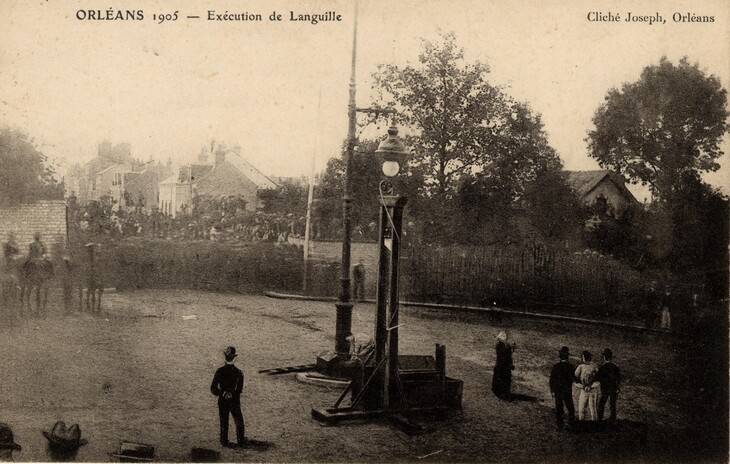
Scientists persist. In June 1905, in Orléans, Doctor Gabriel Beaurieux got along with the death sentence Henri Languille to have the head of the interested party, once the sentence is executed. Afterwards, the chief doctor of the Hôtel-Dieu d’Orléans turns to the head of the tortured and calls it several times.
The rest is told by the practitioner in an archived report, that the daily Le Parisien published two years after the facts, in September 1907. “I then saw the eyelids rise slowly, without any spasmodic contraction, (…) as happens, during life, in people that we wake up or to tear off from their reflectionsdescribes the doctor. Then the Languille eyes stared at a precise way on mine and the pupils “accommodated”. So I did not deal with a vague look, without any expression, as we can observe every day among the dying that we call out: I was dealing with very lively eyes that looked at me. (…) I therefore conclude in a formal way that the meaning of hearing and vision manifestly persist, twenty-five to thirty seconds after death. ”
These arguments are so appointed. They serve the rhetoric of the abolitionists, who hope to remind the closet this obsolete and barbaric death instrument. The question of the abolition of the death penalty is making its way in France. In 1907, it was even the subject of a referendum, organized by the newspaper Le Petit Parisien, but almost 77% of the respondents then pronounced in favor of maintaining the capital punishment.
In June 1956, doctors remained horrified by what they observe on the scaffold. “Death is not immediate, each vital element survives decapitation. There remains, for the doctor, only this impression of a horrible experience, a murderous vivisection, followed by a premature burial ”, Comment the Fournier and Piedelièvre doctors in front of the National Academy of Medicine.
Two decades later, on September 10, 1977, the last capital execution took place in France in Western Europe, on the person of Hamida Djandoubi. This 27 -year -old Tunisian, convicted of the rape, torture and assassination of his former partner, was guillotined in the Baumettes prison, in Marseille. On October 9, 1981, finally, the death penalty was abolished in France, with the promulgation of the law presented by Robert Badinter, the Minister of Justice at the time.
Since then, the debate on post-decapitation lucidity has no longer had to be … However, the progress of electroencephalography bring their stone to the building. In a study published in the scientific journal Laboratory Animals in January 2014, four researchers from Massey University (New Zealand) have shown that rodents were still aware of several seconds after having had the decided head … What would the executioners of the French Revolution think?
