
If you placed a human brain next to that of a chimpanzee, you would see two strikingly similar organs: the same general architecture, the same large territories, a shared plan. And yet, one of those brains writes symphonies, builds telescopes and asks himself questions. What makes the difference? The most honest answer is that science doesn’t have it complete yet, but it does have fascinating clues about where to look.
Looking alike is not working the same
For a long time there was a search for something like an “intelligence neuron” or an exclusive area that alone explained what humans do. That unique piece is nowhere to be found. Humans and chimpanzees belong to the same lineage of great apes and share a general brain organization: the same lobes, equivalent structures, a recognizably common design.
The key is in a distinction that should be established from the beginning: anatomical similarity does not mean identical functioning. Two systems can share the same parts and use them very differently. That is why the interesting question is not whether we have a magical component that they do not have, but how an evolutionarily shared machinery comes to produce such different capabilities.
Let’s start with the most visible. The adult human brain weighs, on average, about 1.3 kilogramscompared to about 0.38 to 0.40 kilograms in the chimpanzee: approximately a three-fold difference, according to the comparative synthesis of the Smithsonian Human Origins Program. It is a striking figure, but misleading if taken alone. Absolute size alone does not determine the organization of networks or the efficiency of connections. A bigger brain is not necessarily a smarter brain.
It’s not the volume, it’s the connections
If size is not enough, where to look? More and more works point to the connectivity: how some regions are linked to others. In 2025, the ChimpBNA atlas, built with diffusion images from 46 chimpanzeesdelimited 200 cortical and 44 subcortical regions. When compared with human atlases, the researchers found especially marked connectivity divergences in so-called association areas, including lateral temporal and dorsolateral prefrontal regions.
In 2025, the ChimpBNA atlas, built with diffusion images of 46 chimpanzees, delineated 200 cortical and 44 subcortical regions.
This matters because the association areas are those that integrate information from several systems at the same time: they participate in planning, memory, language and social cognition. A change in how they connect can alter the dynamics of entire networks even though the overall anatomy remains, at first glance, unmistakably ape-like. The difference, then, would not be so much in the pieces as in the wiring that joins them.
Concept neurons: when a cell recognizes an idea
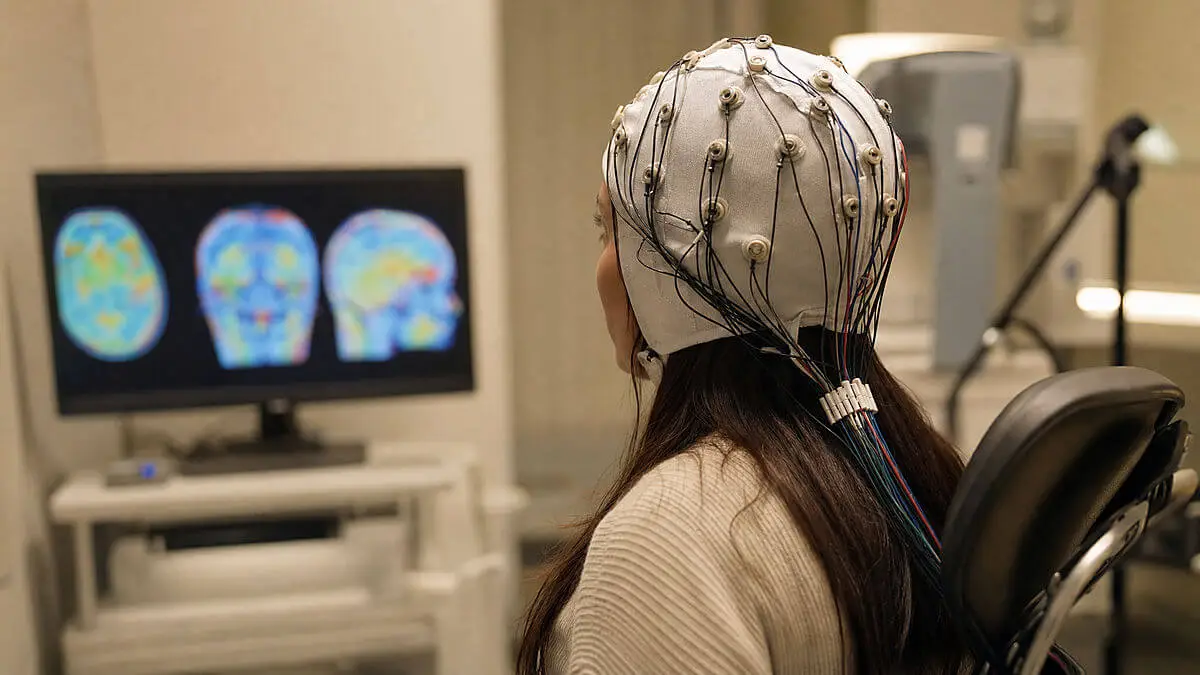
There is one finding that especially illuminates this question of functioning. In a study published in Nature In 2005, Rodrigo Quian Quiroga’s team recorded the activity of individual neurons in the medial temporal lobe of eight patients with drug-resistant epilepsy, who had electrodes implanted as part of their clinical evaluation. Over 21 sessions they analyzed 132 units that responded to at least one image; of them, 51 met the response criterion invariant.
What does that mean? That the same neuron was activated when faced with very different photographs of the same person – famous examples were neurons that responded to several images of Jennifer Aniston or Halle Berry – and even, in some cases, when faced with their written name. The cell was not reacting to a concrete image, but to something more abstract: the identity or the concept from that person, the signal will arrive wherever it arrives.
Quian Quiroga, today an ICREA researcher at the Hospital del Mar Research Institute, has formulated a suggestive hypothesis. “My hypothesis is that concept neurons are exclusive to humans and are one of the bases of our intelligence,” he stated in an interview published in 2025. It is worth underlining the word hypothesis: It is a proposal by the researcher, not a proven fact. The founding study did not make a direct equivalent comparison with chimpanzees, so we do not know if these cells are truly unique to our species or if they are enough to explain language, consciousness or general intelligence.
An ancient virus hidden in DNA
The other clue comes from genetics, and is especially counterintuitive. An article published in Science Advances on October 23, 2026, signed by Patricia Gerdes, Ofelia Karlsson, Raquel Garza, Diahann Atacho and collaborators, described a chimpanzee-specific retroviral insertion—identified as PTERV1—within the gene LINC00662.
What is interesting is not the appearance of a new gene, but a change in the regulation of an existing one. In the cell models studied, this insertion was associated with methylation of nearby DNA and the absence of LINC00662 expression. When the researchers removed the insertion using the CRISPR gene editing tool in chimpanzee stem cells, the gene’s expression was restored. The retroviral element acted, in practice, like an off switch.
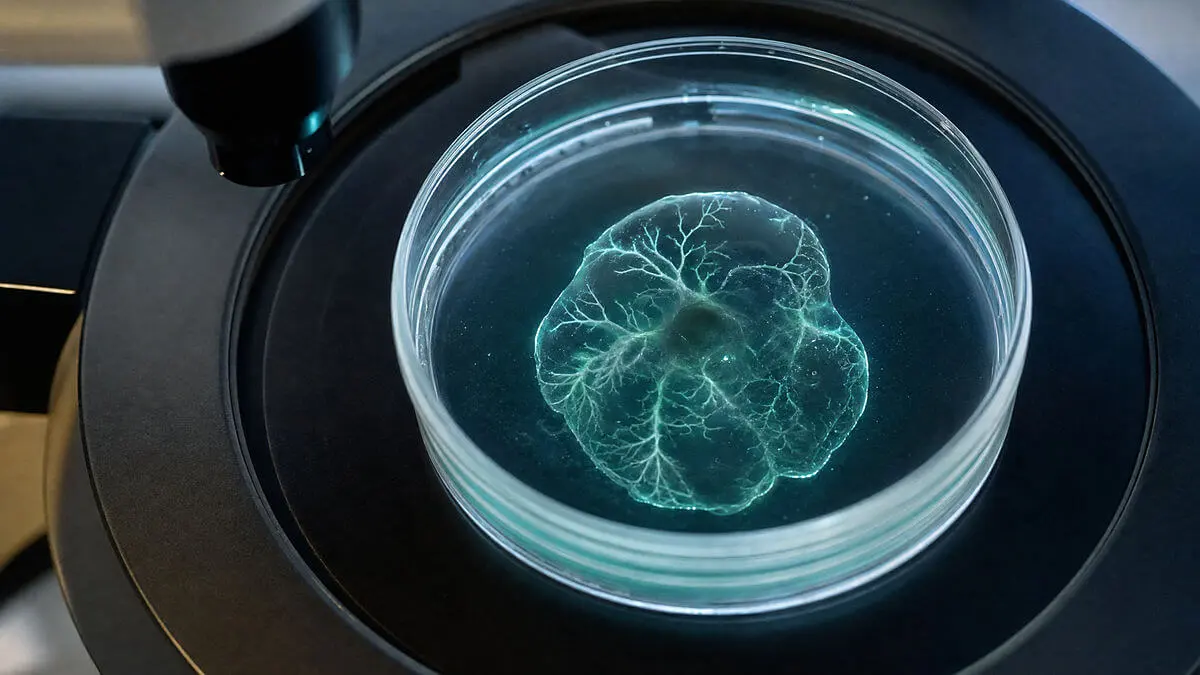
And in humans? By experimentally silencing LINC00662 in human neural organoids—tiny lab-grown structures that replicate some processes of brain development—a marker associated with developing neurons and neurites was reduced by day 30. The overall growth and formation of the organoids were not altered. The result suggests a possible regulatory function during neuronal development.
Caution is mandatory here. These experiments link viral insertion to gene silencing and show a role for LINC00662 in laboratory models. They do not demonstrate That insertion explains human brain size, cognition or behavior. Organoids lack vascularization, sensory input, and the complexity of a complete brain: what happens in them does not automatically translate to a living brain.
And the language, and the culture?
Reducing everything to neurons or genes would leave out a decisive part of the story. The communication of other primates presents precursor capacities—intentional signals, social learning, a certain flexibility—but it is not equivalent to human language in its productivity, in the open combination of symbols or in the cumulative cultural transmission. The difference seems gradual in some components and much more marked when looking at the complete integrated system.
And human capabilities do not depend only on a brain at birth, but on years of social learning, language, tools, education and cultural accumulation. An exclusively anatomical or genetic comparison falls halfway: it leaves out the process that converts biological possibilities into observable abilities.
What we still don’t know
Let’s go back to the question at the beginning. If human and chimpanzee brains share so much, what makes our distinctive capabilities possible? The most solid answer, for now, is that there is no single cause. The evidence favors an explanation distributed: the interaction between size, connectivity of association areas, genetic regulation during development, a longer maturation rate and, on top of all of this, learning and culture.
The evidence favors a distributed explanation: the interaction between size, connectivity of association areas, genetic regulation during development, a longer maturation rate and, on top of all of this, learning and culture.
The concept neurons and history of LINC00662 are valuable clues, not verdicts. They show us where to keep looking: how the brain transforms diverse signals into common representations, how a few regulatory changes can reorganize development, how networks coordinate in different ways on a shared plan. Perhaps the most important lesson is this: we are not special because we have a piece that others lack, but because of how a set of pieces works that, to a large extent, they also have. And deciphering that “how” remains one of the most exciting open questions in science.