
“A bib of a century.” This is the theme of the Universal Exhibition held in Paris between April and November 1900. But the event is not only intended to learn from the past. Stunned by the heyday, the capital digests the progress of the XIXe century to project yourself with optimism towards the future. The 51 million visitors thus discover a prototype rolling and mechanical sidewalk (ancestor of the escalator), the first diesel engine, the prowess of the “electricity fairy”, the projections of the light brothers, the promises of the radium … The opening of the universal exhibition of 1900 also coincides with that of the Parisian metro, in work since 1898.
By drawing up with state -of -the -art innovations, the City Light presents itself as the international capital of modernity. Visiting this “showcase of the world” is a bit discovering in preview the city of the future. “Never and nowhere have we gathered so many curiosities, wonders, attractions of all kinds, dazzling and sumptuous shows”welcomes a reporter from the Petit Journal on the sidelines of the Universal Exhibition. It is the golden age of oil and industry, vaccines and photography, telegraph and department stores … An era synonymous with progress, enthusiasm, confidence, where no impossible project seems out of reach.
Graphic premonitions
It is in this spirit that is published, at the dawn of the new century, a series of prints anticipating the new millennium. Directed by the French painter Jean-Marc Côté, a collective of artists imagines the scenes that could punctuate daily life in the year 2000. This reflection on all aspects of life in society: education, police, army, leisure, sciences, transport … So, have the predictions of these illustrators have fallen right?
The first observation which is essential is that the conquest of the tunes is a recurring motive of the prints. Aerotaxis, flying tanks, firefighters, factors or winged police … A plane driver even takes the time to take a ball of red wine to take away from his aircraft!
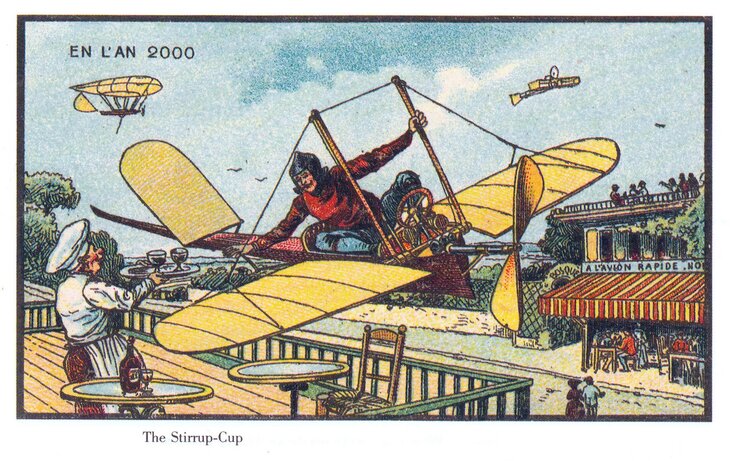
These fantasies reflect the socio -cultural upheaval generated by the transport revolution which, in the XIXe Century, gave birth to the railroad, steam boats, metros, electric trams, automobile … So, by moving all traffic to the sky, there is only one step! Alas, the flying car still belongs to the XXIe century, in the science fiction register. Even if advances are now underway, this means of transport is still encountering many issues.
On the leisure side, the illustrators invent several non-approved sports: air hunting, “air tennis”, eels race, underwater croquet or underwater fishing in Goéland (opinion to amateurs).

This inventiveness is undoubtedly linked to the multiplication of clubs and sports associations in France in the last third of the XIXe century. Indeed, if sport has long remained an entertainment reserved for the elites, it is democratized thanks to the geopolitical upheavals which push the tricolor schools to integrate the sport, considered to be the key to future military victories, in the school programs.
The reign of machines
As often in futuristic visions of the late 1800s, at Jean-Marc Côté and his artist colleagues, robots are everywhere: a robot-barbier capable of style several customers at the same time, a spare robot sweeping and recurring the floors, a robot-architect leading a construction site, a harvesting robot harvesting in the fields … having invented the XIXe century hits the vision of an automated world, where the work week would fall at 3 p.m. and where humanity could get rid of too exhausting tasks.

On the other hand, some machines leave perplexed, such as this acoustic device allowing “to hear the newspaper”. While the radio is at its beginnings and it is also the installation of radio antennas at the top of the Eiffel Tower, in 1904, which saved it from the demolition. Or a revolutionary radium heating system which capitalizes on the large fashion of radium since its discovery, in 1896 (it was before the dangers of radioactivity was revealed).

On the scientific level, the premonitions of the designers prove to be more relevant: they represent an astronomical device allowing to study the cosmos card on its work table or a device growing microorganisms. These two paintings illustrate the triumph of the scientists of the XIXe century, which probed both the infinitely small (theory of germs of Louis Pasteur, discovery of the electron in 1897) and the infinitely large (foundation of consumer observatories, birth of spectroscopy, first astronomical photographs, etc.).
Other scenes from the series “In the year 2000” refer, without forcing the imagination too much, towards the modern world. Thus, this illustration of “Auto-Rollers” evokes the electric scooters which have today trivialized in our cities, while the “videootelephonia” anticipates a prototype (a little bulky) of visiophony, a century before Skype or Facetime. Finally, a scene called “intensive breeding” prefigures the industry of the same name, which has been thriving since the end of the Second World War, despite its environmental and ethical consequences. In France, intensive farming today concerns more than eight animals out of ten.

Go to a century or two
What to conclude from this excursion in the unconscious of our ancestors? Beyond the curious and wacky aspect of this collection, it is clear that it perfectly illustrates the optimism of the Belle Époque, galvanized by the promises of an industrial revolution arrived at maturity. Here, no artificial intelligence (AI) out of control, a vigipirate or global warming: technology and humanity coexist harmoniously, as you could believe at the time by lingering on the sites of the 1900 universal exhibition.
Since then, our vision of the future has been more pessimistic, nourished by nuclear psychosis inherited from the Cold War and increasingly urgent environmental issues. Hence this question: if we were to reissue the experience today-to represent the earth and our daily life in a century or two-what would we draw? And above all, will there be still humans in 2125 or 2225 to see if our predictions have fallen right?
