
From the first pages of the novel Anarchy in the Ukrpublished in 2005 in Ukraine and in 2016 in France (Black on white editions), the writer and poet Serhiy Jadan, figure of contemporary literature and the Ukrainian left, stages himself in Houliaïpole (oblast of Zaporijia). It was there, in this city in the south-east of Ukraine, that the corn, this wind of the steppes, made black flags beat struck with a skull, at the beginning of the XXe century. The flags of the Makhnovtchina, a local revolutionary movement which hatched between 1917 and 1921.
With a raw style and irony, Serhiy Jadan is sorry. The anarchist leader of the Makhnovtchina, Nestor Ivanovitch Makhno, born in Houliaïpole in 1888, fell into oblivion. At best is it a vague tourist attraction. The Ukrainian poet and novelist laughs at himself, questioning there “The first one that falls under hand to find out if his grandfather had not fought with Makhno …”.
Since then, the city of Houliaïpole has been damaged by war. From the start of the Russian invasion of Ukraine in February 2022, she found herself on the front line. In May 2024, in the city center, a statue of Nestor Makhno with a little kitsch look, erected in 2009, was destroyed by Russian artillery.
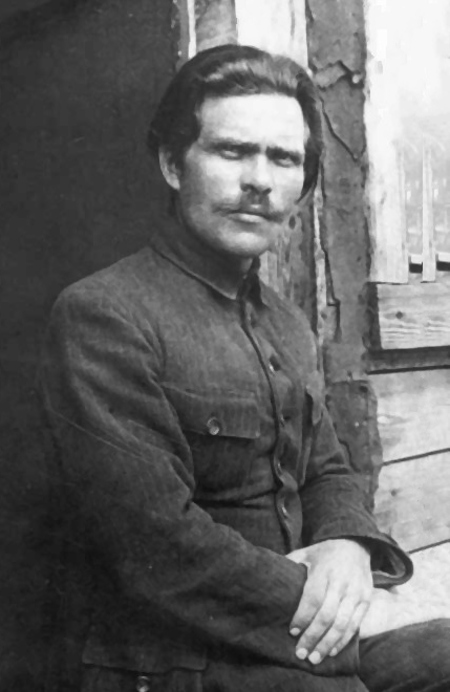
Since the publication of Serhiy Jadan’s novel, Nestor Makhno has signed a discreet but palpable return. With his mustache and his proud gaze, he reinvites himself in public space, in the form of graffiti, frescoes and stencils. “In June, a Makhno fresco appeared in Zaporijia”can we read on a loop of Ukrainian anarchist activists on the Telegram network. The artist David Chichkan apologizes for not being able to answer questions: he finds himself involved in the Russian-Ukrainian war and manipulates a mortar. On the front, a few dozen anarchist activists, armed volunteers or volunteers providing care for the wounded, claimed from the Makhnovist memory.
New Mural in Zaporizhhia! pic.twitter.com/ew4ylzqej8
– Vladyslav Starodubtsev (@vlstarodubtsev) October 12, 2023
An ephemeral Ukrainian revolution, barred by the Bolsheviks
Difficult to summarize in a few lines the epic life of Nestor Makhno, both romantic and political. When the Revolution broke out through the Russian Empire in 1917, this peasant of cosacher origin was released from the Tsarist prison where his anarchist convictions had brought him. Ukraine is agitated by the socialist revolution and by a powerful nationalism. A Ukrainian People’s Republic was born for the first time during this 1917 pivotal year.
Nestor Makhno quickly takes the lead from one of the Soviets in Ukraine, these workers’ committees that form the spine of the Revolution. He fights the white armies and the Tsarist troops, counter-revolutionaries and faithful to the Empire. He has repeatedly combined with the Bolsheviks, led by Lenin, who won everywhere at the head of the Revolution. Courageous, inventive, quickly haloed with glory, Makhno becomes “Batko”“Little father” in Ukrainian, after a series of fast victories.
More than the Bolsheviks and the Ukrainian nationalists, he finds the words to rally the peasant masses. In 1919, the army of the Makhnovtchina – or “Ukrainian insurrectionary army” – had thousands of insurgents. His ingenious Tatchankas, machine guns mounted on light trolleys, towed by horses, offer him a rare mobility on the battlefields.
Through the vast Ukrainian territory, between 1917 and 1921, alliances are made and defeat between nationalists, tsarists, anarchists, Bolsheviks … Between the Bolsheviks and the Makhnovists, initially united by their desire for revolution, relations deteriorate. An irremediable conflict ends up bursting between the two forces. The Makhnovtchina, surrounded and repressed by the enemies, runs out of steam and must lay down their arms.
In 1921, with his last wrestling companions, Nestor Makhno fled Ukraine. The anarchist leader successively finds refuge in Romania, Poland, Germany and finally in France in 1925, where he worked in particular as a worker at Renault in Boulogne-Billancourt. He died on July 25, 1934 at Tenon Hospital, XXe District of Paris. His ashes are still resting in the French capital, in the Cemetery of Santa-Lachaise.
From a “clandestine” memory to a current Makhnovist heritage
Meanwhile, Nestor Makhno will have tried to understand why his version of communism, libertarian communism (or anarcho-communism), gave way everywhere in the face of Marxism-Leninism of the Bolsheviks. With four Russian anarchists also in exile, he wrote the “organizational platform of libertarian communists” in 1926, a text which made debate within the anarchist movement. Makhno accuses his camp of having moved away from social issues to shut himself up in individualistic considerations, far from the realities of the workers and peasant masses. This criticism makes him a theorist always read among libertarians around the world.
Currently engaged in the Ukrainian army, Vladyslav Starodubtsev is a historian and militant within the social movement (Sotsialnyi Rukh), an organization of the Ukrainian radical left. He explains: “In Ukraine, the flame of his memory was kept illegal in the workers’ unions which gained power in the 1980s”while the country is still a Republic of the Soviet Union. Besides, Soviet propaganda will not have failed to denigrate Nestor Makhno.
In Ukraine, in February 2014, on the occasion of the Maidan Revolution (or “revolution of dignity”), which led to the dismissal of the Prorussian power, the memory of Nestor Makhno has experienced a real revival of popularity. “In the student mobilization above all, anarchist groups claiming to be his inheritance played a certain roleunderlines Vladyslav Starodubtsev. Serhii Kemskyi, a young anarchist activist killed by a sniper’s ball during the movement, has become one of the figures. ”
From left to far right
From the collapse of the Soviet Union in 1991 to the Russian invasion in February 2022, including the Maidan Revolution of 2014, the Ukrainians began reunion with whole sections of their traditions and their history. The cosacher culture which Nestor Makhno, the deep soul of the Houliaïpole region claimed to be claimed, which found itself in the Tactics of Makhnovtchina based on the cavalry, resonates with this background movement.
It is until the Ukrainian state which sometimes commemorates the anarchist leader. More surprisingly, the Ukrainian and intellectual sociologist on the left Volodymyr Ishchenko notes that even far -right political groups, powerful in Ukraine, mobilize his name or his image. “They reduce it to the fact that he fought the Bolshevikshe sums up. That’s all that interests them. Of course, the fact that Makhno himself was a claimed communist is put aside. ”
“In Ukraine, young people rediscover Makhno. The left seeks how to express themselves through stories and truly Ukrainian experiences, those of our ancestors. ”
Indeed, Makhno’s report to the Ukrainian national idea was ambivalent. In a revolutionary biography, published in 1981 and reissued in January 2024, the French historian Yves Ternon quotes his faction: “Speaking of the independence of Ukraine, we hear this independence not as national, but as the social independence of workers and peasants. We declare that the laborious Ukrainian people have the right to forge their own destiny, not as a national entity, but an entity of workers. ”
But in Ukraine, the trend is “decommunization”, notes Volodymyr Ishchenko, which recalls that claiming to be Marxism-Leninism, the official ideology of the Soviet era, can today lead you to prison. Since 2014 and the Maidan Revolution, the statues of Lenin, the Bolshevik leader, who stole the landscape, have been even tumbled.
For Vladyslav Starodubtsev, the interest found for Makhno illustrates a whole process in progress within the Ukrainian left. A complex process which he defines as a “Identity quest”. “Young people are rediscovering Makhno, but also the socialist heritage of the First Republic of Ukraine born at the same time … The left of the country is looking for how to express through stories and properly Ukrainian experiences, those of our ancestors.” Who knows? Makhno’s nickname “Batko”, “little father”, may make sense.
