
On the occasion of the simultaneous release of these three films, however different among themselves, we would like to try, also with humility, to resonate together three tones of the idea of modesty, as a great and noble ambition of cinema.
Modesty as a program-and as a political program-in Christian Petzold, modesty as a vigorously ambitious formal bias in Paul Vecchiali and modesty as a status imposed on the film by Jean-Gabriel Leynaud by the state of the cinematographic spectacle are three modalities of a “being in the world” of films which transgresses the enormous pressure of formatting.
Everyone in their register affirms an energy that seeks to make its way among the standards of domination as it manifests everywhere, including in what occupies the vast majority of large screens.
“Mirrors n ° 3”, by Christian Petzold
There was a world, a certain world, couple of wealthy urbanas, unequal relationships between man and woman, badly held promises, beautiful red car, countryside as a luxurious setting. Speed, arrogance, certainties. And then boom.
There will be … ah! What? Time. Places. Gestures. Looks. It’s like a tale, but very, very realistic, concrete. A tremendously material and sensitive way of complaining that, yes, another world is possible. At least for a while.
The nineteenth feature film by Christian Petzold, an experienced director to whom the French Cinémathèque devotes a judicious retrospective from August 26 to September 4, continues in the vein of the two previous successes of the German director, Ondine (2020) and The red sky (2023).
The scenarios have nothing in common. Here, the story of what is played out between a Berlin student in music, victim of a road accident, and the family in the countryside which she is welcomed without them and they know each other before. It is the finesse and precision of emotions, the vibration of plans and beings which, from one film to another, are in unison.
Presented by the fifteen of filmmakers at the last Cannes festival, this fable on hospitality imagines the ways that different people may need each other, even without knowing the motivations of each and everyone. And not always only in sweetness.
As delicate and rich in echoes as the piece of Maurice Ravel from which he borrows his title, Mirrors n ° 3 is embodied with a grace on the skin, especially by the two actresses who work for so long with Christian Petzold, Paula Beer and Barbara Auer. They are so present, so alive, that we would risk not paying attention to the two male roles, behind but remarkable – remarkable, among other things, to be set back.
In Cannes, the film was unanimously loved by those who saw it, but very little. It was presented in a parallel section, it did not arouse controversial or glitter flicker. And it was strange like his status on the Croisette, also modest, looked like what activates so intense on the screen during the projection.
There is something that evokes the notion of decrease-from the spectacular, of show business, buzz effects-in the film itself as in the way in which it appeared in public space. It is an idea that is gradually emerging and that has found, in Cannes always, place par excellence of the overexposition of films, an even more radical translation with the masterpiece gone unnoticed The Mastermind by Kelly Reichardt.
In Mirrors n ° 3 flourish A proposal that is not soothing or simplistic. It is set up between working people, who take care of healing who goes badly, who are to eat, repeat the fence and repair a bicycle. They experience multiple feelings, not necessarily peaceful, without illusion on complete reciprocal transparency.
Thus circulates the possibility of living together a block of space-time. A proposal that it would be wrong to misseen radicality, as elegant, is the way in which it is formatted.
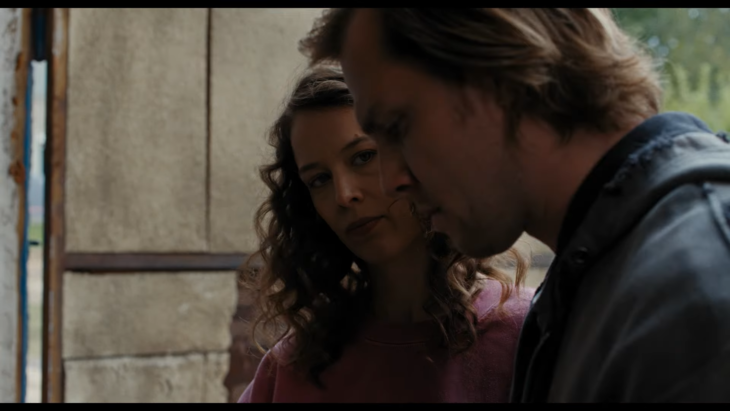

“Hello the language (impromptu)”, by Paul Vecchiali
“He thought I was going to die, it’s missed my coconut!”,, Launched, brave, the very old man to his son, who arrives after six years of absence. How can it be that this sentence, pronounced by someone who will indeed die incessantly, who died when we see the film, is also … yes … Joyeuse?
This is the miracle, or one of the miracles of the last feature film by Paul Vecchiali-and here “last” must be held in full sense (he died on January 18, 2023, during the film’s finishes). It is him, the old man first partly hidden by a surgical mask, facing Pascal Cervo, who is for the seventh time actor in a film of the filmmaker. They are them, but it is also a father and a fiction son, Charles and Jean-Luc, who begin by confronting each other dryly.
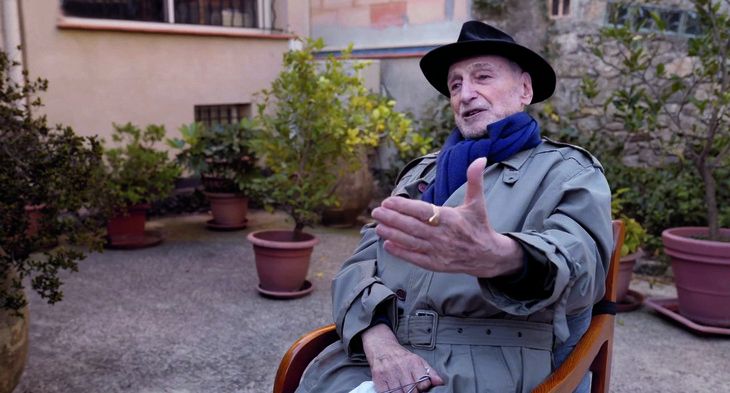
A card at the beginning warned that the film, shot in one day, was fully improvised by the two performers. The way in which, in three acts in three sets-the courtyard of the house of Charles, which could well be that of Paul Vecchiali, the terrace of a restaurant in Sainte-Maxime (Var) and a park-Relations between the two men will be enriched and reconfigured is undoubtedly, not at all improvised.
Growing in the passage of some extracts from Dunce (2016), a previous film by Paul Vecchiali where Pascal Cervo was already playing his son, Hello language Impression by its attentive and inventive journey, but above all by the living harmonics who keep deploying during this chain of dialogues.
The filmmaker of Café des Jules (1988) and White nights on the pier (2015), who loves John Ford so much, has often pleaded that cinema can be born from the conversation and he proves it again. Charles (Paul) and Jean-Luc (Pascal) will each stay in “his images”, in his context. During the first two parts, speech circulates from one plan on one to one plan on the other. And it is a swarming of stories and affects that proliferates between them. The third act will finally bring them together in the same framework, to reconfigure what binds and opposes them.
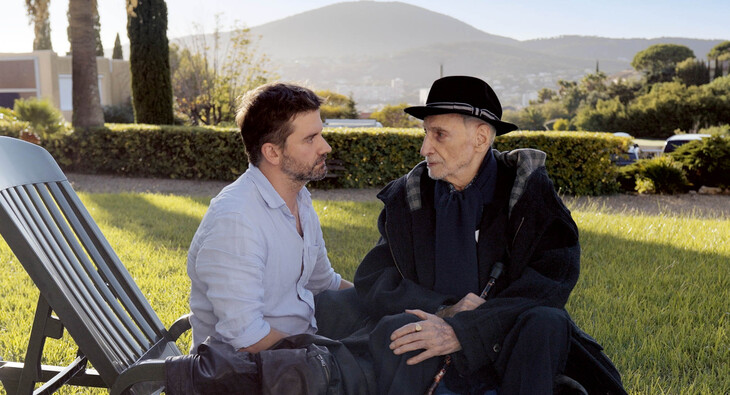
From this device where cinema appears to be reduced to its simplest device, arises a tonic activation, inhabited by multiple presences and echoes. And this is what makes the proposal that the hatching, at the end of his life by the filmmaker with thirty-two feature films so joyful in more than sixty years of constantly inventive practice.
The title –Hello language-And more than one sign before the ultimate dedication establish another dialogue, smiling and also incisive, with Jean-Luc Godard, who died a few months earlier (September 13, 2022), and his penultimate feature film, Farewell to language (2014). Way of continuing what is both an ambitious reflection on the powers of cinema, a friendly game, a debate which deeply implies which participates in it (the filmmakers, but also the spectators), beyond death.
And simultaneously, he activates in a fun way, therefore serious, a very beautiful declaration of a form of love, between the two men who are on the screen. But “love” is too imprecise here, if not misleading. A link which indicts two people of two generations, a filmmaker and an actor, where affection and parentage are fragile and fair benchmarks to approach something else, which perhaps has no name. Hello language.

“Blood and mud”, by Jean-Gabriel Leynaud
Modest, this film? Surely not with regard to what he deals with. These are 6 million deaths, which practically no one is talking about. Direct victims of the Coltan’s operation, this ore necessary for the operation of electronic devices, starting with our mobile phones. From this extermination, in progress in the east of the Democratic Republic of Congo (DRC), each of us has a piece in his pocket, as seventy-five Nobel Prize winners recalled in a tribune published in the newspaper Le Monde, at the beginning of June.
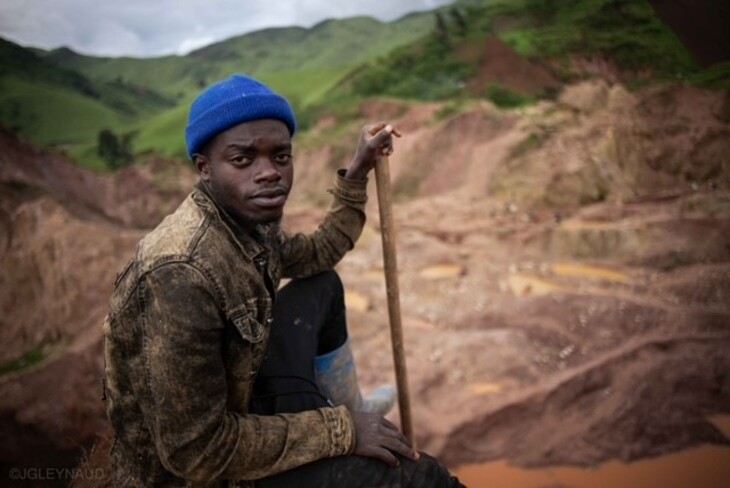
And no more modest, the form of this film, fresco where epic adventures, breathless post-western, melodrama and chronicle mix, while Jean-Gabriel Leynaud weaves the fate of a Creuser and his family together, that of the young forced mother to prostitution, that of the intermediaries along the marketing chain, that of the soldiers who have controlled the area- Passed under the thumb of the M23, subservient to Rwanda, which plunders Congolese resources. And the course of the ore, the fixing of courses for the benefit of the richest multinationals on the planet, Apple, Google, Meta, Microsoft …
The only modest dimension of this tragedy on a planetary scale will be, alas, the visibility it will have, the place to which the film is promised in collective attention, when the monstrosities to which we are all so directly linked should lift hurricanes of protests all over the world. No name known in the credits, no promotional means, no invitation at major festivals. Circulate …
Built on proximity to a dozen people who largely become characters, both by the way to film them and by the exemplary side of their trajectory, Blood and mud However, is a documentary in many ways more romantic and more overwhelming than the vast majority of fictions.
This lyric relationship is translated into the way of filming Jean-Gabriel Leynaud, so neat, so impeccable that we sometimes doubt his degree of realism. These “beautiful images” of extreme misery, the violence of humans, elements and the economic system question. And it is an additional quality of this film signed by an experienced director who is also a high -end operator.
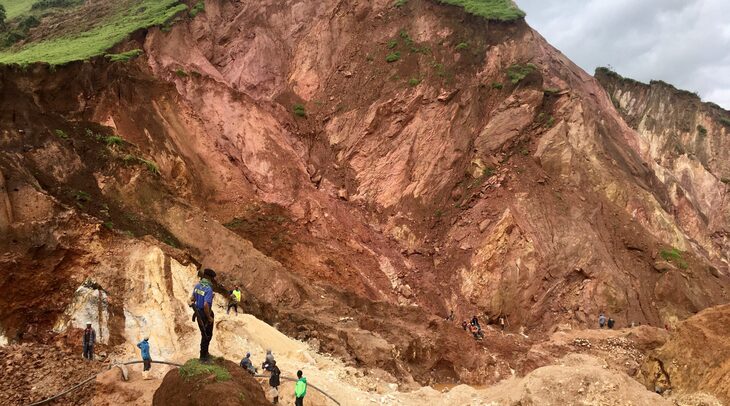
These sumptuous plans and these exceptional destinies also have the merit of questioning by what means to show the murderous atrocities of which these field situations testify.
Without reducing the assurance of the veracity of these situations and these mechanisms, the images require what our eyes and our spirits are ready to accept, even require as visual and narrative forms to deal with the bare terror of the capitalist law, and its bloody and humiliating procession. Blood and mud thus manages to associate with vigor the precise testimony and the open question.

