
“Central Europe is divided into twenty-four cantons radiating around the Cathedral of Saint-Etienne de Vienne. Their capitals are Brussels, Paris, Munich, Geneva, Milan, Marseille, Berlin, Warsaw… ” This is what you could have recited during history-geography in place of the twenty-seven member states of the European Union (EU), if the incongruous project of a “new Europe for a lasting peace”, formalized in 1920 by an eternal anonymous, had emerged.
To understand this astonishing initiative, we must look at the geopolitical map of the 1920s. At the end of the First World War, Europe is exsangue, ruined and devastated. Four empires were cut into pieces: Austria-Hungary, Germany, Russia and Turkey (formerly the Ottoman Empire). Raitified in 1919, the Versailles Treaty was supposed to bring peace through the continent, but it only throws oil on the fire by exciting revenge feelings. The rise of nationalisms throws tenacious shadow on the reconstruction of Europe and the prospect of lasting peace.
Thinking about European integration
During what will ultimately prove to be the interwar period, there are, however, voices that urge European countries to reconciliation and mutual aid. One of the first craftsmen of European construction is the cosmopolitan intellectual Richard Coudenhove-Kalergi. Unjustly overlooked, this diplomat of Austro-Hungarian origin, who became a Czechoslovak citizen, published in 1923 a manifesto, Panteropawhich offers the creation of a democratic federation of European states. Time is running out: a few months earlier, at the end of 1922, the USSR was born and the Transalpine fascist Benito Mussolini took power in Italy after walking in Rome.
For Count Richard Coudenhove-Kalergi, it is not only a question of bringing peace to Europe, but also of showing the muscles in the face of the American and Soviet blocks and of drawing up a bulwark to the Bolshevism which appears in the east. “Europe would safeguard its inner peace by arbitration treaties; by defensive alliances, his freedom vis-à-vis Russia; by the customs union, its economy threatened by American competition ”notes the newspaper news, economic and political information, September 19, 1925.
Above all, Europe would retain by this union its prestige and economic weight. At the end of the Great War, in fact, intellectuals see the old continent sink. “One may wonder if the star of Europe does not turn pale and if the conflict from which it has suffered so much has not started a vital crisis which presages decadence”feared the French geographer Albert Demangeon in 1920. more dynamic, nations like the United States, Russia and Japan would they not take this opportunity to govern the new world order?
“The cause of the decadence of Europe is political and not organicadds Richard Coudenhove-Kalergi. (…) It is not the peoples of Europe that are suffering from Senility; it is their political system. ” Faced with these models in the impasse, the diplomat offers an alternative: a federal union which would introduce a collective arbitration of conflicts (precursor of European courts) and the first milestones of free trade (ancestor of the common market). Richard Coudenhove-Kalergi also wants to abolish the idea of nationality, called upon to become a private characteristic as a panic, in the same way as religion.
Twenty-four cantons “where love prevails”
It is in this context that the strange card entitled “New Europe for lasting peace” is born. Drawn in 1920 by a mysterious cartographer identified by the initials PAM, this document does not come from the Viennese offices of Richard Coudenhove-Kalergi, even if he claims to be of the Europeanist boiling which then seizes the continent. The map offers an artificial cutting of the belly of Europe into twenty-four slices, whose points converge in Vienna (very precisely, at the Cathedral of Saint-Etienne, located in the heart of the Austrian capital).
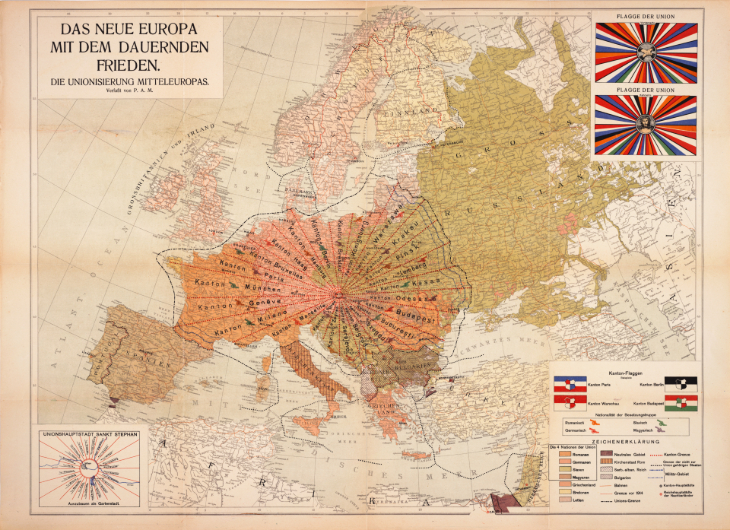
Each of these “cantons” will take the name of the main city it crosses, considered its capital. “In my project, the national states are certainly torn, but they are, so to speak, united under one roof thanks to the creation of sub-regions in which all nations are mergedindicates the manifesto that accompanies it. (…) A new human nature emerges from all the good and noble aspects of each nation, in which racial hatred no longer prevails as before, but where the love of the people prevails. ”
This new geographic entity will be governed by a president elected for a three -year term and will adopt common attributes: unique money and flag, shared postal services and Esperanto as an official language.
Of course, the big advantage of an artificial division, which frees itself from the geographic, religious, linguistic and ethnic borders, is to defuse nationalist ambitions and the tendency to withdraw to oneself. What is more, by considerably reducing the sphere of influence of the great nations, it forces the cantons, necessarily interdependent, to collaborate with their neighbors.
Witness
In 1929, one of the objectives of Richard Coudenhove-Kalergi was about to come true when the Frenchman Aristide Briand, convinced Europeanist and then Minister of Foreign Affairs, presented himself at the gallery of the League of Nations to propose that a federal link unites the main European nations. Failed: Despite its great promises, the project is rejected and Europe is ignited in the outbreak of nationalisms. Qualified as “Universal bastard” By Adolf Hitler, Richard Coudenhove-Kalergi-French Naturalized in 1939-is forced to flee to the United States in 1940: he will only return to Europe after the war.
If “new Europe for lasting peace” has never materialized other than on paper, it is to recognize the influence of the first paniciens in current EU institutions. Visionary, Richard Coudenhove-Kalergi will have created the intellectual conditions so that figures such as Jean Monnet and Robert Schuman put his plan to leave the Second World War.
For historians, Pam’s identity remains a mystery. However, as a signature, the enigmatic cartographer has slipped these prophetic words: “For many readers, this work may seem to be the fruit of an overflowing imagination; One day, even if it is late, knowledge of the truth will take over. ” Who of us, European, European, could give him wrong?
