
Which of these territories is the largest: the United Kingdom or Madagascar? The right answer: Madagascar. Exhausting 587,000 square kilometers, the fourth island in the world is more than twice larger than the United Kingdom (nearly 247,000 km2). This means that we could for example accommodate Italy, Greece, Switzerland and Portugal together. Do you find it weird? So you probably have a Mercator planisphere hanging in your mental office, which distorts your appreciation of terrestrial geography.
Do not blame yourself: no world card is free from errors. The first known atlas mixed real places with mythical benchmarks – the implementation of paradise, for example – and filled the voids of their cards by representing dragons, sirens, krakens or sea rhinos. terra incognita.
The major explorations of the XVIe and XVIIe centuries have not resolved the case. Even after the return of travelers, their mapping remain full of fantasy islands-California is considered to be island until the XVIIIe century -, covered with imaginary cities, swung with approximate contours.
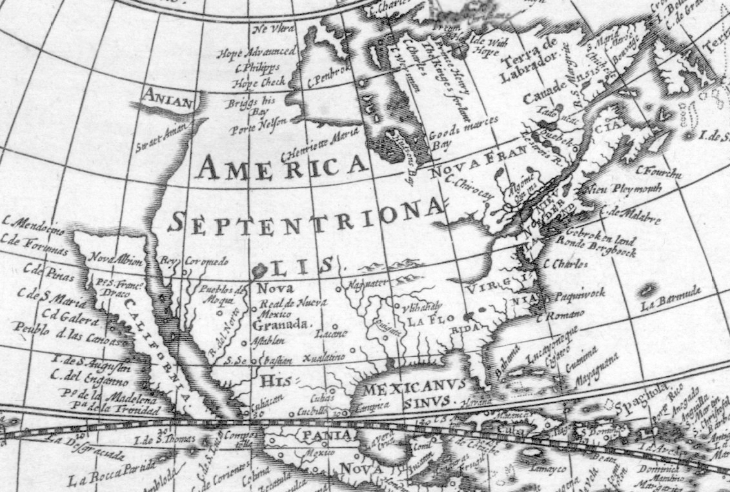
Some of these “errors” are, moreover, it seems, added voluntarily by their authors in order to discourage any attempt at plagiarism … However, the biggest pitfall concerns the perspective. How to put flat, on a two -dimensional card, a spherical planet?
On a planisphere (“flat sphere”), the shortest path is the straight line. However, on a terrestrial globe, the same trajectory becomes a curve, because it marries the rotundity of the earth. This is the reason why thefts between Europe and North America generally fly over Greenland. If it seems counter-intuitive, then imagine yourself in the shoes of an XV sailore century, with only a compass and an approximate map to guide you, as well as the risk of undergoing the whims of the weather if you do not take the right path!
Go up
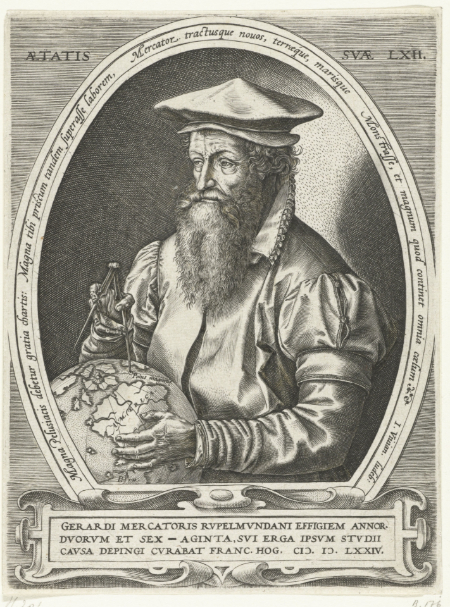
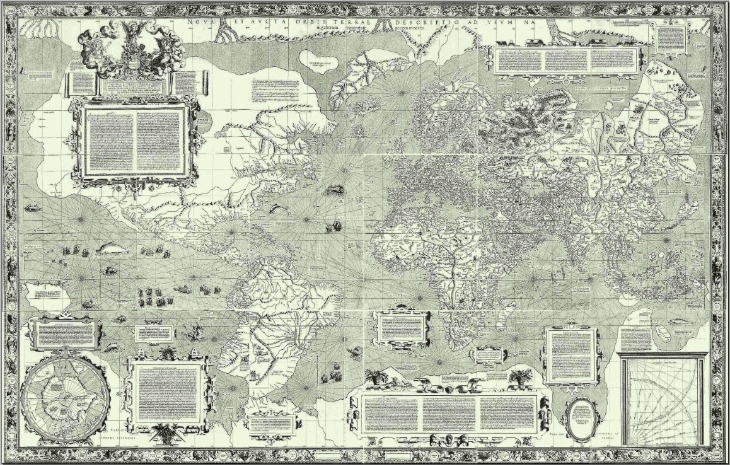
Enter the stage Gérard Mercator (1512-1594), a Flemish geographer and cartographer from the 16the century. At that time when the United Provinces-Netherlands-dominated trade, which explains their learning in terms of cartography, he designed in 1569 an unprecedented map in his workshop in Duisburg (current Germany). Broken down into eighteen sheets, its masterpiece is called Nova and aucta Orbis Terrae Descriptio ad usum navigantium Emendata (“A new and extended description of the world, modified for the use of browsers”).
What is Gérard Mercator’s method? To prevent the sailors from getting lost, the Flemish scholar distorted the proportions of the earthly expanses so that the parallels and the meridians – these circles which surround the planet – can keep their right angles. Thus, navigators will be able to follow a single direction – the technical term is “loxodromy” – cutting the meridians at a constant angle and maintaining the same cap on their compass without ever deviating to the destination. A revolution for the maritime industry.
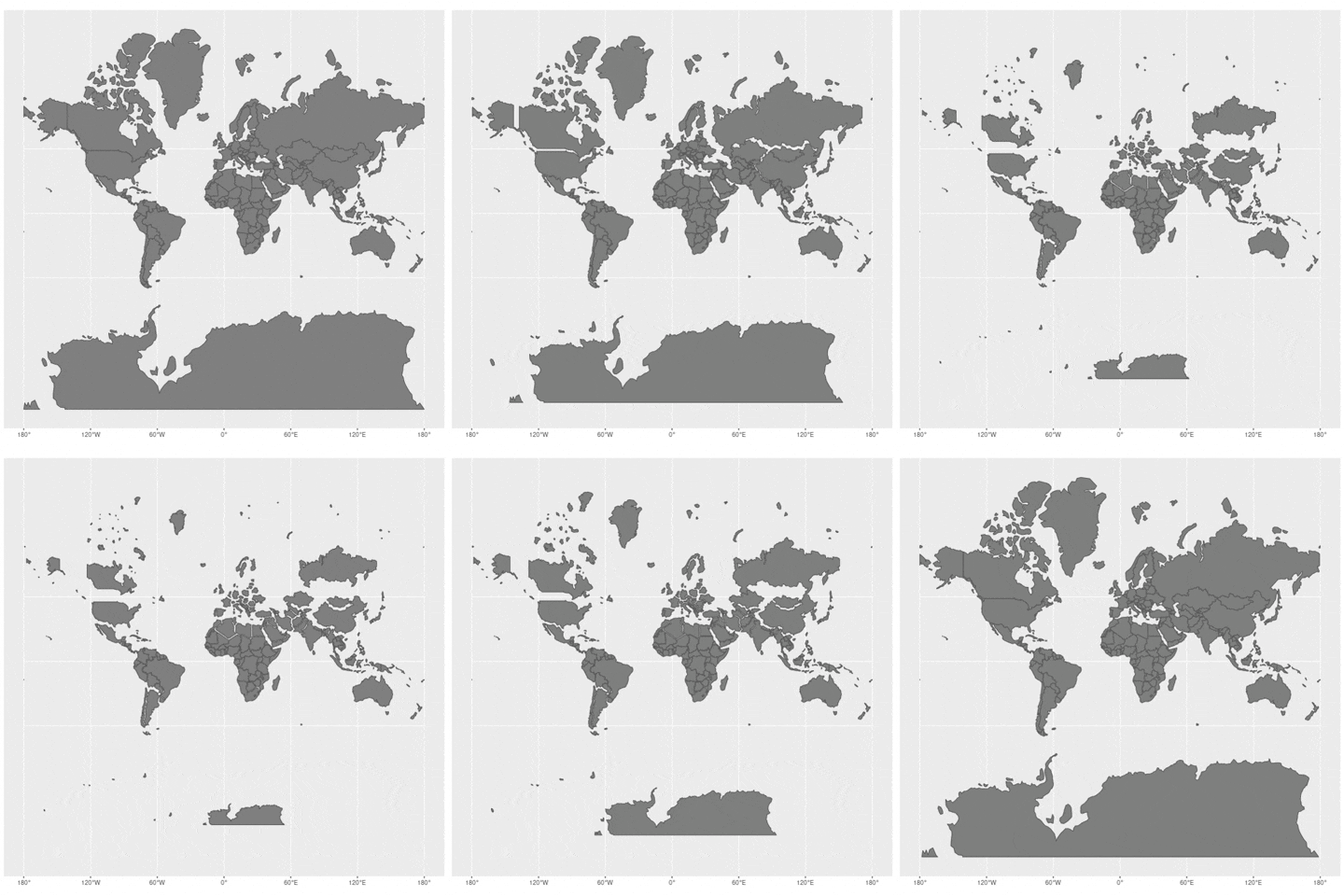
Problem: To make this card, the geographer had to crush the proportions. The land located near the equator are atrophied and become more and more gigantic as we get closer to the poles. Greenland, for example, is deployed on an immense extent that approaches, visibly, the area of Africa … while it would hold fourteen times. In reality, its surface is more or less equivalent to that of Mexico, which itself is greater than Alaska. Incredible, right?
Geographic controversies
By its author’s own admission, this work was only a “projection” obtained after learned mathematical calculations, not a faithful representation of the world. What is more, it was exclusively intended for maritime navigation. However, it is this version that will anchor in consciences and will be recycled, centuries later, by school cards or online mapping tools like Google Maps.
Meanwhile, voices have been raised to denounce what they consider as an imperialist instrument. “By stretching Europe and North America, the projection of Mercator gave the white nations a feeling of supremacy”the German historian and cartographer Arno Peters will be indignant in the 1970s. It should not be forgotten that the cards have an eminently political connotation. It is no coincidence that the Chinese mapping cannibalize Taiwan or the Indian cards incorporate cashmere, which is however the subject of an old argument between India, Pakistan and China. We ourselves, Europeans, with our old continent enthroned at the center of the planisphere, are we free from all reproaches?
To resolve this debate, several alternative projections were proposed, like that of the Scottish James Gall in 1855, resurrected by Arno Peters (1916-2002) a century later, in 1973. This intends to return their real areas to the countries to the detriment of their forms.
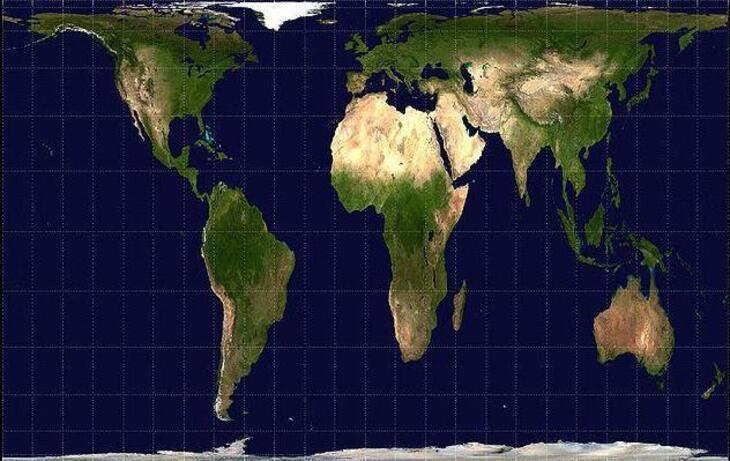
Others resolved to abandon the rectangular form of the planisphere, such as the authagraph projection of the Japanese architect Hajime Narukawa (1999), which uses 96 triangles to model the incredible complexity of our planet.
For its part, the United Nations (UN) organization has endowed its flag with an “equidistant azimunstal projection” which fairly well respects the proportions of the world, with the North Pole in its center. Initially aligned with the United States for the creation of the organization, in 1945, the planet was offset the following year on the Greenwich meridian (and therefore Europe). A way to challenge American supremacy in the aftermath of the Second World War? No doubt.
You will understand: no card is never neutral. To deflate our geographic egos, a simple solution exists: use a terrestrial globe.
