
A very sporty young girl born in 1969 in California, Marla Runyan saw her life rock at 9 years old when doctors diagnosed Stargardt syndrome. This rare disease of genetic origin is a juvenile degeneration of the retina, which affects the central vision of those affected by it. Concretely, the visual faculties of Marla Runyan are limited to a peripheral vision. “It’s as if I had a black hole in the middle of the eye”she describes.
Despite a 90% reduced visual field and an inability to see everything in front of her, the young American is far too passionate about sport to abandon practice. After trying football during his childhood, then artistic gymnastics while vibrating in front of the exploits of the Romanian prodigy Nadia Comăneci at the Montreal Olympic Games in 1976, she turned to athletics during her university course.
Naturally, this jack-of-all-trades takes a taste for heptathlon, a demanding discipline that brings together seven events (100 meters hedges, high jump, weight throwing, 200 meters, long jump, throwing javelin and 800 meters). Whether in sprint, jump or throws, its explosiveness and excellent athletic capacities allow it to shine on all terrains.
Marla Runyan qualified for the Paralympic Games in Barcelona in September 1992 and won four gold medals. Titled over 100 meters, 200 meters, 400 meters and in the high jump, it will complete its paralympic record four years later, in 1996 in Atlanta, climbing on the highest step of the heptathlon podium and taking the silver medal at the weight launch. At 27, Marla Runyan is one of the best para-athletes of her generation. Always eager for new challenges, she now aims to measure herself up to valid sportsmen.
A non -light runner among the valid
For her, it is the logical continuation of things. Officially recognized as non -sighted, Marla Runyan has never considered her weak visual acuity as a handicap. Admittedly, she is unable to see the finish line in front of her and distinguishes her opponents as well as waves silhouettes, but the Californian athlete has accommodated it. Marla Runyan has been living for almost two decades for almost two decades and categorically refuses to attribute her counter-performance to her partial blindness. She simply asks to be treated like the others and to be able to fight in front of the best world runners.
In 1996, Marla Runyan already dreamed of participation in the Olympic Games. Engaged on the 800 meter of the American selections, the American athlete had finished in the 10e place. Far from the best to claim a selection in the Olympic Games alongside the valid, but also to discourage it.
After having definitively turned her back on the Paralympic disciplines, she signed her first exploits in July 1999, winning the 1,500 meters from the Pan -American Games in Winnipeg (Canada), her first continental title in valids. This success opens the doors to the world athletics championships, organized in Seville (Spain) a month later. Same test and same determination: Marla Runyan qualifies for the final and ends at 10e row. This excellent result is among the best American semi-floors over 1,500 meters.
It is still necessary to confirm these beautiful promises on D-Day, on the occasion of the American selections organized on July 16, 2000, at home, in California. These Trials are a compulsory passage for any American athlete who claims to participate in the Olympic Games. Marla Runyan knows it, the first two places are unplayable and promised to the two large specialists in the 1,500 meters, Regina Jacobs and Suzy Favor-Hamilton. In the final, these two runners dictate an infernal rate, fly away at the top of the race and logically win their tickets for the Sydney Olympics.
Behind, a third ticket is at stake. In front of the 23,000 spectators of the Hornet Stadium in Sacramento, Marla Runyan offers herself the third and last qualifying place for the Olympic Games in Australia. The public cheers his feat and the non -clairing athlete can savor. In two months, she will become the first para-athlete in history to participate in the Olympic Games, alongside the valids.
Sydney 2000, the fulfillment of a lifetime
Wednesday, September 27, 2000, first round of the 1,500 female meter of the Sydney Olympics. That’s it, at 31, Marla Runyan reached her grail. Engaged in the second of the three series, with the Russian world champion Svetlana Masterkova, the American athlete ends his race at the 7e Place, one hundredth of a second of a direct qualification for the semi-finals. But thanks to her time made, she is still narrowly drafted and accesses the next round.
An identical scenario repeats itself in the semi-finals the next day. Marla Runyan is missing a direct ticket for the final at a place, but is once again drafted thanks to her time. Dreaming of a simple participation in the Olympic Games, here she is now propelled in the 1,500 meter final.
And Marla Runyan does not intend to play a role of figurative. Busts leaning forward, eyes riveted on the white strip of the start, the twelve finalists are in place and concentrated, ready to do battle once the shot is given. The signal sounds and releases athletes. Under the pummer of the public, they rush for just under four laps. The start of the race is very slow and strategic. None wishes to take the lead and dictate the look, for fear of leaving feathers.
Part of it as usual, Marla Runyan agrees to take responsibility for the race. After only 300 meters traveled, she left the last place in the peloton, goes up the line and comes to place herself at the forefront to impose her own tempo. Step after stage, she who had neither abandoned her dream or revised her ambitions down is now at the top of an Olympic final.
During a tour, she leads the race before letting go, as the final packaging approaches. The Algerian Nouria Merah-Benida places a decisive acceleration in the last 200 meters and flies towards victory. Behind, the two Romanian athletes Violeta Szekely and Gabriela Szabó complete the podium, while Suzy Favor-Hamilton falls in the last straight line. At the mind, Marla Runyan hung on the 8e Place, shoulder-to-comet with the British Kelly Holmes (who will be sacred on the distance to Athens in 2004). It equals the best result of a US athlete over 1,500 meters and between a little more in the legend of Olympism.
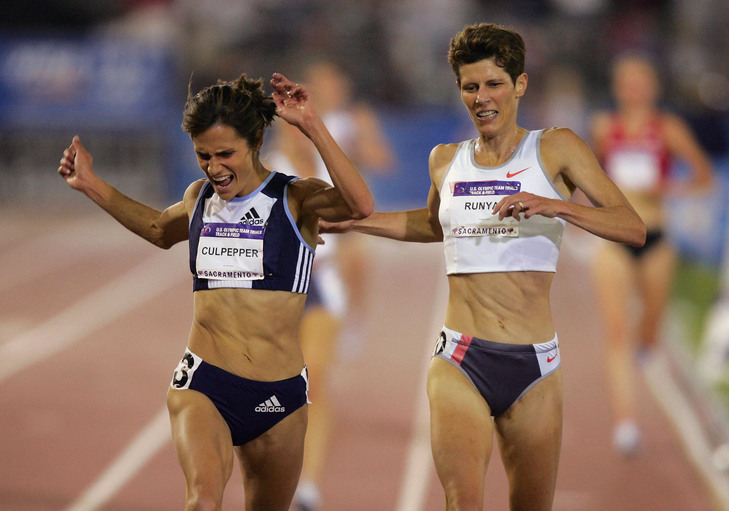
In the following years, Marla Runyan abandoned the 1,500 meters to focus her preparation on longer events. She became triple champion of the United States over 5,000 meters between 2001 and 2003, completed the 2002 New York Marathon in a very good time of 2 hours and 27 minutes for her debut in the discipline, then savor a second participation in the Olympic Games in Athens in 2004, engaged on 5,000 meters. Marla Runyan fails from the series and competes with her last official race on the track of an athletics stadium. A chapter ends, but a new one starts immediately. A few months after this final Olympic adventure, the American athlete announces to wait for her first child, a girl, who will be born on 1er September 2005.
