
About 35 million years ago, long before the large rodents that inhabited South America appeared, an animal of extraordinary dimensions roamed the landscapes of what is now southern Thailand. It was not a predator or an ancestor of elephants, but a rodent weighing about 30 kilograms, belonging to a family that disappeared millions of years ago. Its existence has come to light thanks to two fossilized teeth that have allowed the identification of a hitherto unknown species: Yakamys sirindhornae.
The discovery, published in the scientific journal Scientific Reportsis the work of an international team of researchers from Thailand, France and Canada, led by paleontologist Yaowalak Chaimanee, from the University of Poitiers. The fossils come from an ancient lignite exploitation located in the Krabi basin, a region that during the Eocene was home to a notable diversity of mammals.
The most striking thing is that the remains were found in 2004, but more than two decades had to pass before scientists could formally describe the animal. One of the teeth, an incisor of enormous size, initially baffled its discoverers. Its appearance was so unusual that it was mistaken for a bone fragment.
Now, The study of its anatomy and the microscopic structure of the enamel has made it possible to determine that it belonged to a giant representative of the ischiromyids, one of the first large families of rodents. The discovery considerably expands what was known about the size that these mammals could reach during the early stages of their evolution.
Some teeth that hid an extraordinary animal
The remains of Yakamys sirindhornae They consist of a lower right second molar and a fragment of the lower left incisor. Both appeared very close to each other, on the same clay level sandwiched between coal deposits, so researchers have provisionally attributed them to the same species.
The molar measures 11.56 millimeters in length and 11.27 millimeters in width, exceptional dimensions when compared to those of other Asian rodents in the world. Paleogene. In fact, the largest representatives previously known in Asia had molars less than half those measurements.
To study the fossil, paleontologists turned to micro-computed tomography, a technique that allows obtaining highly precise three-dimensional reconstructions without destroying the piece. The analysis revealed a combination of dental characteristics that did not fit any known species.
The incisor provided another decisive clue. Although it was extraordinarily large, it had an enamel layer just 235 micrometers thick. Its internal organization, observed by electron microscopy, showed a characteristic pattern of ischiromyids, which reinforced the identification of the animal.
What was this gigantic prehistoric rodent like?
Determining the size of an extinct mammal from two teeth is not easy. However, there is a statistical relationship between the dimensions of certain teeth and the body mass of animals. The researchers used seven equations based on these proportions to calculate how much Yakamys could weigh.
The results ranged between 21.4 and 47.3 kilograms, with an average of 31.6. Therefore, the authors propose an approximate estimate of 30 kilograms, comparable to the weight of a large dog and close to half the mass of a large capybara.
However, this figure should be interpreted with caution. By incorporating the margins of error of the different models, the individual estimates cover even broader values. Without remains of the skull, limbs or spine, it is also not possible to safely reconstruct its appearance.
The species lived during late Eoceneapproximately between 35.1 and 33.7 million years ago. At that time, rodents had already begun to diversify across different continents, although most known forms were considerably smaller.
The giant from Thailand changes the evolutionary history of rodents
For a long time, the most spectacular examples of gigantism among rodents came from South America. Animals such as Josephoartigasia monesi evolved there, an extinct species whose body mass has been estimated, in subsequent research, at about 350 kilograms.
However, the discovery of Yakamys demonstrates that the extraordinary increase in body size had already occurred in other lineages long before the appearance of those South American giants.
The researchers also compared its teeth to those of Manitsha tanka, a large rodent that inhabited North America during the Oligocene. Although both were able to achieve high body masses, their molars present important differences. This suggests that gigantism was not associated with a single dental configuration within that family.
There is another particularly interesting issue: the environment in which he lived. The fossils appeared in sediments related to ancient lakes, which raises the possibility that it frequented humid areas. However, scientists warn that there is not enough evidence to consider it semi-aquatic, like today’s capybaras.
Two fossils and many questions about Asia’s past
The Krabi Basin has become an important enclave for rebuilding the ecosystems of Southeast Asia during the Eocene. Its deposits have provided remains of primates, carnivores and hoofed mammals, in addition to this new giant rodent.
The study even mentions a large incisor from the Pondaung formation in Myanmar, possibly older. However, this fossil has not yet been formally described or identified, so no evolutionary relationship with Yakamys can be established.
The new species gets its name from the Thai word yak, which means giant, and the Greek word mys, related to mice. Its specific name pays tribute to Princess Maha Chakri Sirindhorn for her support of scientific research in Thailand.
For now, two teeth constitute all the available evidence for this animal. But they are enough to demonstrate that, about 35 million years ago, gigantism had already appeared among the first large lineages of rodents, much earlier and much further from South America than their best-known fossil representatives suggested.
References: Yaowalak Chaimanee et al., A giant ischyromyid eocene from Southeast Asia reveals the early evolution of rodent gigantism, Scientific Reports (2026). DOI: 10.1038/s41598-026-76711-6
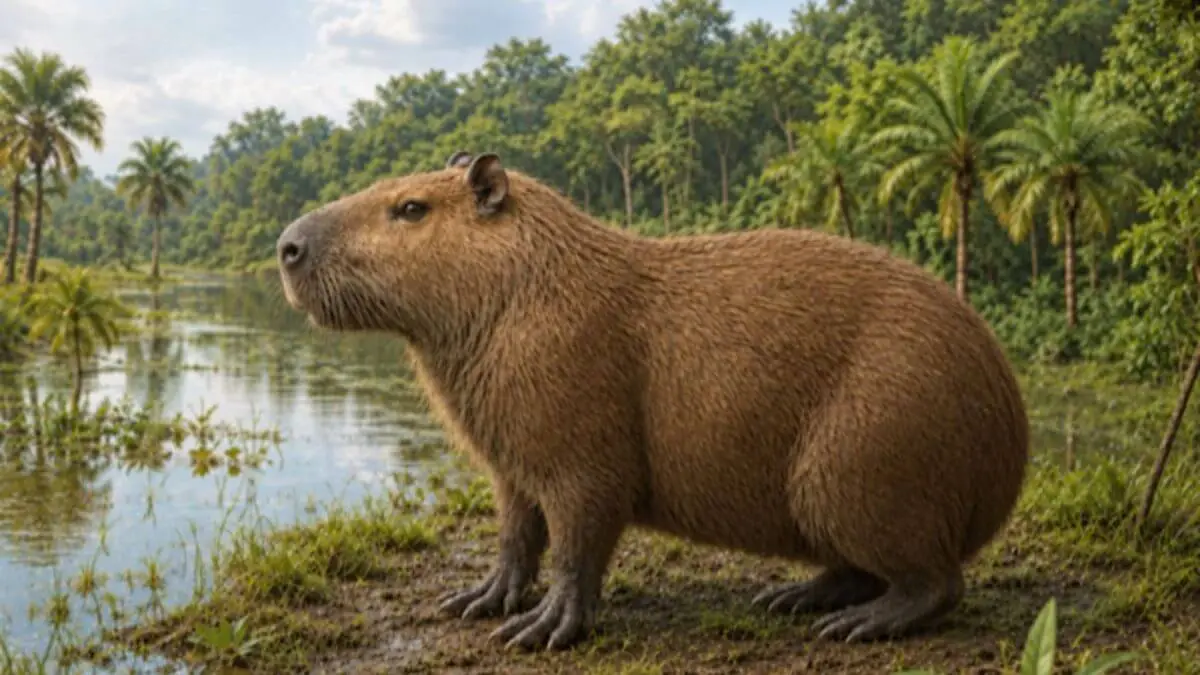
Cover photo credits: Artistic recreation. Photo: ChatGPT-4o/Christian Pérez
Photo credits: Scientific Reports (2026). DOI: 10.1038/s41598-026-76711-6 / Yaowalak Chaimanee