
“Fresh air is necessary to renew and purify blood and it is just as necessary for health and growth (of the child) as a good diet”decrees the American pediatrician Luther Emmett Holt in The Care and Feeding of Children (“Children’s care and power supplies”), a bestseller published in 1894. His opinion is shared by many scholars, doctors and seven-sided pediatricianse century. Evil from the time, mass industrialization created an environment vitiated by toxic fumes, industrial discharges and fetid miasmas. Above all, the stagnation of the waters, the unhealthy ranges of garbage, the pollution of rivers, the unhealthyness of the houses.
In a context of the proliferation of cholera and tuberculosis, two plagues that are associated with confined environments full of “miasmas”, doctors recommend better ventilation. “How do you want a city to be healthy if its tracks are not well oriented, if they are not wide enough for the sun and the light to be spread there in waves and the air is renewed there frequently?”wonders doctor Marius Bousquet in his book Cities hygiene – Atmosphere, Publique Wayhe published in 1912. Little by little, the health instructions transform metropolitan cities: sewer sanitation, street expansion, parks layout, etc. But that is not enough to appease the hassles of hygienists.
Obsession with pure air
The solution: Take a good breath of fresh air in the countryside. In Europe, outdoor schools are emerging at the turn of the century, moving instruction in a purified and healthy environment. It is nearly 400 to 450 establishments of this type that were born in France between 1900 and 1950. The same trend printed pedago-hygienists in Germany, Switzerland, Italy, Belgium, Sweden, Great Britain … across the Atlantic, the first outdoor school opened its doors in 1908 in Providence, in Rhode Island.
Alas, life in the open air is not accessible to everyone. In smoky megalopings, population growth cups parks and abolishes the gardens for the benefit of collective housing. It is in this context that the cage to baby appears (baby cage), a device allowing to make your offspring take air … without leaving home. “The many difficulties to raise and properly accommodate babies and young children in overcrowded cities are well known, particularly from the health point of view”justifies a certain Emma Read, resident of Spokane (northwest of the United States), who filed in 1922 a patent on a cage in his design, in 1922 in the United States.
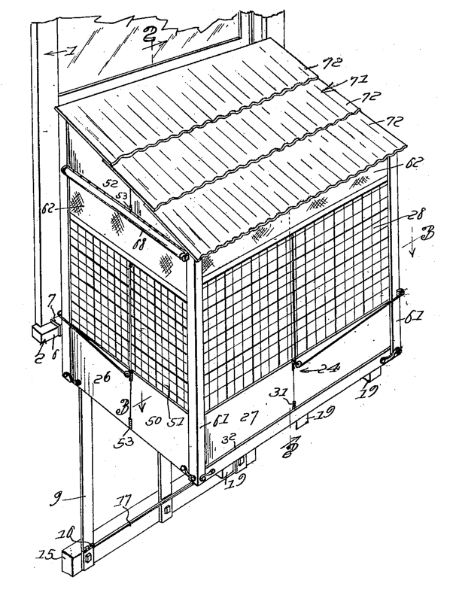
The appearance of the first prototype is difficult to date. Before becoming the First Lady of the United States (1933-1945), it seems that Eleanor Roosevelt had installed one in 1906 at a window in her New York apartment, on the north side. But little Anna, the first child she had with Franklin Delano Roosevelt, was not so convinced by her usefulness and expressed her with her regular infant crying. To the great despair of his neighbors, who would even have threatened to call the social services of the city of New York!
The little ones are also entitled to their balcony
In 1913, a resident of Richmond, Virginia, popularized a “cradle of health” (Health CRIB), intended to improve the daily life of infants “In overcrowded cities where lawns and meadows are rare”. But it is especially in the interwar period that the Baby Cages multiply on the facades of London and New York. In addition to offering the infant a good bowl of fresh air, they maximize the living space in the absence of gardens or balconies.
When does the fashion for baby cages run out of steam? It is a safe bet that the deadly air raids of the German Luftwaffe discouraged their use during the Second World War; The British preferring to close their windows double -tone and keep their offspring near them. Reports seized by Pathé News in London in 1949 and in 1953 show that, if the invention survived the conflict, the cage hung on the balcony is no longer after the war only a domestic curiosity called to disappear.
What is more, the medical science of the XXe century has ended up abandoning the theory that “miasmas” would carries illness. From now on, it is the germs that are found guilty of health plagues. Regardless of air quality, urban planners of the years 1960-1970 are reassured in front of the explosion of automotive traffic … which has the consequence of stuffing the atmosphere of fine particles and exhaust smoke. Is it still very prudent to ventilate baby in these conditions?
