
Make several kilometers every day to obtain drinking water and be able to water her animals is the daily life of Alexandre Darengosse a year ago. This goat breeder and producer of local cheeses lives in Sospel (Alpes-Maritimes), a small town perched in the Nice mountains. “The big disadvantage when you live on a rock like that is that the dwellings are not or hardly connected to the public water network”explains the farmer. Difficulties to which have been added for a few years more and more frequent droughts, during which the water consumption of residents and companies is limited by local authorities. On the advice of his entourage, Alexandre Darengosse decided to call on a dowser in August 2024.
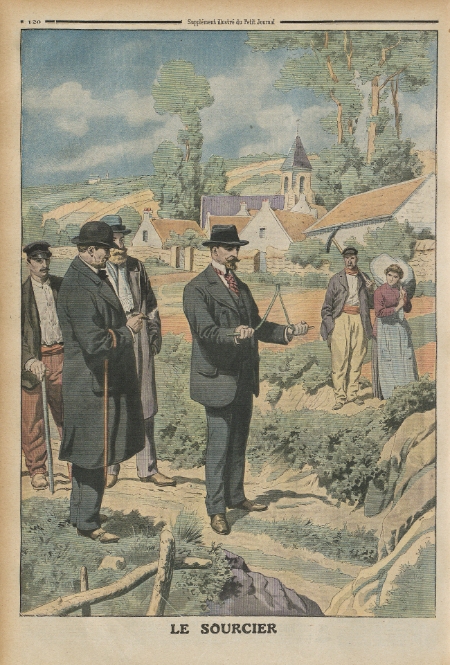
Sourcière is precisely what Véronique Wurtz does. Interim president of the association Sourciers and geobiologists of Europe, she defines her practice as that of a “Person fundamentally related to nature, with all that the earth can say, who has his feelings and can find water”. The members’ dores of the association are involved in individuals or in communities to help them detect reserves of groundwater. Their working tool? Two baguettes, with which they crisscross the terrain. If they meet, it is a vein of water flows into the ground under their feet.
The customers of the dores mainly contact them as a result of a word of mouth. This is the case of Alexandre Darengosse. “I trusted him directlyassures the Sospellois breeder. The sore I contacted had already intervened in several people I know and has a very good reputation in the region. ” For 70 euros, he traveled the farm and stopped three times when his chopsticks intersect. Using a pendulum, he then managed to identify the depth with which the sources of water would be.
The farmer was amazed: “The dowser made us try his chopsticks and it was quite crazy. Without my knowing why, they crossed out alone in certain places. ” Same experience with Véronique Wurtz’s brother: “He is a researcher at the CNRS, he is very Cartesian and Pragmatic. He had doubts about my practice until I put my baguettes in his hands and it moves at the right time, in the right place. ”
“As soon as I make a drilling on the advice of a dowser, we find water”
After the intervention of his dowser, Alexandre Darengosse spent 9,000 euros to make a drilling twenty-five meters deep. This well now allows him to have daily access to almost two cubic meters of water for his goats. Owner of the company who carried out the drilling at Alexandre Darengosse, Damien Debiane struggles to explain this source, officially named dowsing or rhabdomancy. “I was a little skeptical at the beginning, but it must be admitted that as soon as I make a drilling on the advice of a dowser, we find water”recognizes the driller. He estimates that around 90% of his customers consult a dowser before contacting him.
“We believe in it or we don’t believe it, but it worked for us anyway”confesses Alexandre Darengosse. For him, it is therefore a story of belief. And Florent Martin, spokesperson for the Zététique Observatory (association founded in 2003 and based in Grenoble) and author of scientific experiences on dowsing, confirms this. Zetities are interested in “All the subjects that come from science and for which people place themselves in a position of belief”. The experience led by Florent Martin aims to validate or scientifically invalidate the practice of dowsers.
A voluntary downship responds to a series of tests which consist in detecting a vein of water hidden under a wooden platform. After many trials, the time comes to observe the results. The success threshold does not assert that this practice is scientifically viable. Florent Martin says, however, that the dores are in good faith. “They are all intimately convinced that it works for a simple reason: there are results.”
But why does it work?
Patrick Lachassagne, Chairman of the French Hydrogeology Committee, Science Studying groundwater, explains the abnormally high success rate of dowser interventions. For him, it is because most regions of France have underground underground water tables in their basements. “The basement under our feet is made up of rocks, like sand grains whose interstices are filled with air. But from a certain depth, the water replaces the air. It is a tablecloth of groundwater ”indicates the hydrogeologist.
The needs of an individual are low: a few hundred liters of water per day. Whether or not they call on a dowser, whether they are a few meters away, they are likely to find water in the groundwater table located under their property. Even if the tablecloth is not very productive.
And in case of the wardrobe? Imagine: you believe deeply in the practice of the dores, you bring one home and there, it does not find water. “When our hypotheses are not realized, we tend to retain only the examples where they have proven to be correct. This is called confirmation biases ”explains Virginie Bagneux, researcher at the University of Caen in social psychology and member of the Zététique observatory.
In this context, the dowser will draw a line on this failure: “Our brain is set for adaptation, not for accuracy.” For researcher Romy Sauvayre, sociologist of sciences and beliefs and lectures at the University of Clermont-Auvergne, the dowser will, in this context, use a vocabulary “Difficult to understand, a pseudo scientific language to make it difficult to understand its customers”.
“Sourckers do not detect anything at all”
The confidence that the general public has to the brutals challenges Patrick Lachassagne, who warns: “The dores are generally in good faith, but do not detect anything at all.” Highlighting “dowser” is an abuse of language, since a source is the place where underground water comes out of the ground. This is therefore necessarily visible on the surface of the ground. The expert corroborates Florent Martin’s words: “It has never been scientifically proven that it is possible to detect an electromagnetic field linked to water, if it is, with simple chopsticks.”
Agricultural cities or farms have greater water needs, several tens or hundreds of thousands of liters of water per hour. To feed them, you have to find a very productive tablecloth and dig more deeply. Only hydrogeologists, underground water professionals trained at the university, are competent in this scenario. If a low margin of uncertainty persists, the geophysical studies they carry out make it possible to indicate the ideal place and depth of a drilling, or the type of pump to be installed. But its high price is not within the reach of individuals who, very often, prefer to rely on the source, even if it means not understanding everything about practice.
And the media in all of this? Each summer, in periods of drought, articles highlight the profession of dowser, sometimes without calling on contradictory. “Some journalists highlight too much the mystical side, without giving the floor to scientists so that they” begin “the subject”regrets Mikaël Salson, lecturer in computer science at the University of Lille and professor of scientific culture with journalism students.
