
In the pilot of GirlsHannah Horvath, a young, spoiled twenty -year -old, embarks on a passionate tirade to convince her parents not to cut her food. While she explains to them that she needs money to be able to devote herself to her book project, she pronounces a replica that will immediately become cult: “I think I may well be the voice of my generation … or in any case a voice, of a generation.” In the mouth of this immature, lost and narcissistic heroine, the sentence has a comic scope. Unfortunately for Lena Dunham, main actress and creator of the series, many will only retain the first part of the quote and will interpret it as a note of intention in the first degree.
When his series arrives on our screens in 2012, this girl from New York artists is only 25 years old. By staging in this caustic comedy with formidable distributed, the young director examines the worst through her generation with a justness a little too striking. But the fact that Lena Dunham embodies the role of Hannah quickly pushed part of the criticism to confuse the creator and her character and to blame her for all that she nevertheless seeks to satiate: her privileges, her navel and her imperfections.
Brought to the clouds by some, descended by others, Girls was a media and cultural tidal wave during the five years of its dissemination (2012-2017). With its subversive humor, its graphic sex scenes and its deliciously unbearable protagonists, the daring series has shaken up a good number of television conventions and launched an infinite flow of controversies, misogynist attacks and other outraged reactions. But retrospectively, she turned out to be as emblematic as her heroine would have liked it.
Shock of representation
Broadcast on HBO, Girls is presented as a more realistic heiress of Sex and the city and immediately claims the parentage by referring to it from the first episode, when the character of Shoshanna proclaims himself to be “A Carrie, but sometimes I have a little samantha side that comes out”. As Sex and the citythe program actually marks a turning point in the representation of women on the screen.
But unlike the thirties imagined by Darren Star, the heroines of Girlsas the title suggests, are not entirely women. At the beginning of twenty, they have just finished their studies, still struggle to find their place in the world and are not interested in much other than their navel.
The New York of Girls is antiglamour, much rarer than that of Carrie, Miranda, Charlotte and Samantha. The characters live in roommate and chain food jobs. Manhattan’s luxurious mundane is replaced by evenings lose in Brooklyn. And the pair of Carrie Manolo Blahnik gives way to cheap and poorly adjusted clothes by Hannah and Marnie. Despite this assertive research of authenticity, we will criticize the series (as Sex and the city) to be too bourgeois, too standardized and above all too white.
Antiheroine
However, more than thirteen years after its beginnings, it is impossible not to recognize the precursor of Girlswho hastened to shake up a lot of television conventions – and this, from the second episode, centered on the abortion of Jessa (Jemima Kirke). Voluntary pregnancy interruptions (abortion) remain extremely rare on American TV, even today. The character will finally make a very practical miscarriage before arriving at his appointment, while his friends await him at the clinic. A few seasons later, in 2015, the series goes further, approaching the abortion of another character, Mimi-Rose (Gillian Jacobs).
Girls Take full of funny or disturbing sexual interactions, but always terribly realistic, highlighting the sometimes troubled power issues that arise in intimacy. It also features highly antipathetic and morally ambiguous characters and refuses to choose a camp between drama and comedy, which makes it a pioneer of Successionwhose broadcast will start on HBO in 2018.
These narrative choices – which would not shock anyone today – seem difficult to accept for part of the press at the time of broadcasting. In an article entitled “”Girls is not diversified, not feminist and not inspiring ”a journalist from the British daily newspaper The Independent writes: “How to celebrate the feminism of a series that depicts four young egocentric women and a heroine with the most depressing and asujective sex that can be imagined?”
Hannah’s intimate life may not be inspiring or victorious, but it reflects the reality of many young women who explore their sexuality and sometimes suppress their desire for the benefit of mediocre partners. What the public does not seem to understand immediately, as it is little used to the concept is that Hannah is not a heroine, but an antiherian.
While antiheros is a dominant archetype in the world of series (Tony Soprano, Walter White, Don Draper, DR House or Dexter Morgan), the idea of a main female character full of faults is still a novelty at that time. We meet some in comedies like Veep Or 30 rockbut much less in dramas and rarely with behaviors as dark and toxic as those of Hannah.
Grossophobia
But the greatest glance in the series-and perhaps its greatest inheritance-concerns Hannah’s body. When Girls Starts, the heroine weighs 66 kilos (we are told during a medical appointment). For TV, accustomed to extreme thinness, the slightly round and trivial morphology of Lena Dunham detonates, especially since the designer insists to be constantly naked on the screen. In 2012, the concept of POSITIVITY BODY is still far from popularized. For the public, it is a real visual shock.
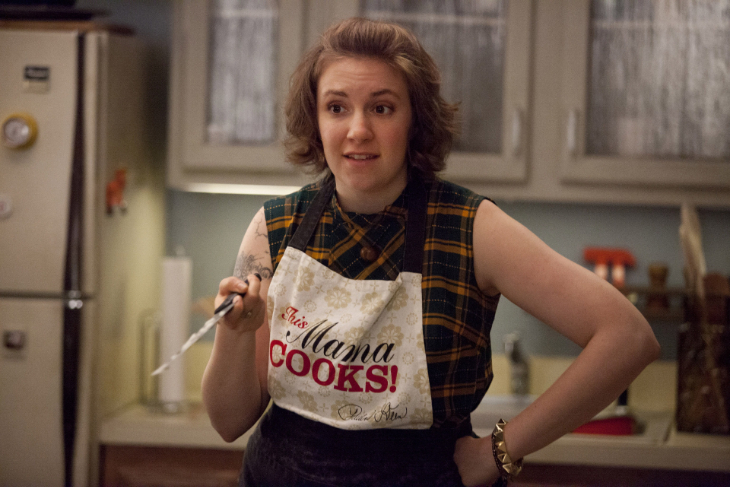
Some criticisms deplore the constant stripping of the actress, without suspecting their own grossophobia, nor note that the nudity of thin bodies never disturbs anyone. And if these scenes offer a saving paradigm change for many spectators in lack of representation, they also cause the misogynist of certain commentators. In particular the American radio host Howard Stern, who does not hesitate to declare in full program that, when he sees Lena Dunham nude, he has the impression of being violated: “She keeps removing her clothes, it’s almost like a rape … I don’t want to see that.”
A story of subversive friendship
To date, Girls There remains also one of the series that will have best explored the nuances of female friendship, including in its most ungrateful aspects. While Sex and the city And Insecurethe two series to which it is most often compared, ended with a traditional romantic resolution, Girls There remains that of the three with the most bitter and subversive end.
Not only are the majority of the characters still single and lost, but Hannah, whose friendship with Jessa and Shoshanna gradually disintegrated, ended the series by raising her baby alone, helped by her mother and Marnie. Eight years after the broadcast of this last season, as hilarious as it is cruel, impossible not to admire its singular ambition.
After several years far from the spotlight, Lena Dunham made her comeback on July 10, 2025 with a new series that she coated, Too Muchbroadcast on Netflix. This time she plays a secondary role there and leaves the front of the stage to new heads, notably Meg Stalter, who embodies the main role of Jessica. Like Hannah Horvath thirteen years ago, this new heroine is a female character as we rarely see on the screen.
After a traumatic break with her ex, Jessica left New York to settle in London and try to rebuild herself. But far from being handed over, she regularly engages in video confessions published on a private Instagram account, in which she claims to address the new girlfriend of her ex, a much thinner and cooler influencer than she.
With her little beardless dog that she is adorned with an extravagant wardrobe, her “Victorian chamber dresses” and her constant emotional overflows (it’s not for nothing that the series is called TOo Much), Jessica can sometimes be crisp and pathetic. But it is also deeply endearing and offers a more realistic counterpoint to the archetype of the cool girlthis male fantasy that combines attitude chill and a model’s physics (a shot that Too Much Also deconstructs with the characters embodied by Emily Ratajkowski and Adèle Exarchopoulos).
Inspired by the classics of romantic comedy, the series offers this clumsy, sticky and unstable heroine a superb love story. And more than ten years later GirlsLena Dunham proves that she has lost none of her talent to tell modern femininity.
