
We usually imagine an orbit as a track drawn around a star. The planet travels the same circuit over and over again and, barring catastrophe, everything continues in its place. This image serves to begin to understand a planetary system, although it hides something important: the path is not painted in space.
TOI-1355 b provides a rare opportunity to test this. As we read in Publications of the Astronomical Society of Japana team led by Noriharu Watanabe of the University of Tokyo, compared records obtained between 2019 and 2024 using the TESS space telescope and several ground-based instruments. In this material, a slight, persistent and revealing variation emerged: the giant did not always cross the same sector of the perceptible surface of its star.
The question seems paradoxical. If that world continues its revolutions normally, How can the place where we see him pass move until he ends up outside the scene? Solving it requires first understanding what astronomers really detect when they talk about a transit.
See a planet without seeing it
A transit occurs when a planet comes between us and its star.. From such a distance, we do not normally see a small ball silhouetted against a luminous circle. Telescopes record a tiny drop in brightness: for a few hours, the body blocks a fraction of the light we receive.
Geometry rules here. Imagine the face of the star as a huge target located very far away and the exoplanet as a marble that repeatedly passes in front of it. If it crosses the central strip, it produces a clear transit. When it touches the contour, it barely covers a small portion. It is enough to run that apparent route a little more so that the marble no longer touches the target.
That does not mean that it has vanished or that it has stopped rotating around its sun. Simply, the alignment between three protagonists is broken: star, planet and observer. In fact, most extrasolar worlds do not transit from Earth’s perspective. Locating one using this method requires that its path adopt a very specific configuration with respect to our line of sight.
A giant stuck to a scorching sun
TOI-1355 b belongs to the hot Jupiter familygaseous colossi located a short distance from their stars. has some 5.84 masses of Jupiter and a radius 1.42 times larger. Each revolution completes in 2.17 days.
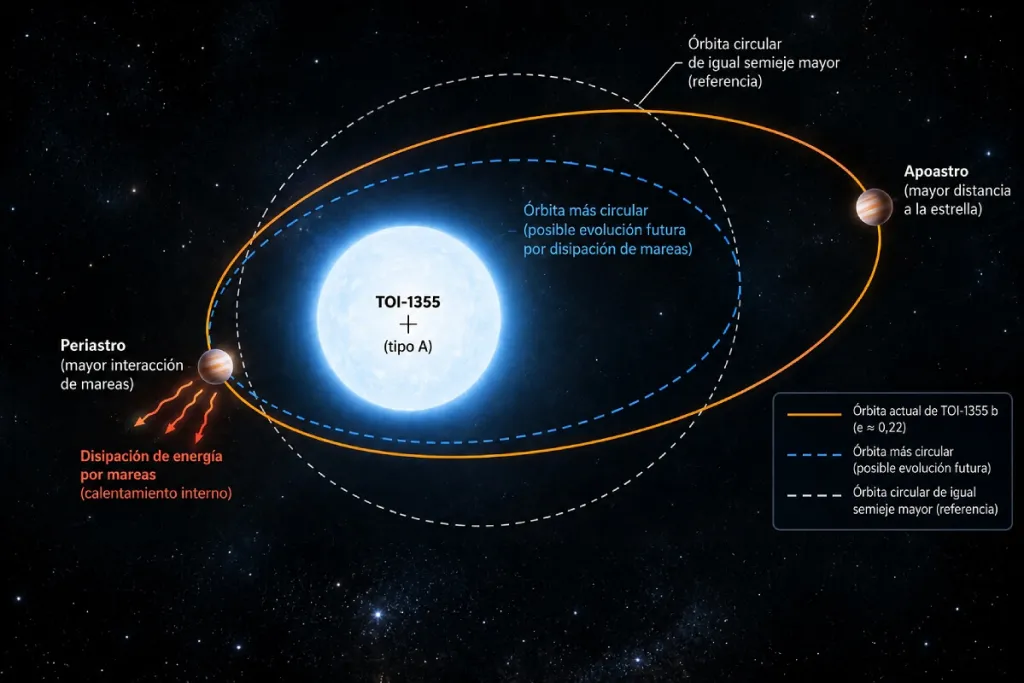
The orbit of TOI-1355 b has an eccentricity of 0.22, with 0 corresponding to a circumference and increasing values to more pronounced ellipses; an unusual deviation among hot Jupiters.
Your hostess is also not ordinary. Located about 247 parsecs, equivalent about 806 light years away, in the constellation Cepheusit is about an early, fiery A-type star with 2 solar masses and an effective temperature that exceeds 8,000 kelvin.
There is another peculiarity. The course of TOI-1355 b has an eccentricity of approximately 0.22. This parameter indicates how much an orbit departs from a perfect circle: zero would correspond to a circle; Increasing values describe more pronounced ellipses. Among hot Jupiters that surround very warm stars, maintaining a deviation of this caliber is unusual.
Four years revealed a displacement
To find out why their steps in front of the puck are no longer the same, another measurement must be introduced: the impact parameter. The name sounds technical, but it expresses a simple idea: it indicates at what separation from the stellar center, seen from us, the planet crosses.
The separation of the stellar center, seen from us, at which the planet crosses increases by about 0.016 per year, and the planetary disk is now partially outside the stellar silhouette.
A low value corresponds to a more inland path; As it increases, the step approaches the edge. And the measurements draw a clear progression: andThe team obtained 0.853 in 2019; 0.862 in 2020; 0.904 in 2022, and 0.928 in 2024.
The trend is equivalent to an increase in the impact parameter of about 0.016 per year. In 2024, the transit has already begun to be grazing, that is, the planetary disk is partially outside the stellar silhouette. Projecting this advance leads to a surprising consequence in a few years.
The orbit can also change orientation
The responsible phenomenon is called nodal precession. To visualize it, it is convenient to think of a spinning top. While it rotates rapidly on itself, its axis can simultaneously describe a slower reciprocation and modify its inclination little by little.
An orbit experiences something conceptually similar: the planet continues its journey while the plane that contains that itinerary is reoriented.
In TOI-1355 b, the authors identified this precession thanks to the variation of the impact parameter. The host star rotates rapidly: spectroscopic examination gives a projected speed of about 80.8 kilometers per second.
This rhythm means that the star is not a perfectly symmetrical gravitational sphere, a circumstance that can gradually modify the orbital configuration of the companion.
The host star rotates quickly, at about 80.8 km per second, which means that it is not a gravitationally symmetric sphere and this modifies the orbital configuration of the companion.
The distinction is important. TOI-1355 b is not moving away until it is lost in the cosmos nor is it on track to leave its system in 2033. Nor does it mean that it will stop circling its star. The angle from which we appreciate its course varies. The physical setting remains; The fit necessary to witness the planetary eclipse is unraveling.
In 2033, it will cross outside our target
The owner’s date appears here. If the observed rhythm remains practically constant, the researchers calculate that transit configuration current will disappear completely by mid-2033.
From then on, TOI-1355 b will continue to complete a lap every little more than two land days but, From here, its silhouette will run alongside the stellar disk instead of overlapping it.
The prediction contains a condition that should be preserved: it projects into the future the trend observed during the analyzed interval.
The paradox is attractive precisely because it does not require any effective disappearance. The same planet and the same star will continue to exist. What will close will be a geometric window from Earth, and with it we will lose an especially valuable tool for examining that distant body.
An orbit that preserves traces of its past
The uniqueness of TOI-1355 b goes beyond its imminent departure from the stage. Gas giants are difficult to originate in the vicinity of a starso astronomers study different mechanisms capable of leading them towards interior regions after their birth.
Gravitational interactions with other planets or a companion star can lengthen and tilt its path, the tides generated during approaches round out the ellipse, and the outcome can be a hot Jupiter in the domains of its host.
one of them is high eccentricity migration. Gravitational interactions with other planets or a companion star can initially lengthen and tilt its path. Later, the tides generated during approaches to the central star dissipate energy and tend to round the ellipse. The outcome may be a hot Jupiter installed in the domains of its host.
That TOI-1355 b retains an eccentricity of 0.22 is interesting because perhaps we are contemplating an intermediate phase of that story. The authors estimate a circularization timeframe of about 33 million years under certain assumptions about the planet’s internal dissipation, although that property is poorly understood.
That is why they present possibilities, not a proven biography: the giant could have acquired its eccentric layout relatively recently or dissipated energy in another way.
A scientific window with a closing date
Transits are useful for much more than discovering planets. When a world passes in front of its star, a small part of the radiation passes through the layers of its atmosphere before reaching us. Certain molecules absorb certain wavelengths and leave traces capable of revealing features of that gaseous envelope..
TOI-1355 b constitutes an attractive target for that kind of monitoring. The study finds signs of atmospheric variability between various periods, although those responsible warn that more tests are needed to clarify the cause. They also mention high-resolution equipment and space telescopes such as Hubble or James Webb among the alternatives for future campaigns.
The occasion, at least through transits, will not last indefinitely. Each season until 2033 offers the chance to find out how this process progresses and, potentially, gather information about its atmosphere before the planet stops blocking the brightness of its star from our point of view.
Orbits are not rails
There is a broader lesson behind this case. In school diagrams, we draw ellipses around the Sun because we need to represent something imperceptible. It is easy to end up confusing that line with a tangible construction, as if each world traveled along a rigid path that remained intact throughout its existence.
Actually, An orbit arises from the dynamics of bodies subjected to gravity, which rotate, deform and exert mutual influences. Its dimensions, contour and inclination may vary. These processes often span enormous time scales, and here, part of that metamorphosis is perceptible when comparing observations separated by just a few years.
That makes TOI-1355 b more instructive than a planet whose transit has an expiration date. It allows us to conceive a set of worlds as what it truly is: a dynamic architecture. Around mid-2033, the marble in our analogy will stop hitting the bullseye. Nothing will have vanished. The giant will continue his journey, while we will have witnessed how an astronomical arrangement changes before our eyes.
