
Whatever the source consulted, from the postal calendar to the list of saints of the Conference of Bishops of France, we note that the proportion of babies born in France and receiving a name of Saint Catholic decreases during the last century.
The fall started earlier for baby girls. Around 1900, almost all babies received a derived name derived or close to that of a Catholic saint (the dotted line of the graph below compares the first four letters of the first names, where Marinette and Louison were associated with Marie and Louis). The law obliged this choice: it was necessary to give a first name “For use in different calendars” Or a first name inspired by ancient history.
Today, about a quarter of the babies, at the maximum, receive the first name of a Catholic Saint. One in ten girls receives one of the names of the postal calendar.
A reference to calendars that decreases
We can explain this decrease in different ways. By referring to the secularization of French society in which the Roman Catholic Church plays a less role, competed by other institutions. Recall that in 2019-2020, 25% of French people declared themselves Catholics against 43% in 2008-2009. But we can also refer to parental taste for novelty. However, the names of the saints are likely to be old -fashioned names, since they were given by the previous generations.
We can finally emphasize the liberalization of the choice (effective from a circular of March 3, 1993, but in gestation for several decades), which allows parents to get out of the reference to “Uses of different calendars”. Religious diversification undoubtedly plays a role, too: it is obvious that the Catholic repertoire is not that of Islam or Buddhism.
This decrease can be tackled otherwise, taking an interest in birthday. Did the parents whose child was born on the day of Saint-X often gave the name of the saint of the day to their child? Was there a lot of Marie on August 15 and Valentin on February 14, from Xavier on the day of Saint-François-Xavier (December 3)?
For this, we need a large nominative list, including the first name and the day of birth. We have the file of deceased people (published by INSEE), which gives us the identity of people who died in France since 1970, who are nearly 29 million. This file is not a perfect source: it is undoubtedly fairly representative for births of generations 1910-1960, but it only contains the very early deaths of more recent generations.
As the following graph shows, some first names are more often given on the day of the festival of the saint (or equivalent, like Christmas), others escape this rapprochement. In the file of deceased people, there are around 4,000 Marie born on January 15 or on June 2. But almost 9,000 born on August 15, also visible day for the Marie in the second name.
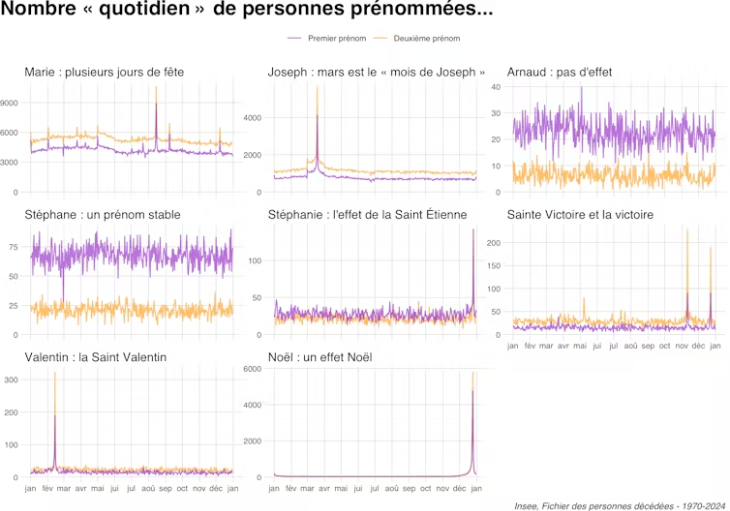
He will be born a lot more from Joseph on Saint-Joseph Day-March 19-and throughout this month than in any day of the year. If, in the file of deceased, it was born about twenty-five Valentin on July 3, they are 200 in this case on February 14.
The victory are visible on the day of the Holy Victoire (November 15), but also, for a precise historical reason, on November 11, 1918, the day of the armistice which ended the First World War. The 230 little girls born on November 11 and having received the first name victory found in the file of deceased people were born on November 11, 1918.
Choices of increasingly free first names
By exploring the distribution of other first names, such as Stéphane or Arnaud, we would be hard to detect what is the day of their party. This day does not attract parents more than another day of the year. It is perhaps because the parents who choose these first names are far from Catholic references (they choose, in the middle of the XXe century, a first name which is then a “new” first name). But why was the first name Stéphanie widely more attributed on the day of Saint-Etienne (Etienne being a Latinized version of the Stéphane Greek), on December 26, when it is not the case of Stéphane?
In the previous graph, I calculated the number of births per day, ignoring the year of birth. I cling to individuals born in 1910 and others born in 1947 or 1972: the only thing that interests me is day, 1er April or June 15 …
Then, if we are interested in evolution over time and we consider all first names, what happens? As parents ceases to name their children according to Catholic saints, the practice of choosing the first name of the saint of birth much more frequently.
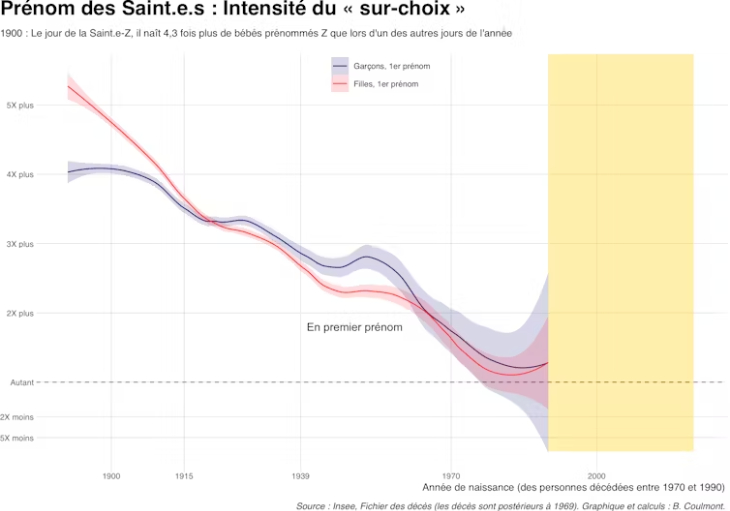
People born at the beginning of the XXe century had between four and five times more likely to be called “Z” if they were born on Saint-Z than another day of the year. For people born in the 1980s (and already died), there is no more “saint of the day” effect.
The disappearance was slower on the second first names, these invisible first names, known to the nearby entourage. These first names are often names of an older generation (cousins and cousins, grandparents, uncles and aunts) and more associated with sponsorship and therefore with a protective saint.
One can even think that today born on the day of Saint-Z leads the parents to avoid this first name. The choice of first name is sometimes lived as a free choice, entirely free.


