
When we think of amphibians we imagine frogs next to a pond or salamanders under a wet stone: animals with thin skin and fresh water. That is why a new fossil described in China is so disconcerting, an armored amphibian from 237 million years ago that, according to a study published in Nature Ecology & Evolution and explained by the University of California at Davis (UC Davis), he spent his life at sea. Is called Gerrothorax maritimusand its story is that of the first fully marine amphibian known so far, an evolutionary paradox that forces us to rethink how vertebrates conquered the ocean.
An amphibian where it shouldn’t be
The skin of today’s amphibians is permeable and not very suitable for salt water, which tends to dehydrate their tissues. That is largely the reason why only a few living species tolerate brackish environments and none live permanently in the open sea. A fully marine amphibian is, therefore, a rarity that requires solid evidence before being accepted.
Gerrothorax maritimus lived during Late Triassic and it measured around 74 centimeters. Its body was short and flattened, a very different silhouette from that of many modern amphibians, and much of it was covered in bony plates: a kind of dermal armor embedded in the skin. That combination—medium size, flat shape, and armor—already suggests an animal adapted to living near the bottom, not jumping between ponds.
Three clues that point to the ocean
A marine sediment may occasionally preserve remains washed up from land, and a flattened anatomy alone is not enough to place an animal in the sea. What makes this interpretation robust is that several independent pieces of evidence coincide.
The first is the environment. The two almost complete skeletons—a holotype and a paratype found in the same stratum in the Chinese province of Guizhou—appeared in sediments interpreted as marine. The second is geography: this deposit was located at least 30 kilometers from the nearest islanda distance difficult to explain if we imagine a freshwater animal transported by chance from the coast.
The third clue comes from the chemistry of the bones themselves. The strontium preserved in the skeleton matches a signal compatible with seawater. It is a different line of evidence from the sediment and the distance to land, and it points in the same direction. When three pieces of evidence that could fail separately converge on the same conclusion, the hypothesis gains strength.
How did an armored hunter hunt?
One thing is where I lived Gerrothorax maritimus and another, how it behaved: the marine environment is supported by data; the way of hunting is a reconstruction based on anatomy.
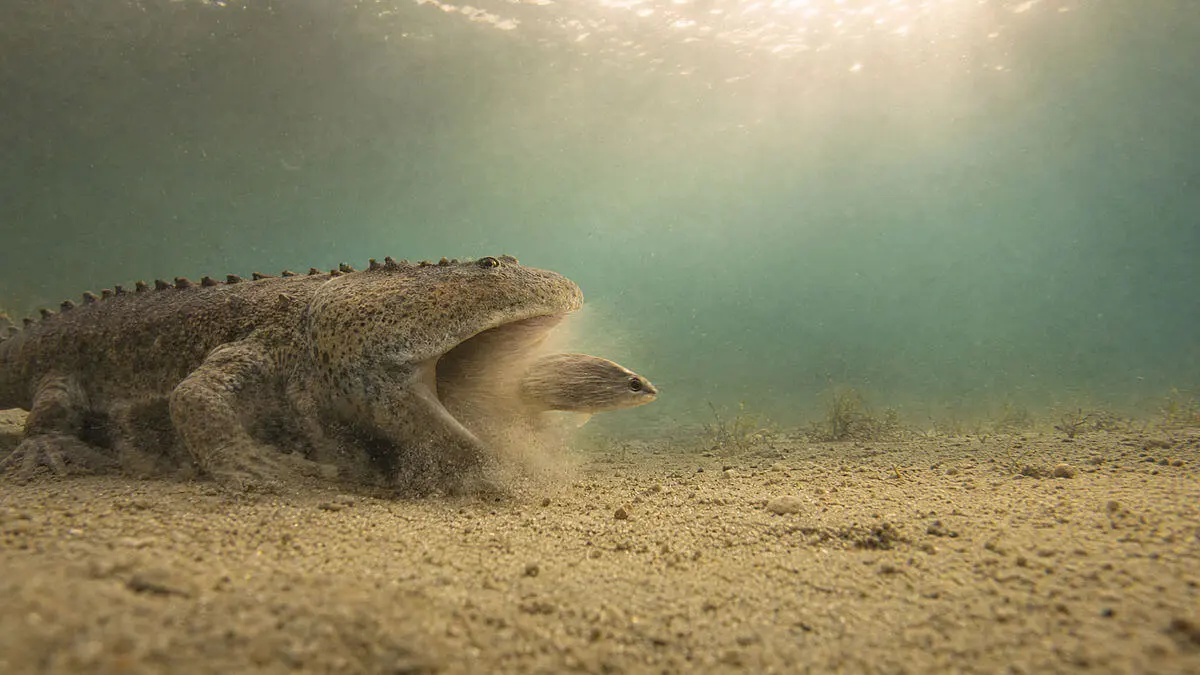
Its flattened body fits with a benthic life, that is, linked to the bottom of the sea. Such an animal could rest on the substrate, remain semi-hidden and wait. The study proposes that it captured prey through suction: a rapid expansion of the mouth that would drag water—and with it, the animal that was nearby—into the interior. It is a strategy that appears in numerous current aquatic vertebrates, which makes it plausible. Even so, it is worth emphasizing: no one has observed this behavior, and it cannot be determined precisely what prey he caught or how often he resorted to this method. The anatomy makes the scene plausible, but does not demonstrate it.
What was the armor for?
The bone plates are the most striking part of the fossil, and also the most difficult to interpret. They covered a good part of the body and would have acted as Gerrothorax a heavy and protected animal, the opposite of the lightness of many living amphibians. This armor may have offered defense against predators, although its exact function is not resolved.
The study also raises a bolder idea: that the plates could have participated in managing the exchange of salts with seawater, one of the great physiological challenges of any vertebrate with permeable skin in the ocean. This is a physiological hypothesis, not a proven fact. The fossils do not allow us to observe how it regulated salt or how it maintained water balance in its tissues. We know that he survived at sea; How he solved that problem remains an open question.
Of course, when talking about ancient amphibians that moved across soft bottoms, it is tempting to resort to fossil footprints attributed to other temnospondyls, the large group of extinct amphibians to which this species belongs. Those marks help imagine how some of these animals walked or crawled. But they are not traces of Gerrothorax maritimus: They belong to other animals and do not serve as direct evidence of how this specific species moved. Distinguishing what a fossil shows from what it merely suggests is part of the job.
What does it tell us about the conquest of the sea?
The value of this discovery goes beyond a singular species. The vertebrate transition between land and ocean He did not follow a single recipe. Some lineages transformed their limbs into fins, others adopted hydrodynamic bodies to swim in open water, and Gerrothorax maritimus seems to have combined a flattened shape, extensive armor and a life tied to the bottom. Three different strategies for the same challenge: inhabiting an environment that, for an amphibian, should have been almost uninhabitable.
What this armored hunter illustrates, deep down, is the diversity of paths that evolution can take when faced with the same problem. Much remains to be clarified—how it handled salt, what exactly it ate, how much time it spent in each area of the bottom—but the most interesting question has already been posed: if an amphibian could live in the sea 237 million years ago, how many other ways of adapting to the ocean are we still undiscovered in the fossil record?
References:
R. Motani et al. A fully marine stem amphibian from the Late Triassic of China. Nature Ecology & Evolution. 2026. doi: 10.1038/s41559-026-03209-9 BP
Kear et al. Revision of the trematosaurid Erythrobatrachus noonkanbahensis confirms a cryptic marine temnospondyl community from the Lower Triassic of Western Australia. Journal of Vertebrate Paleontology. 2026. doi: 10.1080/02724634.2025.2601224