
Is it possible to find out what a protein that has been extinct for more than 100 millions of years? There is no intact sample waiting in amber or tissue from which to extract it. However, their descendants survive in modern animals and keep, scattered in their sequences, clues about that distant time.
The question matters because we usually tell evolution by looking at bones, teeth or impressions in stone. This record shows body silhouettes, sizes and relationships, but it barely indicates how a molecule functioned within an extinct organism.
Exploring this dimension would allow biological transformation to be observed from a considerably more intimate scale.
That’s what Titas Sil and his collaborators at the University of Oregon tried, according to an article published in PLOS Biology. Instead of searching for ancient matter, they estimated ancestral configurations from genetic signals from living species. Then they made equivalent segments and experimentally tested what they could do.
Can you reconstruct a protein that no longer exists?
The technique is called reconstruction of ancestral sequences. Its logic is reminiscent of the restitution of a lost manuscript of which only later copies remain.. If numerous versions share certain passages and differ in others, their kinship ties allow us to deduce, with different degrees of confidence, what the text from which they come could have been like.
Here, The letters are amino acids, the units with which proteins are assembled. The team gathered 376 sequences of transferrins, lactoferrins and melanotransferrins from various vertebrates, mapped their evolutionary tree and calculated which amino acid was best supported by the data at each location from several extinct ancestors.
It is not, therefore, about extracting a molecule preserved for 160 million years. “Resurrecting” means computationally recreating its most plausible composition. To gauge this uncertainty, Titas Sil and his colleagues also evaluated alternatives at uncertain points.
They assembled 376 sequences of three proteins from various vertebrates, mapped their evolutionary tree, and calculated which amino acid was best supported by data at each locus from several extinct ancestors.
A tool hidden within another
Before understanding the discovery, you have to know its protagonist. Lactoferrin is a protein capable of binding iron. It is abundant in the milk and colostrum of mammals, although it is also found in tears, certain immune cells, and other body fluids.
Within that large structure, a tiny piece is hidden: lactoferricin. It is a peptide, that is, a short chain of amino acids. It can be released by cleavage of the protein by enzymes and display antimicrobial activity. It is similar to one utensil that houses another: the larger object fulfills its tasks, while a separate portion takes on different attributes.
Many peptides that fight microbes They are small and have a positive charge. This trait favors its interaction with negative components present in the microbial envelopes. The combination helps explain how a tiny chemical filament manages to attach to a bacteria, destabilize its outer border and, in some cases, kill it.
A genetic accident opened a possibility 160 million years ago
The story begins about 160 million years ago, in the ancestor of placental mammals. So, a duplication of the transferrin gene occurred: the hereditary material generated an additional copy. From that episode the branch that would give rise to lactoferrin was born.
Two related genes favor evolutionary innovation. If we have a single essential resource, modifying it too much can make it unusable. If we accidentally get a second copy, one specimen maintains the initial function while the remaining one accumulates mutations and explores new pathways.
This does not imply intention or a prior plan. Successive mutations remodeled the region that would end up corresponding to lactoferricin. Over time, it became enriched in positively charged amino acids and others with hydrophobic qualities, traits associated with numerous antimicrobial peptides.
It remained to be known when that portion began to fight bacteria.
The past enters the laboratory
To solve it, scientists synthesized 25 amino acid peptides corresponding to several inferred ancestral sequences and contrasted them with current human and bovine lactoferricins.. They were then confronted with Pseudomonas aeruginosa, Escherichia coli, Staphylococcus aureus and Streptococcus agalactiae.
The molecule associated with the ancestor that emerged just after the duplication already showed a modest response. Another belonging to a later stage reached considerably greater potency compared to all the species tested. This bactericidal potential, therefore, had appeared early and had been strengthened during the evolutionary journey.
The count of viable bacteria made the magnitude clear. After 24 hours, one of these ancestral lactoferricins reduced the colony-forming units of P. aeruginosa regarding control. Against S. aureusthe decrease was around 100,000 times. The modern bovine variant showed even more activity in these crops: in specific tests, no colonies were detected after two hours.
An ancestral lactoferricin reduced colony units of P. aeruginosa; against S. aureuswas around 100,000 times; and, with the modern bovine variant, no colonies were detected within two hours.
The finding is defined as follows: some recreated ancestral peptides killed bacteria under these circumstances.
How a chain of just 25 amino acids can kill
A bacteria is isolated from its environment by an envelope whose integrity is essential. It is not a solid wall, but a delicate molecular assembly. If it loses control over what goes in and out, the cell faces a potentially lethal problem.
The scientific group examined how they operated using permeability analysis, polarization and microscopy. Both ancestral and contemporary lactoferricins altered membranes. The former could make them permeable; more powerful modern forms produced much more intense damageuntil causing contraction and collapse of the cell cover.
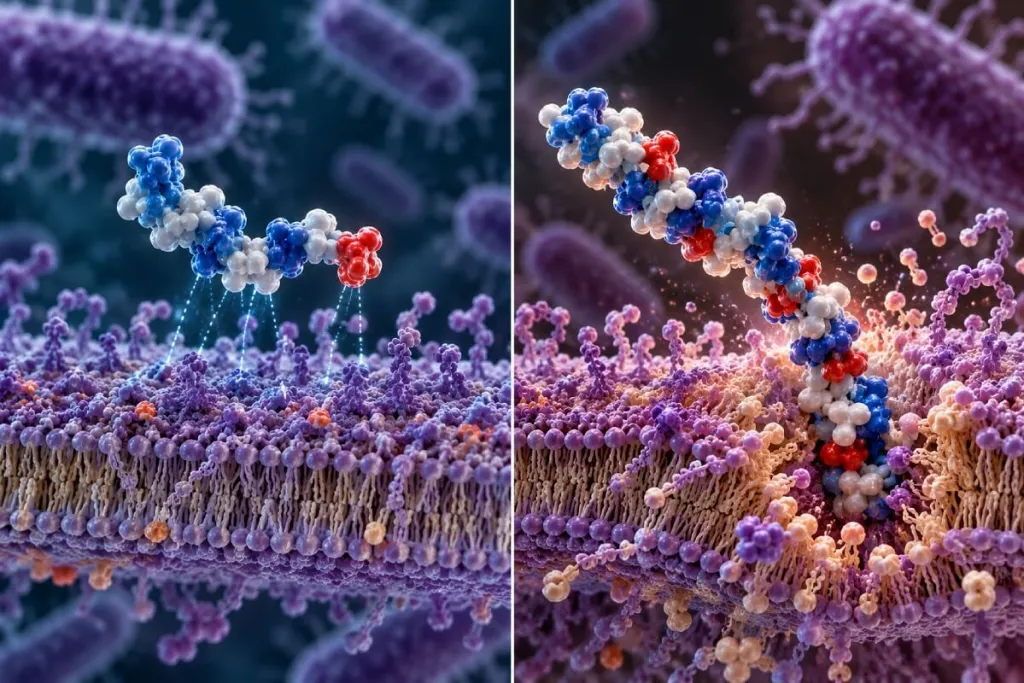
A microscopic wedge that disorganizes a surface can be represented, although the mechanism is more complex. Evolution did not suddenly invent a fully refined solution. An initial ability to disturb this barrier intensified until it led, in certain lineages, to a very powerful bactericidal action.
A single amino acid can alter the outcome
One of the most eloquent observations arose when comparing two ancestral lactoferricins that differed in just three mutations. Their strength against microbes varied greatly. In particular, he highlighted the substitution of a glutamine for an arginine in position 8. The latter provides a positive charge, precisely a relevant characteristic for interacting with bacterial surfaces.
The team made mutant peptides to measure the amino acid contribution. Facing P. aeruginosaintroduce that arginine was necessary and sufficient to reinforce its antimicrobial effect. By reversing the replacement, that benefit disappeared.
But S. aureus added a crucial nuance. There, arginine was also essential for the superior performance of a next-stage peptide, although adding it alone to its predecessor was not enough to replicate it. That same alteration does not offer the same outcome against any opponent. What happens depends on the molecular context and the microorganism in front.
Evolution does not pursue a perfect antibiotic
It would be tempting to order this route like a staircase: each step, better than the previous one. The data refutes that idea.. Contemporary human lactoferricin, for example, was less effective against some gram-positive bacteria—microorganisms characterized by a thick cell wall—than certain inferred precursors. The bovine, on the other hand, was the most powerful of the group tested.
Natural selection also does not work with a predetermined objective. Hereditary novelties appear and their consequences are filtered according to the scenario that affects survival and reproduction. An advantage over a certain microbe may provide little over another.
Contemporary human lactoferricin was less effective against some gram-positive bacteria—with a thick cell wall—than certain inferred precursors, but bovine lactoferricin was the most potent.
The story continues even in recent primates. Those responsible for the study identified positions of lactoferricin subject to selection and introduced two changes in the human version. Replacing glutamine in position 5 with arginine significantly increased its strength against S. aureus and other staphylococci analyzed. This data indicates that a protection that arose in ancestral mammals continued to evolve long after their appearance.
What the experiment still does not show
None of this makes recreated lactoferricins ready-made new antibiotics for a pharmacy. The tests were carried out in vitrooutside an organism, and the conditions of the environment influence the behavior of these compounds. It remains to be determined how candidates based on them would respond in much more complex physiological environments.
Nor can it be said that the study has shown that they destroy multi-resistant “superbacteria”. The strains examined are important pathogens, but the goal was not to specifically analyze microorganisms selected for resistance to multiple antibiotics..
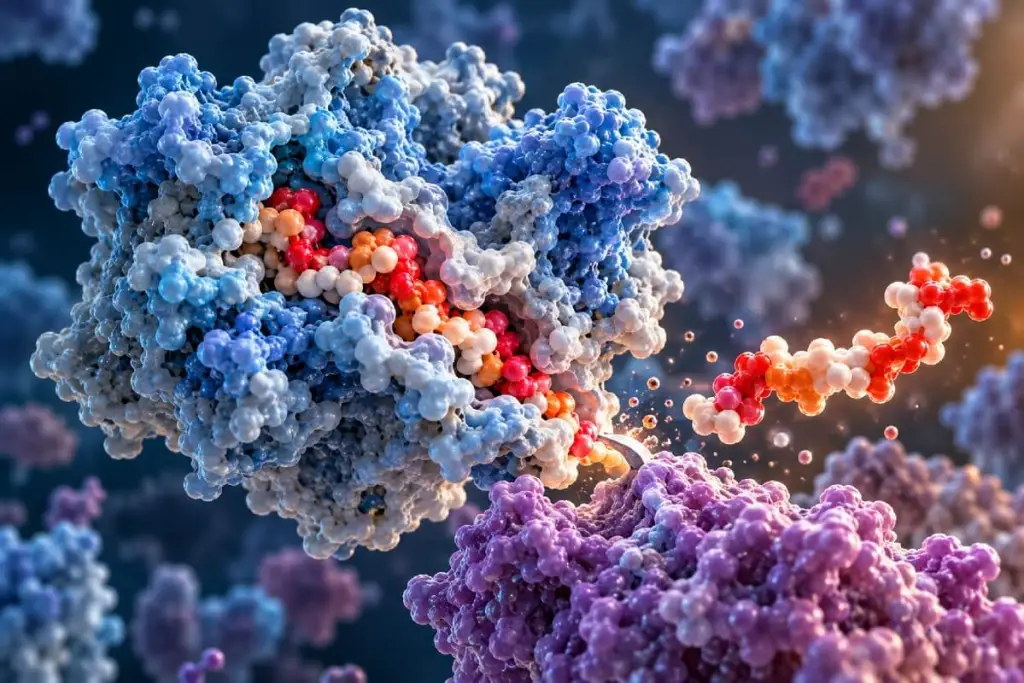
There is another essential caution: ancestral sequences are statistical estimates. The study addressed that uncertainty by testing alternative ancestral compositions; The main trends broadly persisted. Still, no one has an authentic sequence with which to compare them.
An archive of life hidden in molecules
The deepest value of this advance may not lie in finding an eventual drug, but in demonstrate how much the present can tell us about extinct biological functions. From derived living lineages, science can propose a plausible model of an ancestral molecule, obtain the corresponding peptide in the laboratory, and subject that historical hypothesis to experiments.
This is how our way of conceiving evolution also changes. The duplicated gene opened a space for innovation; Subsequent genetic alterations refined chemical parameters; some combinations acquired the ability to disrupt bacteria and other substitutions later modified their potency. There was no magical leap, but a traceable series of stages.
The genomes of living species harbor vestiges of past biological solutions, of what they were capable of doing.
Fossils reveal skeletons of extinct creatures. The genomes of living species offer another less visible source of information: they harbor vestiges of past biological solutions. Reading them properly serves to clarify not only what certain molecules from the past could have been like, but also something even more difficult to know: what they were capable of doing.
