
A compassionate thought for the cinema lover who tries to find his way among the eighteen outings of this week. In addition to unpublished works and not to be missed under any pretext for Edward Yang, there are among the new features at least three films that deserve to draw attention.
Two of them –Segundo Premio And Kouté Vwa– have in common to be built around music and two of them –Kouté Vwa And Super Happy Forever – concern a tragic disappearance, where the resources of the staging give a place to the missing person among the living.
And all three, without raising in the usual sense of the fantastic genre, have to do with the presence of the invisible in the visible. Everyone makes a unique and moderate use of non -realistic special effects to melt the real and the imaginary together, in order to better make a truth sensitive. Cinema, what.
“Segundo Premio”, by Isaki Lacuesta and Pol Rodríguez
First, we don’t really know. Information entered on the screen (Granada, XXe century), a strange plan where the ground seems to breathe, images like a vacation video where a young couple skiing and arguing, a new sibylline inscription (“This is not a film on the legend of the planets”). Then, on a terrace in the sun, the young couple in full breakup.
Images of a rock concert and the same young woman who breaks with the group, of which she was the bass player. It takes a while to capture that the singer is the guy from which he has been seen to separate. But it doesn’t take long to realize the melodic and rebellious force of their music.
We were rather with the girl, we end up with the boy, the singer, and soon his relationship with the guitarist, they are the pillars of the group. There follows a real adventure, which is above all an adventure for the spectator, according to the tribulations of these two types, together or separately, on stage, on TV (where they plant a souk King size), at home, in the studio, at the dealer of one and during the hiring of new members of the group, in Granada and New York.
One of the film’s co -readers, Isaki Lacuesta, is one of the main figures of the living and creative contemporary Spanish cinema, with Jonás Trueba, óliver Laxe, Helena Girón and Samuel M. Delgado, Julia de Castro and María Gisèle Royo, Víctor Iriarte, Itsaso Araba, etc. On his previous film, the memorable A year, one night (2023), he had as assistant Pol Rodríguez who joined him on it. Cosigned film, Segundo Premio is therefore a group film.
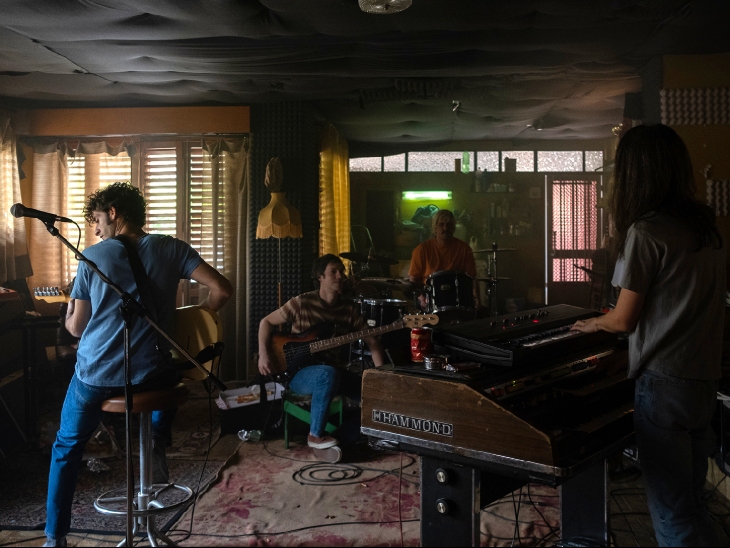
Musical group, Los Planetas whose film follows the trajectory, but above all, and in a much more singular and inventive way, development of a story and even more of a staging in several centers, to several narrators, on several points of view. In France, few will be those who will immediately know that Los Planetas have been and are always one of the large Spanish rock groups and in this case will also know that it is not his real members that we see on the screen, even if it is their music that we hear.
Real false documentary which reinvents and shifts the inheritance of Spinal Tap (1984), the film navigates between the registers, flies away from riffs of stratocaster and cracks of crack, tense, furious, caressing. The uncertainty between a possible realism and a unbridled invention opens the space to wacky, tragic, hallucinated situations …
So many scenes which, one by one, impress and seduce. But above all Segundo Premio is the discovery of this multiple and tonic form that is the film as a whole, always appearing to be deployed on several levels and at several distances, playing and thwarting the biopic, the musical film, the chronicle of the entry into another age of life, or in another relationship to reality.
Haunted and funny, anxious and intense, Segundo Premio Advance in several directions at the same time, finds anyone who seemed lost, did not cross with anything. When it is finished, we are still not very sure of what we have seen, but quite certain of the richness of the emotions and the sensations proven. And, yes, Los Planetas (the real) are super musicians.

“Kouté Vwa”, by Maxime Jean-Baptiste
First, no doubt. The emotion and anger of the young woman who pronounces in front of the inhabitants of a district of Cayenne which is both from a funeral praise and a cry of revolt about the assassination of a young man, whose portrait is seen on posters. This emotion and this anger are authentic.
But this boy who listens and who soon trains to play the drum-the activity for which was known the one who died-, is it a fictional character? And this grandmother, a radiant woman of energy and malice and yet crossed by terrible suffering, is it an actress?
The film will never entirely say how assembled the elements which refer to the reality of the murder of Lucas Diomar – a man stabbed at the end of a party in March 2012 and whose death raised an immense emotion in Guyana – and what is fiction.
🎬 Kouté Vwa is released today.
He returns to the true story of Lucas Diomar, 18, killed in Cayenne in 2012.
In this archive, her mother Nicole spoke, a year after the facts.
Moving words.
#Koutevwa #LucasDiMar #Guyana #Justice #Archives pic.twitter.com/mlzvqqjd6l– in.fr (@inafr_officiel) July 16, 2025
And this uncertainty, partly raised in the end credits where it appears that the main protagonists play their own role, is open to a freedom to tell, to make sensitive rage and anxiety about urban violence, but also the richness of relations within the district that the adolescent, who came from France, explores the time of vacation with his grandmother.
Those who he meets, playing football, browsing the city by bicycle or by practicing his instrument, what they and they say or keep of what happened, the formidable presence of the elderly woman, who was the mother of Lucas, would be enough to give her stake and his breath to the film. But there are drums, which play a role in this society, or decisive roles. And in Kouté Vwa Also.
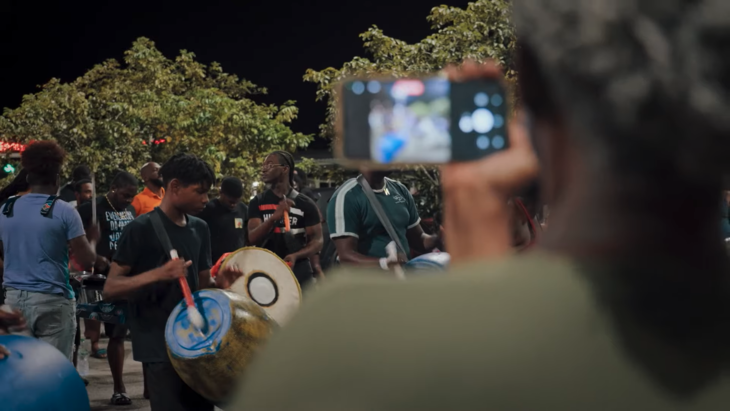
Lucas Diomar was a renowned tambouyé. His nephew tries to look like him. But around him, that is also everything that activates in a community to the sound of percussion, in the rhythmic sound energy of ten, thirty, a hundred drums beaten together in the streets and on the squares.
Among those who listen, those who dance, those who play, there are the friends of the dead, those who played with him, his neighbors. And also, perhaps, the assassins. “Listening to the voices” (“Kouté Vwa”), says in Creole the title of the film. The voices of those who are not listened to, the voices of men and women, the living and the dead and the voices of the drums which, perhaps, make a link between them.
Saturated with presences, emotions, tension, sounds, real and imaginary public space becomes a reconfigured territory, thanks to the tightrope walking of the staging of the first film by Maxime Jean-Baptiste, on the thread between documentary and dream, between mourning and vital impulse. Where the violence of a tragic news item converges with a mythological dimension.

“Super Happy Forever”, by Kohei Igarashi
What happened to this red cap? The two young people in a resort in a seaside resort do not really behave like vacationers. They are looking for something, but is it really this scarlet headgear?
Little by little will be unfolded, on two eras at five years apart, the real sense of the presence of Sano and Miyata on the beaches of Izu and in room 819 of the hotel facing the sea. It will be a game of signs, fortuitous meetings, sentences evoked. There was a story. She was light and joyful, fragile. There is another. It is opaque and tense.
Between the two, a disaster has arrived. It will also break the relationship between the two men. But that makes existed in an extraordinarily present, touching, delicate way, a young woman who also came to enjoy a stay at the sea, where a friend could not join her. And another young woman, who came from much further, foreign who works where the others are on vacation.
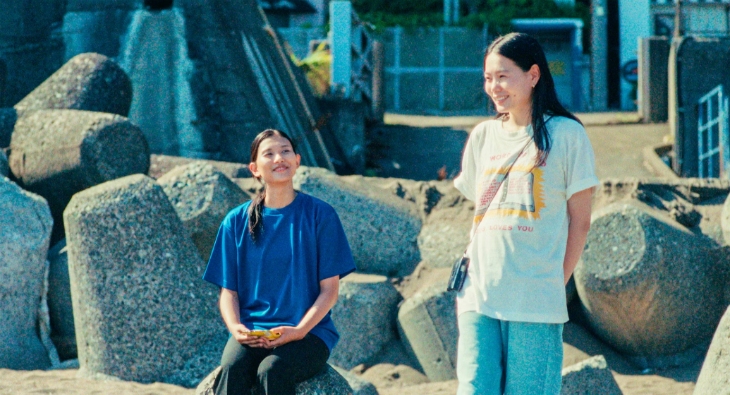
There will be games and songs, collective leaps and solitary expectations, an acrobatic gesture and misunderstandings. A tiny and very violent act. Lots of light moments in the staging of this story of luck seized and loss. It will be a matter of tempo and distance, synchronization or not with a look, a gesture, a way of saying or not saying.
Under the sign of an impossible mourning, there will be much not much and almost nothing, which make a poignant drama and a simmering sweetness. In the grace of a staging attentive to the invisible beings and currents which circulate between them, a perfume of humanity.

