
A person develops a fever after being exposed to ticks. Fatigue, digestive discomfort and certain blood abnormalities fit with a familiar ailment for doctors in several Asian regions. It seems reasonable to track the microorganism that usually causes it. The test, however, says that it is not there.
The confusion increases when this absence is no longer exceptional. More than 30 percent of patients clinically classified as having severe fever with thrombocytopenia syndrome, or SFTS, test negative for the virus associated with this disorder. The symptoms exist; the usual suspect does not appear. So what is affecting these people?
This anomaly led specialists linked to the State Key Laboratory of Pathogens and Biosafety in Beijing and other Chinese institutions to approach the problem from another angle. Instead of limiting themselves to finding out if the samples contained the expected agent, they expanded the investigation.
The answer, as explained to us by paper published in New England Journal of Medicinethe most prestigious and oldest peer-reviewed general medical journal in the world—it has been published since 1812—was well hidden among patients, genetic information and, of course, tens of thousands of ticks.
When symptoms point to a culprit that does not appear
To understand the enigma it is necessary to first clarify what it is severe fever syndrome with thrombocytopenia.
It is a disease transmitted by ticks and endemic in Asia which can cause fever, a decrease in the number of platelets and affect different organs. Its described lethality ranges between 10 and 30 percent. The known causative agent is dabie bandavirusabbreviated DBV and previously called SFTS virus.
A clinical diagnosis, however, begins with what happens in the body, not by directly looking at the invader. Fever, fatigue, or thrombocytopenia—an abnormally low number of platelets—offer clues, but none are an exclusive signature. Unrelated pathogens can cause similar manifestations.
It is a disease transmitted by ticks that can cause fever, a decrease in the number of platelets and affect different organs, and is caused by dabie bandavirus.
The scene is reminiscent of a flooded room in which a burst pipe is immediately inspected. If they are all intact, the water does not disappear because of it. What falls apart is our first hypothesis about how it got there.
The numerous episodes without bandavirus raised precisely that possibility: perhaps some affected people shared clinical appearance, but not origin.
Search without knowing exactly what you are looking for
Targeted analyzes work very well when there is a defined candidate. We could compare them to showing a photograph to a building security guard and saying: “Has this person entered?” The procedure is precise, although it only responds to the face shown. If someone else is responsible, a correct “no” leaves the mystery intact.
Metatranscriptomic sequencing examines the RNA present in a sample and recognizes components from multiple organisms without first restricting scrutiny to a single microbe.
The team turned to a much more open strategy: metatranscriptomic sequencing. Simply put, this technique examines the RNA present in a sample and recognizes components from multiple organisms without first restricting the scrutiny to a single microbe. The question ceases to be whether dabie bandavirus here and it starts to look like what is there.
The material came from hospital surveillance of febrile patients with a history of exposure to ticks in Chinese areas where these diseases are endemic. To the analysis of the genetic material, it was added viral isolation: try to obtain the agent and verify that it can replicate in cultured cells. That combination led to a lead unrelated to the initial suspect.
The virus that was missing in the tests
The intruder was named Asian longhorned tick nairovirus (ALTNV) or Asian tick nairovirus Haemaphysalis longicornis.
The similarity of its amino acid sequences with those of other ortonairovirus species was below 80.04%, a divergence compatible with its distinctive character.
Phylogenomic studies, which reconstruct evolutionary relationships by contrasting molecular characteristics, placed it in the genus Orthonairoviruswithin the family Nairoviridae. And the similarity of its amino acid sequences with those of other species in that group was below 80.04%, a divergence compatible with its distinctive character.
There was something more solid than a peculiar sequence on a computer. When inoculating Vero cells with human serum positive for RNA this nairovirus, the authors managed to make it grow. Immunofluorescence—a method that uses fluorescent antibodies to locate specific molecules— revealed their antigens —molecules recognizable by antibodies—and electron microscopy allowed us to appreciate particles with features typical of ortonairovirus. Likewise, they confirmed his replication in various cell lines.
That journey matters. Finding genetic fragments can reveal the presence of an agent, but isolating it, visualizing it and confirming its multiplication provides independent layers of evidence. The stranger was beginning to acquire a biological entity.
A figure changes the dimension of the discovery
A decisive question remained: knowing to what extent it emerged among those who arrived at the hospital.
The screening included 3,163 febrile patients who had been exposed to ticks. 10.4 percent tested positive for Asian tick nairovirus Haemaphysalis longicornis by detection of RNA or IgM antibodiesdefenses that usually occur in relatively recent phases of an infection.
The proportion gained even more interest within the gap that had motivated the research: among patients negative for dabie bandavirus15.1 percent carried the nairovirus. This, of course, does not mean that the new agent accounts for all those conditions without an etiological diagnosis, whose cause remained unidentified, but it does clear up an appreciable fraction of the unknown.
10.4% tested positive for ALTNV, and among DBV-negative patients, 15.1 carried nairovirus.
The 56 exclusive nairovirus infections allow us to outline an initial profile. 84 percent suffered fatigue; 80, gastrointestinal problems; 38, thrombocytopenia; and 36, elevated concentrations of aminotransferasesenzymes whose increase in the blood can warn of cellular damage, often liver. All of these patients recovered without sequelae.
When two viruses coincide
The situation is complicated because both agents can be housed in the same individual. The authors documented 38 coinfections by Asian tick nairovirus Haemaphysalis longicornis and dabie bandavirus.
Compared to those who only had the second, this group suffered respiratory symptoms more often61 percent compared to 38, and a kidney deterioration in greater proportion: 84 percent compared to 66. Seven of those coinfected died, equivalent to 18.4 percent.
These numbers require prudence. An association does not by itself prove that the nairovirus worsen those outcomes nor is it enough to attribute the observed deaths to it. The size of the sample also does not support excessive conclusions. The work maintains that coinfection seems linked to greater severity and opens a question that must be addressed with more data.
This caution separates a disturbing sign from unwarranted alarm. When the nairovirus acted without the bandavirus, everyone survived and was free of sequelae. Confusing both circumstances would erase precisely one of the clinical differences that the finding helps to introduce.
The tick is not a mere suspect
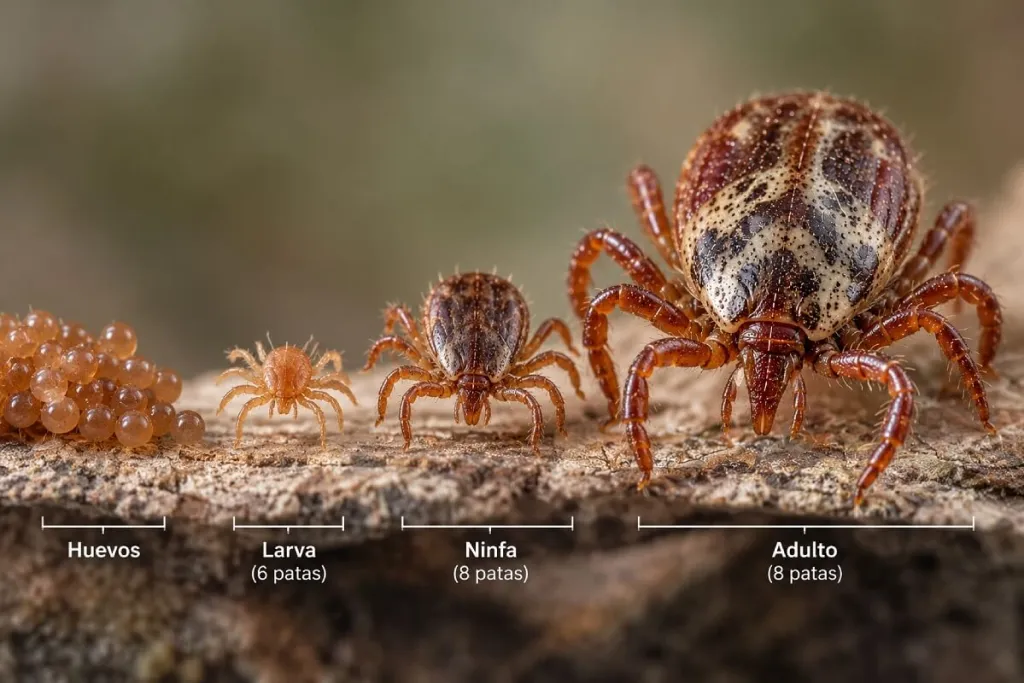
Locate Asian tick nairovirus Haemaphysalis longicornis in humans it still left pending another piece: demonstrate its link with these arthropods. To pursue it, researchers analyzed 47,428 ticks collected in 15 provinces. The virus RNA emerged in 1.29 percent of the set, and the maximum prevalence corresponded to Haemaphysalis longicorniswith a 1.75.
The virus RNA emerged in 1.29% of the ticks analyzed, the maximum prevalence corresponded to H. longicorniswith 1.75, and the transmission was maintained in its stages of development and from the female to her offspring.
But finding a pathogen within a possible vector is not enough to prove that it can infect you. The experiments went further.
H. longicornis sustained horizontal, transstadial and transovarian transmission of the nairovirus, in addition to transferring it to mice. “Transstadial” means that the agent persists when the tick moves from one stage of development to another; “transovarian”, that an infected female can transmit it to her offspring through her eggs.
The exposed mice presented histopathological lesions, that is, changes in their tissues observable under a microscope, and generated antibodies after the parasites were shed. All of this connects three scenarios that separately would say less: sick people, carrying ticks and experimental transmission.
The real discovery is not just a new virus
Asian tick nairovirus Haemaphysalis longicornis expands more than just a catalog of microorganisms. Until now, a condition similar to the syndrome of severe fever with thrombocytopenia could logically lead to seeking dabie bandavirus. New evidence indicates that a portion of these manifestations may be associated with another ortonairovirus that spreads in the same territories and shares at least one relevant vector.
That transforms the meaning of a negative. The absence of bandavirus does not automatically make the episode inexplicable, but rather may show that the diagnostic approach was too narrow. Just as a map improves when it incorporates previously invisible roads, medicine gains resolution by distinguishing origins capable of producing similar clinical landscapes.
The authors themselves emphasize for this reason the need to improve the differential diagnosis in regions where the syndrome it is endemic. Establishing this separation is not a terminological subtlety: it serves to determine which pathogen is involved, monitor its spread and prevent different ailments from being brought together under a shared presentation.
The unknown also leaves clues
The story ends where it began: with a negative result. Only now that “no” contains more knowledge.
The work does not establish that the Asian tick nairovirus Haemaphysalis longicornis explain each episode of severe fever syndrome with thrombocytopenia without dabie bandavirusnor does it support extrapolating its percentages outside the population studied. Yes points an infectious cause that remained hidden within a medical challenge already described.
Its distribution is not limited to a single point on the map either: RNA appeared in ticks from numerous sampled provinces, while human cases were concentrated in the places included by hospital surveillance.
The confluence between host, vector and territory opens up the epidemiological task of clarifying exactly where it circulates and how many cases it really causes.
This confluence between host, vector and territory opens up a different epidemiological task: clarifying more accurately where it circulates and how many cases it really causes.
Sometimes, the decisive clue is not what an examination discovers, but what it repeatedly fails to locate. Those results without the bandavirus were not an empty space: they marked a frontier of what we knew. The nairovirus now occupies part of that gap and reminds us of something basic about infectious diseases: that recognizing the symptoms is not yet equivalent to identifying their author.
