
We hold a magnet to the refrigerator door and assume what will happen. However, this everyday attraction is born from a much less intuitive microscopic universe. Whether a substance exhibits magnetization does not simply depend on containing certain elements: it also matters how its components interact on an atomic scale.
The difficulty increases in certain alloys, where slight composition modifications can lead to very different magnetic responses. For years, physicists have sought a guideline broad enough to sort out such diversity and determine, before making every conceivable formula, what reaction to expect.
An international team led by Farid Labib of the Tokyo University of Science has now examined a particularly intricate family of intermetallic solids. Their purpose was to find out if a shared denominator was hidden behind that apparent labyrinth.
However, to understand what they found according to what they have published in the veteran scientific journal Journal of the American Chemical Societyfirst it’s worth dismantling a deceptively simple idea: what it actually means to behave like a magnet.
Before understanding the discovery, we must know what it means to “be a magnet.”
Let’s imagine that inside a material there are a multitude of tiny compasses. The comparison should not be taken literally: those needles represent the magnetic moments of atoms, a quantum property that serves to express where they point. The decisive thing is not only that they exist, but the bond they maintain with each other.
In a ferromagnetmany of these microscopic “compasses” are coordinated in such a way that their contributions do not cancel and a net magnetization arises. It is what describes it and the scenario that is closest to our common image of a magnet.
There is a second alternative. In an antiferromagnetorder also reigns, but opposite directions compensate each other. The set, therefore, lacks that global response characteristic of the previous example. This does not mean that magnetism has disappeared: the moments magnetic they remain present and organized, only their total effect is balanced.
The third relevant outcome receives an evocative name: spin glass. Here moments freeze chaotically, without reaching long-range collective coordination like that of the other two states. And the question is not only whether a sample “is magnetic”, but what disposition ends up being imposed.
Russian dolls built with atoms
The protagonists belong to the so-called Tsai type intermetallic compounds. An intermetallic is a solid made up of several metallic elements whose atoms occupy defined positions within a crystalline framework.
A useful analogy would be a collection of Russian dolls, but made with concentric atomic layers. The Tsai structures house several geometric envelopes nested inside each other. Among them is an icosahedron, a polyhedron with 12 vertices. At these points, rare earths are located whose moments play a fundamental role in the analyzed phenomenon.
An intermetallic is a solid made up of several metallic elements whose atoms occupy defined positions within a crystalline framework.
Scientists work with systems based on gold combined with aluminum, gallium or silicon and rare earths such as terbium, dysprosium and holmium. Many are approximate crystals: periodic architectures related to quasicrystals, solids endowed with a very elaborate organization, although they lack the conventional spatial repetition of ordinary crystals.
The criteria used until now did not work for everyone
Investigators already had an important clue. Traditionally, The concentration of valence electrons per atom, abbreviated e/a, has been used to classify the magnetic behavior of these systems.. Valence electrons occupy the outermost areas of the atom and participate in bonds.
This indicator associated the electronic composition of an alloy with the observed state. The problem arose when trying to develop a unifying interpretation. The limits obtained by e/a varied depending on the rare earth or the chemical repertoire considered..
The panorama posed an attractive challenge. If related compounds could end up as ferromagnets, antiferromagnets or spin glasses, perhaps there was another magnitude capable of bringing all these results together under the same logic. And the key was, literally, in the structure.
The hidden pattern in the separation between atoms
The variable that managed to organize the set was the network parameter. The name may sound abstract, but it expresses a quite tangible idea: it quantifies the characteristic dimensions of the structural cell that repeats within the crystal. It is not equivalent to the external size of a sample; reflects its internal geometry at the atomic scale.
By comparing numerous compounds, the scientists verified that their states were distributed according to that magnitude. Above about 14.72 angstroms, the antiferromagnetic order predominated; between about 14.62 and 14.72, ferromagnetism stabilized; below about 14.62, long-range coordination was suppressed and spin glass emerged.
What managed to organize the set was the network parameter, which quantifies the characteristic dimensions of the structural cell that is repeated within the crystal, its internal geometry at the atomic scale.
And that taking into account that one angstrom is equivalent to one ten billionth of a meterso they are minuscule differences linked to radically disparate collective outcomes.
Let’s think of a mechanism whose parts slightly alter their separation. Although atoms are not gears, the simile helps: modifying the internal distances transforms the interactions that compete with each other.
A relatively accessible structural magnitude thus provided the common thread that the previous procedure did not offer in a unified way.
Above 14.72 angstroms, the antiferromagnetic order predominated; between 14.62 and 14.72, ferromagnetism was stabilized; Below, the spin glass emerged.
Behind the geometry, there are still the electrons
It would be tempting to conclude that a few hundredths of an angstrom magically governs magnetism. That is not what the team maintains. The network parameter acts as a perceptible trace of deeper electronic processes, not as an isolated cause of everything that happens.
The authors detected an almost monotonic inverse correspondence between this magnitude and the concentration of valence electrons per atom: as one grows, the other tends to decrease. They qualitatively interpret that link as a valence-driven contraction of the network. In other words, the crystalline arrangement preserves information about the electronic configuration that was traditionally captured by e/a counting.
The new criterion thus functions as a measurable marker to locate the compound within a map, although complex physics continues to operate underneath.
They detected an almost monotonic inverse correspondence between that magnitude and the concentration of valence electrons per atom: as one grows, the other tends to decrease.
There is also an important microscopic piece. The analyzes indicate that The interaction between the magnetic moments of the closest atoms changes character: it favors an antiferromagnetic alignment in one case and a ferromagnetic alignment in the other.. At the same time, while a strong local anisotropy conditions the preferred directions for each moment. Anisotropy simply means that for these small “compasses” not all orientations are equally favorable.
From the laboratory to a cartography of magnetism
Reaching this synthesis required gathering tools that explore different facets of the same problem. The x-ray diffraction served to characterize the crystalline framework, the magnetometry recorded the response of the samples and the neutron techniques They helped reconstruct the distribution of moments and probe the energies involved.
Three formulations with dysprosium They illustrate the transition with particular clarity. An alloy whose lattice parameter reached 14.73 angstroms exhibited antiferromagnetic order. Another, located at 14.68, turned out to be ferromagnetic. A third, with 14.60, exhibited the characteristic signs of a spin glass. The proximity of the figures is revealing: 14.73 and 14.68 seem almost the same, but lead to different outcomes.
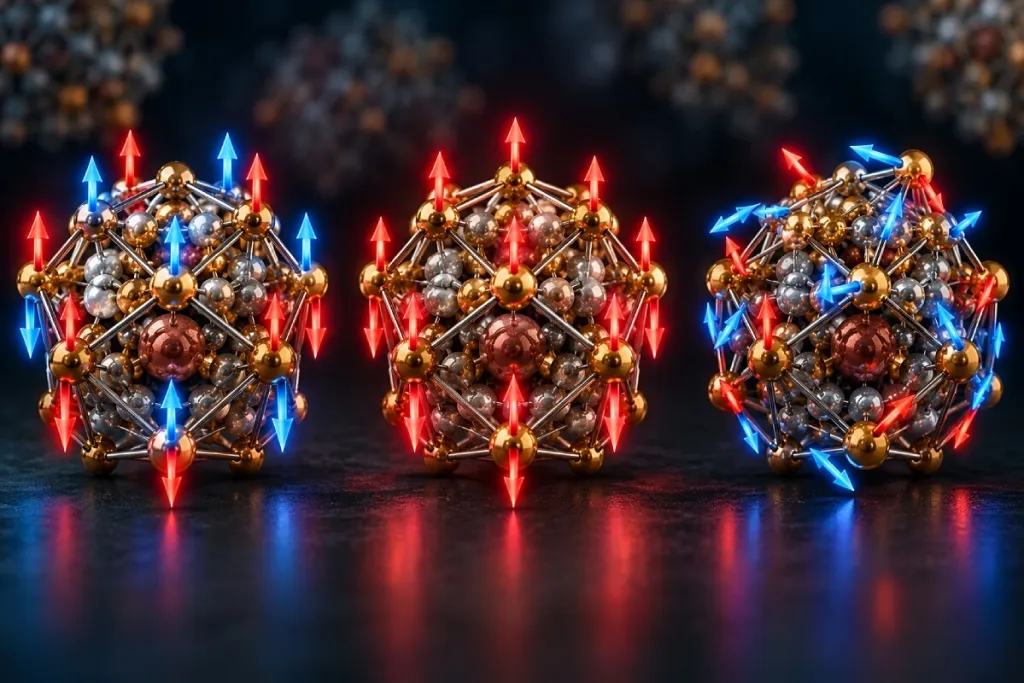
The experiments also revealed non-trivial magnetic arrangements, with moments inclined with respect to local directions. And, near the threshold between ferro and antiferromagnetism, successive transitions and decreases in the ordering temperature were recorded, indications of an intense struggle. This cartography does not erase complexity: it allows us to contemplate it within an integrative vision.
A compass to search for still unknown magnetisms
Having such a guide modifies the strategy for investigating these alloys. Instead of testing compositions without a unifying initial reference, the lattice parameter provides guidance for choosing domains where certain states of magnetism could be stabilized.
The authors themselves point out unexplored areas, including antiferromagnetic quasicrystals and hedgehog-like magnetic texturesconfigurations in which moments draw peculiar spatial patterns.
The lattice parameter provides guidance for choosing domains where certain states of magnetism could be stabilized.
The work does not prove that these phases will be found or promise immediate technological applications, but rather it indicates where it might be worth tracking them. This ability to limit the exploration is valuable in the face of the multitude of possible chemical mixtures.because it turns a detected regularity into a guide for future tests.
The advance does not consist in having designed a revolutionary magnet, but in having a more versatile route to navigate through a territory that until now required separate charts.
What changes is our way of understanding the magnet
Let’s go back to the little compasses at the beginning. When starting, It might seem that magnetism depended above all on what elements a material contains. Now we get a richer perspective: it matters which are its atoms, but also where they are, how far they are separated and what interactions that plot favors.
Therein lies the broader teaching. Many properties perceptible on a human scale emerge from collective decisions made, so to speak, at inconceivably small lengths. A few hundredths of an angstrom can accompany the transition between very different modalities of magnetic organization.
The refrigerator door remains the same, but our view of the phenomenon no longer. Behind such a simple gesture, there is a negotiation between structure, electrons and interactions. Finding principles that connect these levels allows us to progress from explaining what matter does to anticipating what behavior it can adopt.
