
No life form built backwards has appeared. What has just been published is something more subtle and, at the same time, more interesting: a proposal to detect the call mirror lifea hypothetical life form whose molecules would be oriented in the opposite direction to those we know, if it ever existed. The difference between those two phrases is exactly what is important to understand before talking about threats.
What has actually been proposed (and what has not)
In October 2026, researchers Lewis E. MacKenzie, Dominic J. Black and Robert Pal published in the scientific journal Royal Society Open Science a work with a less than reassuring title: a contingency test against possible biological risks of “mirror life.” It is worth underlining the key word: It is a method proposal, not the detection of anything. The study describes how such a hypothetical life form could be sought, but does not present experiments with mirror organisms or demonstrate that the technique works for that purpose.
The distinction is not a technicality. A headline may suggest that scientists fear “mirror life” will wipe out humanity; What is really on the table is a problem of scientific surveillance: how to design an early warning signal for something that, today, does not exist.
Mirror life: biology seen in a reflection
To understand the proposal we must start with a chemistry concept: biological chirality. The easiest way to imagine it is to look at your hands. Your right hand and left hand are mirror images of each other, but you can’t superimpose them: if you place one on top of the other, the fingers don’t match. Many biological molecules have this same property. They can exist in two versions that are mutual reflections, and known terrestrial life almost universally uses only one of those versions.
“Mirror life” would be, in theory, an organism built entirely with the opposite orientation: the molecules that rotate in us to one side would rotate to the other. At the individual level, some authors refer to this hypothetical basic unit as specular cell: a cell whose chiral molecules would be inverted with respect to the terrestrial ones. This matters because chirality conditions how molecules recognize, bind, and react with each other. An enzyme adapted to a “hand” may not work with its reflex.
Here it is advisable not to force the analogy. A cell is not simply a complete “left hand”: it contains thousands of molecules and structures whose orientation need not be uniformly reversed. Defining what should be speculative and what should not is precisely one of the issues that determine any detection attempt.
What exactly would light measure?
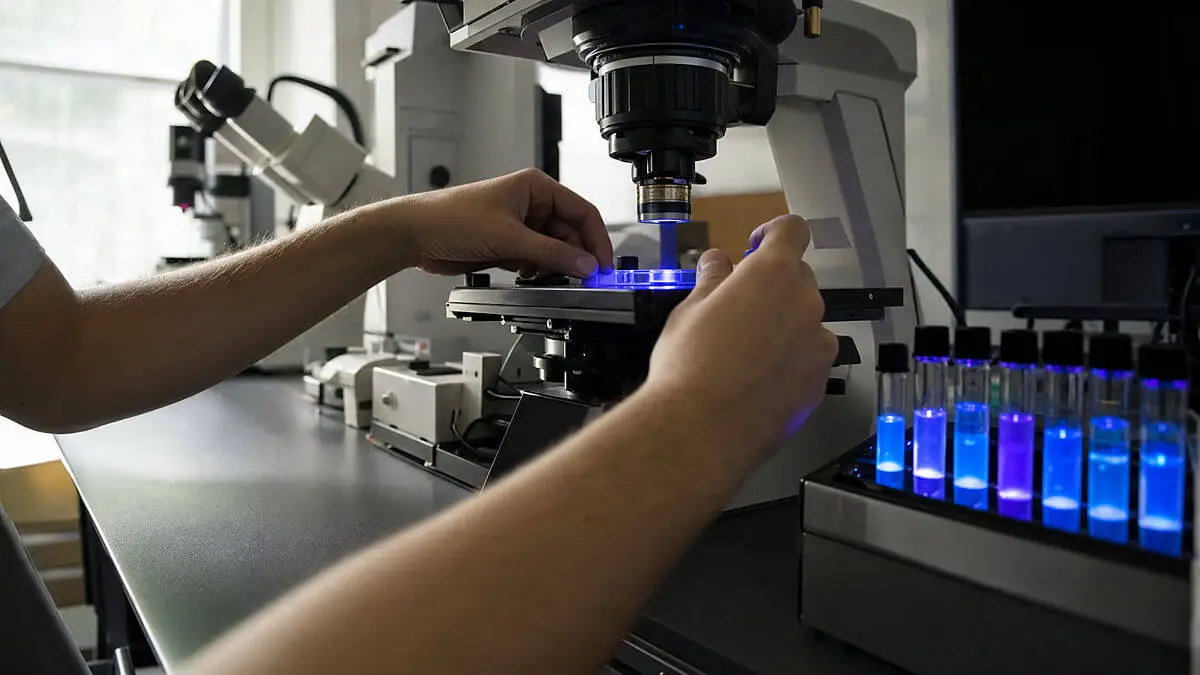
The proposed method combines two ingredients. The first are cellular fluorescent probes: Molecules that bind to specific structures of the cell—membranes, organelles, or nucleic acids—and emit light when illuminated. They are common tools in biology laboratories.
The second is the circularly polarized luminescenceabbreviated as CPL for its acronym in English. Describes a light emission in which components with circular polarization to the left or right predominate. In a chiral system, this difference can provide information about the three-dimensional arrangement of the molecules involved. The idea of the work is that the same probe could emit a different CPL signal when joining a terrestrial structure or its mirror version.
Examples discussed by the authors include DNA-binding dyes, such as DAPI or Hoechst, which are well known in microscopy. The proposal is not limited to a single reading: it proposes comparing several probes aimed at different components, so that the matching of patterns generates a kind of molecular fingerprint more reliable than an isolated measurement. Why a panel and not a single test? Because a solitary signal would be too easy to confuse with ordinary fluorescence, instrument artifacts, contaminants, or terrestrial systems with unusual chiral structures.
There is an instrumental precedent that gives plausibility to the idea. Previous chiral contrast microscopy techniques have been able to distinguish enantiomeric signals—the two mirror versions—of fluorescent probes in living cells. This supports that chirality can be studied with this type of optics. It is not equivalent, however, to having detected a mirror cell.
The border between proposal, demonstration and hypothesis
This is where it is important to carefully separate three planes. What the study proposes is a detection strategy based on probes and CPL. What it demonstrates is, essentially, the instrumental plausibility of reading chiral signals. What remains hypothetical It’s almost everything else.
To not lose perspective:
-
Proposed method: a system of fluorescent probes and circularly polarized luminescence that could, in theory, distinguish inverted chiral structures.
-
Actual detection: none. No organism or mirror cell has been identified; The instrumental plausibility of the technique has only been tested with terrestrial systems.
-
Hypothetical risk: Mirror life does not currently exist and, according to the reports consulted, its possible creation would be, at least, years away, with no guarantee that it will occur.
The work does not present any mirror organism. It does not provide sensitivity, specificity, detection limit, false positive rate or diagnostic precision for this objective. In other words: there is no single performance metric that allows us to know if the method would really serve as a detector. It is also not established what specific CPL pattern would unequivocally distinguish a mirror cell from a terrestrial cell, from a non-biological sample, or from a simple optical artifact. And dyes like DAPI or Hoechst have not been proven to produce a reproducible signature when binding to mirror structures.
Those who sign it state it transparently: it is a contingency test, not an operational detector. A method designed to be prepared, not a ready-to-use test.
And the risk that everyone talks about?
The alarming scenario exists, but it is conditional, and deserves to be precisely located. The report of the UN Secretary-General’s Scientific Advisory Council, published in March 2026, defines mirror life as a self-replicating organism made up entirely of mirror-image biological molecules, and recalls a basic fact: does not currently exist. The report itself states that many experts estimate that its possible creation would be at least a decade away. It is an aggregate forecast, not a confirmed date: it does not rule out faster progress or obstacles that delay the process.
For a relevant biological danger to appear, it would not be enough to synthesize some molecules with inverted chirality. An organism would have to be created capable of obtaining energy, maintaining itself, reproducing, competing with terrestrial life and escaping containment measures. Each of these steps is, for now, an unknown. Manufacturing mirror components is not the same as manufacturing mirror life.
That is why the value of the proposal is not in confirming a threat, but in anticipating it. If such an organism were to develop one day, having a possible surveillance signal would be preferable to having none. And the techniques involved—CPL analysis, fluorescent probes, chiral contrast microscopy—also have their own uses in the study of molecular interactions and cellular organization, whether mirror life exists or not.
The question in the headline, then, admits an honest answer: no one would yet know how to distinguish with certainty a mirror cell from a normal one, because it has never been tested with one. What there is is an idea of how to try it. Before converting it into a real detector, the method needs to be validated with known chiral systems in the laboratory and to establish what signal threshold would distinguish a specular cell from a simple optical artifact.
Mirror Life FAQ
Does mirror life currently exist?
No. Both the UN report of March 2026 and the study itself Royal Society Open Science They assume that no organism of this type has been observed or created to date. This is, for now, a theoretical possibility.
What would this technique actually measure?
It would measure differences in the circularly polarized luminescence emitted by fluorescent probes upon binding to cellular structures. In theory, this signal could vary depending on the chiral orientation of the molecules analyzed, which would serve as an indication—not definitive proof—of a possible mirror cell.
What are its limitations?
It has not been tested with any real mirror organisms, there are no sensitivity or specificity data for this particular use, and it is not clear what signal pattern would be unambiguous against unusual optical artifacts or ground systems. It is, in short, a proposed method awaiting validation, not an already operational detection tool.