
During these holidays, the Earth travels accompanied by a rock of just one or two meters that has been nicknamed “minimoon”. The term sounds spectacular, but it should be clarified immediately: it is a temporary orbital capture, invisible to the naked eye and without any risk to our planet. This is 2026 QQ8, a tiny asteroid discovered around August 20, 2026 that has been temporarily held by Earth’s gravity. It arrived by orbital chance and, in a matter of weeks, it will continue its path around the Sun. Understanding what that “capture” really means helps to read judiciously any headline announcing a new moon for our planet.
What it means to be “trapped” by Earth’s gravity
2026 QQ8 did not come from nowhere far away. Its orbit around the Sun is very similar to that of Eartha trajectory almost twin to ours. It is that similarity that, from time to time, allows a small body to pass close enough and slowly enough for the Earth’s gravity to dominate its motion for a time.
According to orbital calculations reported by the Minor Planet Centerthe organization of the International Astronomical Union that records these objects, this temporary capture would have begun towards the end of April 2026. In practice, it means that during part of its journey the movement of the rock was governed locally by the Earth, although it never stopped being part of the Sun-Earth system. On October 29, 2026, in MPEC circular 2026-U95, the Minor Planet Center noted that additional observations support that this is a natural object and, with high probability, a temporary minimoon.
The important thing is the word temporal. A capture like this does not create a stable satellite: the gravitational perturbations of the Sun and the geometry of the orbits themselves end up returning the object to a heliocentric trajectory. 2026 QQ8 is expected to escape Earth’s influence towards the end of December 2026 or beginning of 2027. There is no exact date set: the window can be adjusted as new observations refine the orbit.
Minimoon, stable satellite or quasi-satellite: three ways to “accompany” the Earth
The headlines tend to mix phenomena that, in reality, are very different. This short guide lets you classify the next “new moon” in the news with just three questions about its link to Earth.
-
Temporary minimoon. The object remains bound to Earth’s gravity for a limited period and then escapes to continue its orbit around the Sun. This is exactly the case with 2026 QQ8: a visit of months, not a permanent addition.
-
Stable satellite. It maintains a long-lasting Earth orbit, with a gravitational relationship sustained over very long time scales. The Moon is the obvious example, and nothing in 2026 QQ8 is like it: neither in size nor in the nature of the link.
-
Quasi-satellite. From our perspective it appears to accompany the Earth, but in reality it orbits the Sun independently and is not gravitationally linked to our planet like a mini-moon. It is a coincidence of views, not a capture.
One piece of information helps to locate the scale of this specific visit. The minimum distance expected for 2026 QQ8 during this episode is about 568,000 kilometers. It may sound close in astronomical terms, but it is considerably further away than the average distance between the Earth and the Moon, about 384,400 kilometers. In other words: our temporary guest passes approximately one and a half times farther than the Moon. That figure, alone, rules out both the idea of a second Moon and any impact alarm.

Is Earth’s minimoon visible?
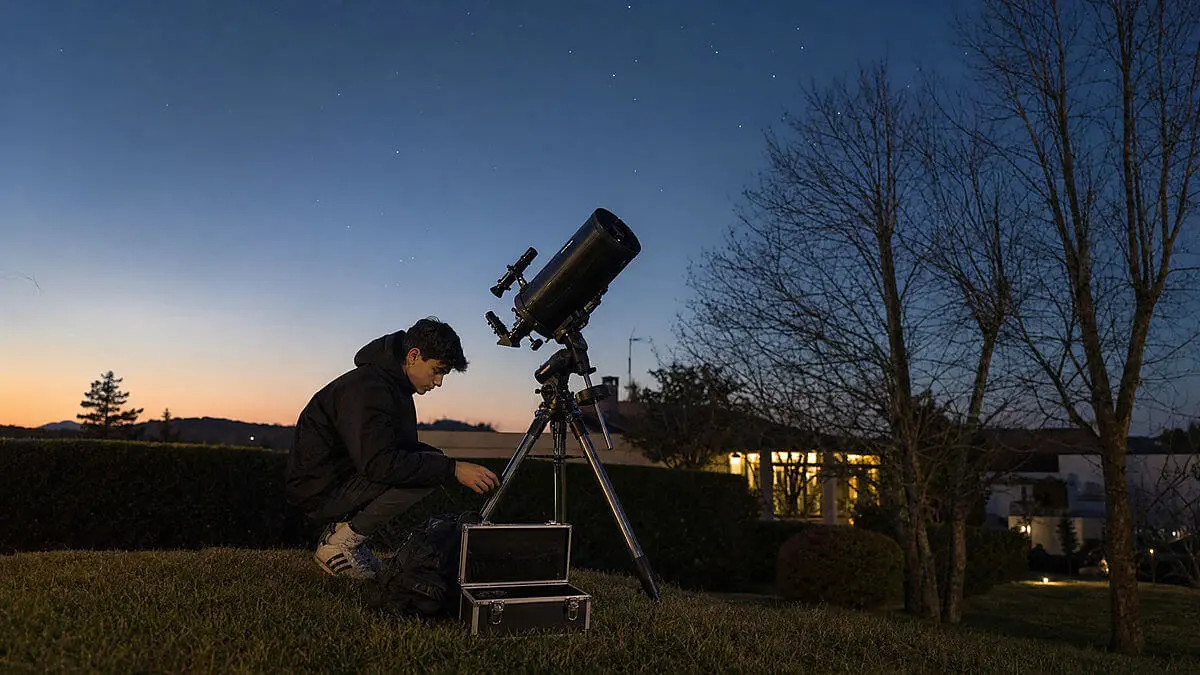
No, and it is worth insisting on this because it is the most common question. A body of one or two meters, hundreds of thousands of kilometers away and with a very weak apparent brightness, is practically unobservable outside of large professional instruments. It will not be seen with the naked eye or with amateur telescopes under ordinary conditions. Anyone hoping to go out to the balcony on Christmas Eve to look for a second bright point in the sky will find nothing.
That invisibility also explains why such objects are so rarely detected, and why their discovery depends on very sensitive tracking campaigns.
What the orbit confirms and what we still don’t know
There is a distinction here that makes the difference between reporting rigorously and exaggerating. Repeated observations and orbital calculations allow two things to be stated with considerable confidence: that 2026 QQ8 is a natural object and that it was temporarily bound to Earth. That is the main confirmation, and it is dynamic, not photographic.
That is not equivalent to knowing the object thoroughly. We do not have a close image, nor a direct measurement of its shape, nor an analysis of its composition, rotation period or specific origin. Even the size of one to two meters is an estimate: it is inferred from its brightness and assumptions about its reflectivity, not from a direct physical measurement. If the rock reflects more or less light than assumed, its actual diameter would vary accordingly. Confirming an orbit and characterizing a body are two very different levels of knowledge, and it is advisable not to confuse them when a discovery is translated into a headline.
A visit that will not be the last
These episodes of temporal capture are not exceptional rarities: they are part of the usual dynamics of the Sun-Earth environment. What is rare is detecting them, precisely because the objects involved are usually too small for current telescopes. When 2026 QQ8 escapes Earth’s influence, it will continue its orbit around the Sun as if it had barely changed course. Each new minimoon detected, like this one, helps estimate how many similar objects pass close to Earth each year without any telescope seeing them.