
For decades, comets have occupied a privileged place among scientific explanations for the origin of life on Earth. These icy bodies, which travel through the solar system carrying water, dust and organic compounds, seemed ideal candidates to have supplied some of the chemical ingredients necessary for our planet to become an inhabited world. However, new research raises a problem that could change this interpretation: the kites They were traveling too fast to deliver their valuable chemical cargo intact..
The work, published in the scientific journal Scientific Reports and led by Richard J. Anslow, a researcher at the University of Cambridge, has reconstructed through computer simulations the comet bombardment that the Earth experienced more than 4 billion years ago. Their results question a hypothesis defended for much of the 20th century and suggest that these space visitors may have had a much more limited participation in the processes that preceded the appearance of the first organisms.
The question is not whether comets carried organic molecules. Its presence is widely documented. The real obstacle appears when studying what happened when those bodies reached the Earth’s atmosphere and collided with the surface. The enormous speeds, extreme pressures and temperatures generated during the impact could destroy precisely the substances that, in theory, should contribute to the birth of life.
And there is another important detail. Even if some molecules managed to survive the crash, they still had to accumulate in sufficient concentrations and remain available for the time necessary to participate in the first complex chemical reactions. A combination of circumstances that, according to the new calculations, was extraordinarily unlikely.
100,000 simulations to reconstruct the first million years of the Earth
To study this scenario, the researchers combined models on the evolution of comets, their interaction with planetary atmospheres and the physical consequences of their impacts. They later carried out 100,000 simulations that reproduced different possibilities during the first hundreds of millions of years of our planet.
The analysis focused especially on hydrogen cyanide (HCN), a molecule containing carbon, hydrogen and nitrogen. Although it is known for its toxicity, it plays a prominent role in prebiotic chemistry, since it can intervene in processes capable of generating substances related to the fundamental components of organisms, including sugars, lipids and nucleotides.
Scientists chose this molecule for a specific reason: in addition to having been detected in numerous comets, it has a relatively strong chemical bond. If even such a substance had difficulty surviving a collision, other more complex organic molecules would likely encounter even greater obstacles.
The results were revealing. 54% of the simulations did not register any impact capable of depositing hydrogen cyanide in concentrations relevant to prebiotic chemistry on emerged lands. In the remaining 46%, at least one favorable episode appeared, although this does not mean that the subsequent conditions allowed the development of the processes necessary for the origin of life.
Furthermore, researchers found that opportunities decreased as Earth’s history progressed. The intense initial bombardment lost strength, while a good part of the primitive surface remained covered by water, further complicating the accumulation of chemical compounds in suitable places.
The problem did not end when the comet reached the surface
Surviving the impact was only the first obstacle. Comets that penetrated the atmosphere could fragment before reaching the ground, dispersing their components over large areas. Those that reached the surface at high speeds underwent transformations capable of destroying much of their organic content.
Even in the most favorable scenario, the survival of the molecules did not guarantee their use. If a comet fell into the ocean, the compounds were quickly diluted. And if it hit land, groundwater, precipitation, and terrain alterations could reduce its concentration in a matter of days or weeks.

This difficulty is fundamental because certain prebiotic chemistry experiments require relatively high concentrations of hydrogen cyanide. The authors used 10 millimoles per liter as a reference, a threshold that their simulations could hardly reach through cometary impacts in suitable terrestrial environments.
Therefore, the study does not prove that comets never contributed organic substances to our planet. What is questioned is its ability to effectively provide the concentrations of reactive molecules necessary for some of the chemical pathways proposed to explain the origin of life.
Mars appears as an unexpected candidate
One of the most interesting results of the research comes from the comparison between Earth, Mars and Venus. Researchers found that the Red Planet offered more favorable conditions for the arrival of comet-borne hydrogen cyanide.
The explanation is mainly related to impact velocities. Mars has a lower gravity than Earth and, in the models studied, comets could reach its surface with less destructive energy. Its atmosphere also represented a minor obstacle for many of these bodies.
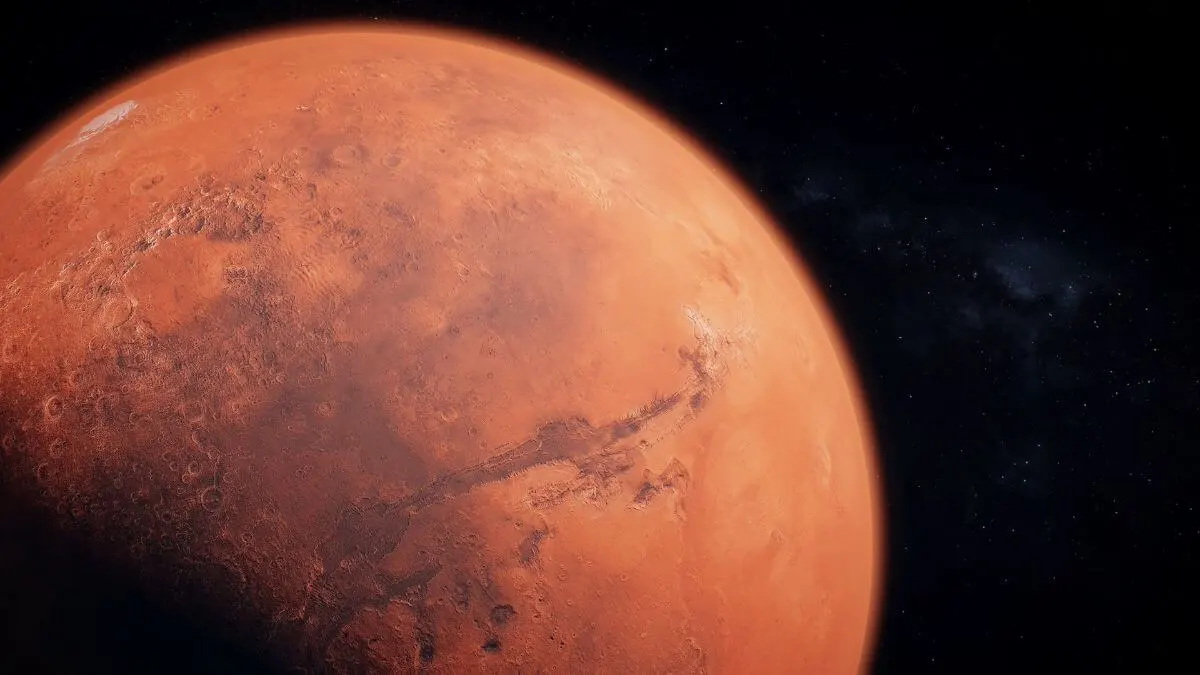
The simulations recorded an average of 744 potentially favorable impacts on Mars, compared to 87 on Earth and 24 on Venusbefore considering the availability of emerged land and other environmental requirements. Even when using a hypothetical higher-pressure Martian atmosphere, Mars maintained a considerable advantage.
However, this difference does not prove that life appeared first on Mars or that its ancient landscapes necessarily met the right conditions. The researchers themselves warn that surface water, the availability of other compounds and the environmental evolution of the planet are decisive factors that remain open to research.
The work also does not definitively solve the mystery of how terrestrial life began. Asteroids, capable of transporting organic substances, and the chemical processes developed on Earth itself continue to be relevant alternatives. The novelty is that an apparently simple explanation—the arrival of the ingredients of life aboard comets—has just encountered much more important physical obstacles than had been assumed.
References: Anslow, RJ, McDonald, C.H., Bonsor, A. et al. Cometary impacts an unlikely pathway towards the origins of life on Earth. Sci Rep 1631688 (2026). DOI: 10.1038/s41598-026-74214-y
Cover photo credits: Artistic recreation. Photo: ChatGPT-4o