
The fact that a couple of small pieces fit together does not yet prove that they can build a habitable base on the Moon. Between that laboratory prototype, made with a powder that imitates lunar soil, and a real work on the surface of the satellite there is a gap that should be looked at closely.
What exactly has been done (and what has not)
Researchers from the University of Arkansas described, in a study published in the journal npj Advanced Manufacturinga proof of concept: producing modular pieces that are assembled together from a material that reproduces the lunar soil. The work fabricated two centimeter-scale interconnectable geometries, intended to be joined together without additional joining material. Hence the comparison with toy blocks that fit together: describe their modular designnot a commercial off-the-shelf technology.
Here the first decisive nuance appears. The material was not dust collected on the Moon, but LHS-1, a terrestrial simulant designed to resemble the regolith of the lunar highlands. Regolith is the layer of dust and loose fragments that covers the surface of the satellite. And the tests were done in a laboratory on Earth, not in a vacuum or with the reduced gravity of the Moon. Therefore, the experiment demonstrates that small parts can be produced without added binders, not that a complete structure can be built and remain stable at its destination.
The method is additive manufacturing, what we usually call 3D printing. A laser travels through the powder layer by layer and sinters it, that is, it partially melts its particles with heat until they join together, without the need for liquid cement. The result is solid objects built by the accumulation of thin layers.
First challenge: fitting in is not the same as resisting
Modularity is the most attractive thing about the prototype, but it also opens up questions. To measure resistance, the team made cubes measuring one centimeter on each side and subjected them to compression. The study reports a maximum compressive strength of approximately 3.4 megapascals. This is a laboratory test, not a structural certification.
A number obtained on a tiny cube does not translate directly to a wall. In a real wall, joints, defects and uneven loads accumulate. The process itself, when building in layers, can leave porosity and produce delamination, the separation between layers, which creates weak planes. To this is added a fact that the work recognizes: the pieces showed differences in resistance depending on the direction of the load and joints that were not perfectly adjusted. The relevant question is not only whether the pieces fit together, but whether they retain that fit after thermal cycles, vibrations and impacts.. None of this is proven yet.
Second challenge: energy, the invisible bottleneck
The power of the laser used does not in itself indicate how much electricity would be needed to manufacture, for example, a ton of blocks. For this calculation, the total exposure time, the deposition speed, the pauses between layers, the preparation of the powder and the consumption of the auxiliary systems would be needed. The study does not establish energy consumption per block or kilogram of material, nor a production rate sufficient to build an infrastructure of useful size.
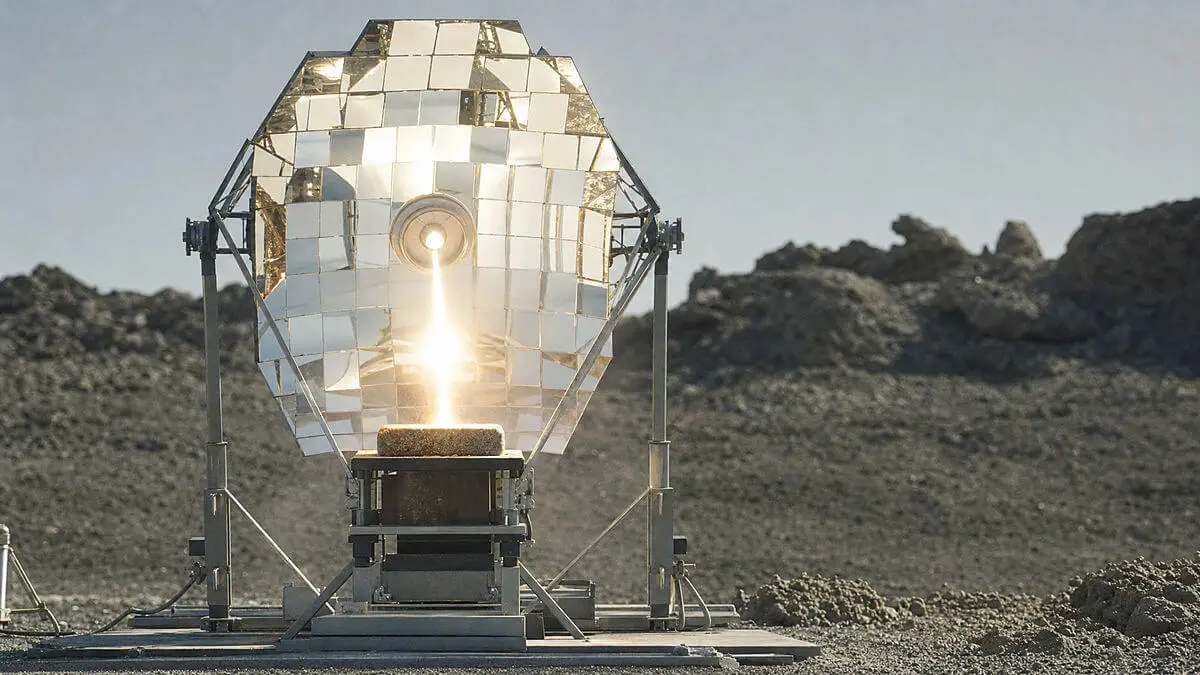
Furthermore, on the Moon, energy is not a free resource. It would have to be shared with communications, thermal control, mobility and life support. To size the problem of productivity a contrast is useful: the European Space Agency has explored another route, sintering with concentrated solar energy, to manufacture parts from lunar soil. It’s not the same process described in this study, but it illustrates why manufacturing pace matters as much as strength.
The sunshine It is proposed as a possible energy source, and it is a reasonable idea outside of Earth. Still, a one-time demonstration does not equate to an energy balance for a lunar manufacturing plant. The availability of light, storage during the long lunar night and the orientation of the equipment would be decisive factors that this work does not resolve.
Third challenge: manufacturing in lunar conditions
The jump from the laboratory to the lunar surface changes the engineering of the process. In a vacuum, the powder may behave differently when handled and spread between layers. Lunar gravity, around one-sixth of Earth’s, modifies how material is deposited and the stability of each layer. It would also be necessary to check how the block evacuates heat, how contamination by dust—extremely abrasive—is controlled, and whether the laser maintains its performance outside of an atmosphere. The study notes vacuum testing as pending work, explicitly acknowledging that its validity on the Moon is not yet established.
There remains one last link: the regolith real is not a perfectly normalized powder. The LHS-1 simulant allows the experiment to be controlled, but the lunar surface presents mineralogical variations, angular particles and differences between regions. The observed behavior would have to be repeated with representative samples and, finally, with authentic regolith, before any manufacturing recipe could be approved.
So are we close to building on the Moon?
The experiment provides something concrete and valuable: modular parts manufactured without binders from a lunar soil simulant, with a design that fits and a resistance measured in the laboratory. This does not mean that there is already a method to build habitats. To go from laboratory to work it would be necessary demonstrate that blocks withstand the loads and cycles of a complete structurequantify the energy and time required to manufacture them in quantity, and repeat the process in a vacuum, with lunar gravity and with authentic regolith.
The usefulness of using the lunar soil itself as construction material is evident: every kilogram that does not have to be launched from Earth makes any mission cheaper and simpler. That is why it is worth following the line of work without confusing the phases. Today we know that the pieces fit together. The open question, the one that will mark the coming years, is How much of that modularity survives when the lab moves to the Moon.
References: Cole McCallum, Youwen Liang, Nahid Tushar, Ben Xu, Bo Zhao, Hao Zeng, Wan Shou. Additive manufacturing of lunar regolith for reconfigurable building blocks toward lunar habitation. npj Advanced Manufacturing2026; DOI: 10.1038/s44334-026-00111-x