
The question sounds simple and has some game: if you had to choose, would you say that our species is more like the competitive chimpanzee or the tolerant bonobo? This dilemma between chimpanzees or bonobos hides, deep down, a broader question about human evolutionary kinship. Before answering, it is worth knowing that the question itself hides a trapand that comparative biology offers a less comfortable answer than it seems.
Two relatives, the same distance
The common chimpanzees (Pan troglodytes) and the bonobos (paniscus bread) are the closest living species to Homo sapiens. But there is one detail that is often misunderstood: neither of them is closer to us than the other. The human lineage split from both approximately 6 to 7 million years ago, before chimpanzees and bonobos split in turn, just over a million years ago. That is why we are, in evolutionary terms, at a very similar distance from both, which illustrates well the evolutionary distance between humans and primates that is so often surprising.
This dismantles a very repeated idea. It is sometimes said that bonobos, due to their more tolerant nature, would be “more human” or genetically closer. This is not the case: they are sister species to each other, and we are left out of that couple at a similar distance. Just because we find them nice does not bring them closer to our genome.
And what about 98.8% of DNA?
You will have read that we share near the 98.8% of DNA with the chimpanzee, a figure often cited as the percentage of shared human and chimpanzee DNA. It’s real, but it’s worth understanding what exactly it means. It comes from comparing individual bases in regions of the genome that can be reliably aligned. It is not equivalent to claiming that 98.8% of complete genomes are identical.
When insertions, deletions, duplications, and repetitive regions are included, the result changes. In fact, there is no single percentage applicable to the entire genome: one thing is the identity of alignable bases, which is how that 98.8% is usually calculated, and quite another is the comparison of the entire genome, which incorporates stretches that are difficult to align and structural variants. A 2024 study on the complete sequencing of the sex chromosomes of several great apes, signed by Makova et al., 2024, illustrates this well: the divergence between the human Depending on what you measure and how you measure it, the number dances. That’s why Any round figure should be taken as a useful approximation, not a closed measurement..
The error of converting two species into two morals
The popular image is familiar: aggressive chimpanzees versus peaceful bonobos. It serves as an informative starting point, but it oversimplifies the differences between chimpanzees and bonobos, two complex societies. Both species cooperate, form alliances, compete for resources, reconcile conflicts, and show aggression. What changes is not so much whether there is conflict, but rather who is involved in it, how it is organized and what mechanisms allow coexistence to be recovered.
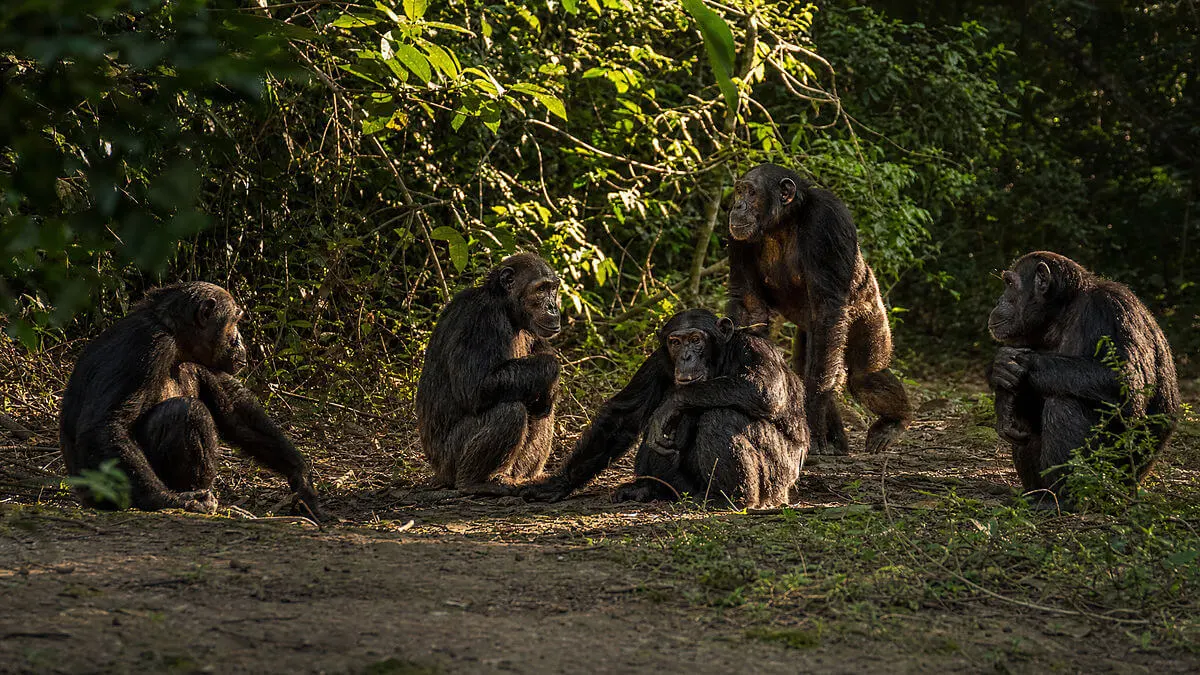
Chimpanzees, for example, are not a caricature of violence. In a study in the Taï forest, in the Ivory Coast, 791 conflicts between adults and 178 reconciliations were observed: after a fight, former rivals recovered their previous levels of interaction, especially when the relationship had cooperative value. Conflict and cooperation, in them, are not absolute opposites.
Bonobos, for their part, do not live in a society without tensions either. They also have hierarchies, competition and aggression. Their reputation for greater tolerance is related to a social organization in which adult females form relevant alliances and can limit the dominance of males. That does not mean that they lack conflict, but that they have different ways to contain or redistribute it.
Tolerance depends on context, not species
A classic experiment helps clarify the issue. When comparing 12 bonobos and 12 chimpanzees in a food cooperation task, the bonobos tolerated the presence of another individual better when the food was grouped and could be monopolized. But when food was dispersed and easy to share, the difference between the two species was reduced.
The reading is revealing: Social tolerance does not seem like a general superiority of a species, but rather a response that depends on the structure of the resource and the risk of conflict.. It is also worth remembering that these are small samples; They are concrete experimental evidence, not an exhaustive portrait of all populations. And a good part of the observed differences could also be due to ecology: different food, different predators, different group size and different contact between communities.
So what are we?
Here appears the trap of the original question. Ask “Are we more chimpanzees or more bonobos?” It turns two different species into two moral extremes and forces us to choose an identity. The evidence points in another direction: humans combine traits present in both. We cooperate intensely within our groups, we compete, we punish those who break the rules, we form alliances, we reconcile and, at times, we engage in organized violence.
We do not have a primarily “chimpanzee” or primarily “bonobo” nature. Evolutionary comparison shows a mixed and flexible repertoire, and does not allow human behavior to be reduced to a single model species.. This does not mean that the comparison is useless; It means that it should be used to ask us questions, not to fabricate a comfortable moral answer.

What we can learn for traffic jams or the office
It is worth bringing the issue to everyday life. Would we resolve traffic conflicts, misunderstandings at work or coexistence tensions like them? The temptation is to say “let’s imitate the bonobos.” But the strongest lesson is not to literally copy one species or the other, but to look at what mechanisms reduce the escalation of a conflict.
These mechanisms appear, in different forms, in both primates: tolerance for the distribution of resources, recognition of other people’s interests, cooperative alliances and reconciliation rituals that repair the relationship after a dispute. Both species also live in fission-fusion societies, where the large group is divided into changing subgroups; This forces us to remember relationships, negotiate alliances and adjust behavior to each situation. It doesn’t sound that different from managing a work team or the flow of a city.
Comparative biology can inspire valuable questions, but it does not by itself provide political or moral design. So perhaps the most honest question is not which of the two relatives defines us, but another: since we carry within us both the capacity to compete and to reconcile, which of the two do we decide to cultivate when conflict arises?