
If you prick your finger, something red comes out. If you pricked an octopus, a blue liquid would come out, known as blue blood, although in the strict sense it is hemolymph: the circulatory fluid of many invertebrates, which does not always travel encapsulated in cells or within a closed system like the blood of vertebrates. And at the bottom of the sea there are worms that bleed in violet or greenish tones. The color does not measure the quality of that blood: it reveals which molecule each lineage uses to trap oxygen. Human red is just one of the solutions that evolution found for the same problem, moving oxygen around the body, solved with different chemistries.
Iron is not the only metal that knows how to breathe
Our color starts in a protein with a metal atom at its heart. Hemoglobin carries iron, and when that iron captures oxygen in the lungs the whole takes on its intense red tone; When released into the tissues, the red darkens. It’s not that the iron “paints” itself, but rather the structure of the protein around the metal determines how it absorbs light and therefore what color we see.
That is the key that explains everything else. The color of a circulatory fluid depends on the molecule that interacts with oxygen, its chemical architecture, its concentration and whether it travels within cells or is released in the plasma. The colors of animal blood, in short, are the visible signature of that internal chemistry. There is no simple relationship between color and effectiveness. Understanding this principle, one of the most elegant corners of comparative biology, is what allows us to stop seeing red as the norm and start seeing it as an option among several. And the first alternative lives in the sea.
When copper stains the hemolymph blue
The octopus does not use iron. In many mollusks and arthropods, oxygen transport is carried out by hemocyanin, a respiratory protein that has copper in its active center instead of iron. When that copper binds to oxygen, the fluid turns a bright blue; when released, it is almost colorless. It is the same work that our hemoglobin does, with another metal and another visible result: the relationship between hemocyanin and copper explains, to a large extent, why we speak of blue blood in these animals.
There is a second nuance that changes the image. In us, hemoglobin travels packaged inside red blood cells. In many of these invertebrates, however, hemocyanin circulates dissolved directly in the plasma, without encapsulation. They are two different circulatory architectures, not two versions of the same plane. That is why octopus blue is not a close relative of human red dyed another color, but rather an independent solution to the same physiological challenge.
The comparison is useful if you think in engineering terms. Iron and copper are two configurations of hardware that solve the same task with performances adapted to each environment. But blue is still an oxygen carrier, just like red. The following case breaks even that rule.

The green that in us would be toxic
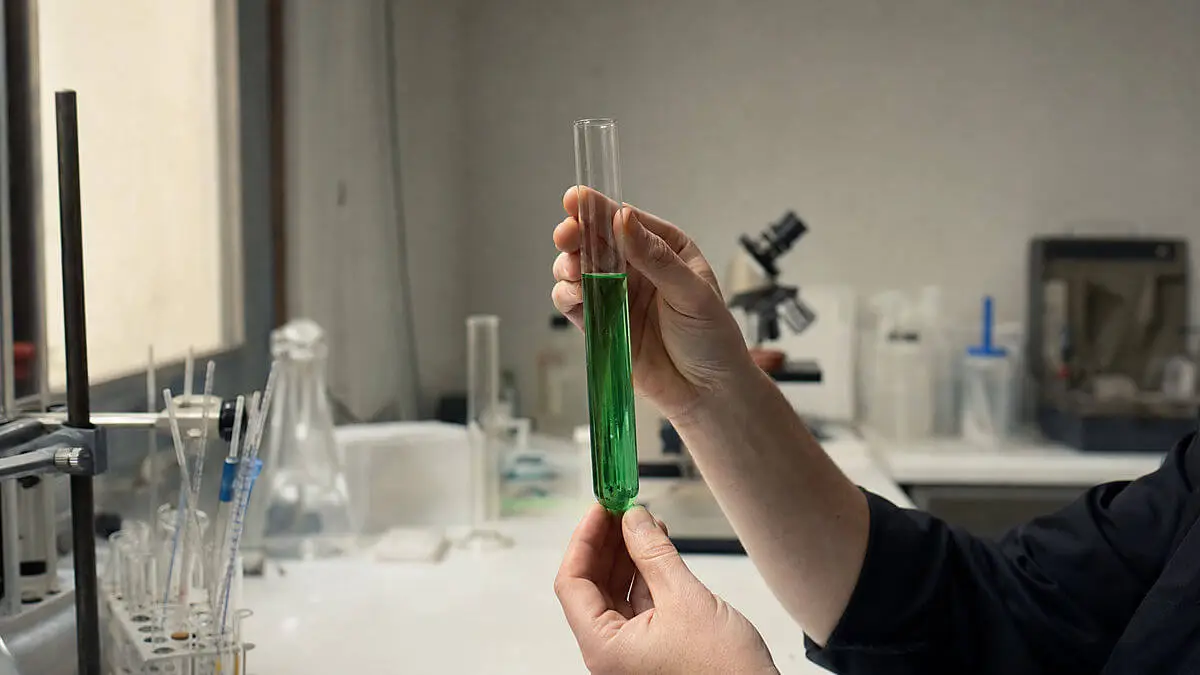
The green blood of certain New Guinea lizards does not work like the previous ones. The pigment that colors it, biliverdin, does not transport oxygen: it is a byproduct that is formed when hemoglobin breaks down. In most vertebrates, this residue is eliminated quickly, because in excess it is toxic and, in humans, would cause severe jaundice. In these lizards, however, it accumulates until it completely dominates the color of the plasma, bones and mucous membranes, an exceptional case of biliverdin in animals that is tolerated without apparent harm.
The figures explain why the case attracted attention. In three species studied, Christopher Austin’s team, from Louisiana State University, measured plasma concentrations of biliverdin of 714 ± 179, 1,020 ± 624 and 819 ± 89 micromoles per liter, levels that greatly multiply those that would trigger clinical alarms in a person. Evolutionary analysis of these reptiles further identified four lineages with green blood and supported that the trait could arise independently multiple times.
That repetition is the most revealing. That such an extreme character appears separately in different lineages points to convergent evolution, similar solutions that emerge without a common ancestor to impose them. If it were a simple accident, we wouldn’t expect to see it spring up again and again. Something, in these animals, makes accumulating a potentially harmful pigment compensates. What that something is remains unclear.
Roses and violets, the least known pigment
The catalog does not close with three colors. Some marine invertebrates, such as certain worms and brachiopods, use hemerythrin, another respiratory pigment distinct from hemoglobin, hemocyanin, and biliverdin. It contains iron, like ours, but its architecture is different, and when oxygenated it takes on tones that range from pink to violet depending on its state. When oxygen is lost, the color fades.
Hemerythrin serves as a reminder against simplification. The color of a fluid is not a three-box label, but a property that emerges from several layers, the chemistry of the pigment, its concentration, whether it travels bound to proteins and its degree of oxygenation. Observing this diversity in marine nature forces us to abandon the idea that red is the standard and the rest are curious exceptions. They are different responses to the same physical pressure.
The question that green blood leaves open
The contrast between the octopus and the lizard marks the frontier of current knowledge. Blue blood is well understood: a metal, copper, which fixes oxygen and stains the plasma as it does so. Green blood moves the question to another terrain. It is no longer just a question of why plasma looks green, but of how these reptiles withstand concentrations of biliverdin that in other vertebrates would be lethal, without apparent liver or neurological damage. There is still no complete mechanistic explanation for this tolerance, and as long as there is not, green will continue to be the color that physiology still does not fully know how to decipher.