
A huge cosmic force grabs the planet and begins to squeeze it. It doesn’t take away any of its matter: it just makes it smaller and smaller. The oceans, continents and the iron core are still there, but they occupy an ever-decreasing volume. What does physics say would happen at the end of that squeeze? The Earth would become a black hole. It is the thought experiment that physicists would summarize as “Earth black hole”, and it would be enough to reduce it to the size of a marble: a radius of just 8.87 millimeters, that is, a diameter of 1.77 cm.
It is worth clarifying before continuing: this is a thought experiment. We know of no force, no machine, no natural process capable of compressing the Earth to that extent. The interesting thing is not whether we could do it, but what the theory of general relativity predicts when the same amount of mass is concentrated in an increasingly smaller space.
The runway is at escape velocity
To understand what is happening, it is advisable to start with an everyday concept: escape velocity. It is the minimum speed that an object needs to move away definitively from a celestial body and not fall again. On the current Earth’s surface it is around 11.2 km/s. That’s why a rocket needs so much thrust to leave the planet.
That speed depends on two things: the mass of the body and the distance to its center. If we maintain the mass but reduce the size, the surface moves closer to the center and the gravity we feel there increases. The escape velocity rises with it. An Earth compressed to half its radius would be much more difficult to abandon. The more we push, the more that number grows.
Following this reasoning we reach a limit point. If the compression continues, the escape velocity would end up equaling 299,792 km/s, that is, the speed of light in a vacuum, which is the maximum speed limit in the cosmos. At that moment not even light would have enough speed to leave. We have built, at least on paper, a black hole.
Why intuition needs a correction
There is an important nuance here. The escape velocity calculation we just used is that of Newtonian physics, and is no longer a sufficient description when we approach the speed of light. It is not enough to extrapolate the classic formula. The correct tool is Einstein’s general relativity, which describes gravity not as a force, but as a curvature of space and time.
In this framework, the precise criterion has its own name: the Schwarzschild radius. It is the radius below which a given mass becomes so concentrated that it forms an event horizon, an invisible boundary from which no signal, not even light, can emerge. Escape velocity gives us intuition; The event horizon gives us the exact answer.
In other words: Newtonian intuition allows us to imagine a speed that increases without stopping, but general relativity replaces that idea with something more precise: we do not have to reach any limiting speed, but rather cross a geometric boundary, the event horizon, which marks the point of no return.
The curious thing is that this radius does not depend on the original size of the object, but only on its mass. Every mass in the universe has its own Schwarzschild radius, although in practice almost no body is even remotely compressed to that point.
The exact figures: 8.87 millimeters of radius
Let’s put numbers to Earth. Its mass is approximately 5.97 × 10²⁴ kg, and its current radius is about 6,371 km. If we calculate the Schwarzschild radius for that mass, the result is about 8.87 millimeters.
It is advisable to stop at this information because it is often miscounted. Those 8.87 mm are the radio: the distance from the center to the event horizon. They are not the total size of the object. The diameter, which is what we would perceive as its width, would be double: about 1.77 cm. Hence the comparison with a marble: when it is said that the Earth would fit in a marble, we are talking about that diameter of 1.77 cm, not the radius of 8.87 mm. The difference between radius and diameter seems minor, but it is essential to avoid the wrong scale when imagining the phenomenon.
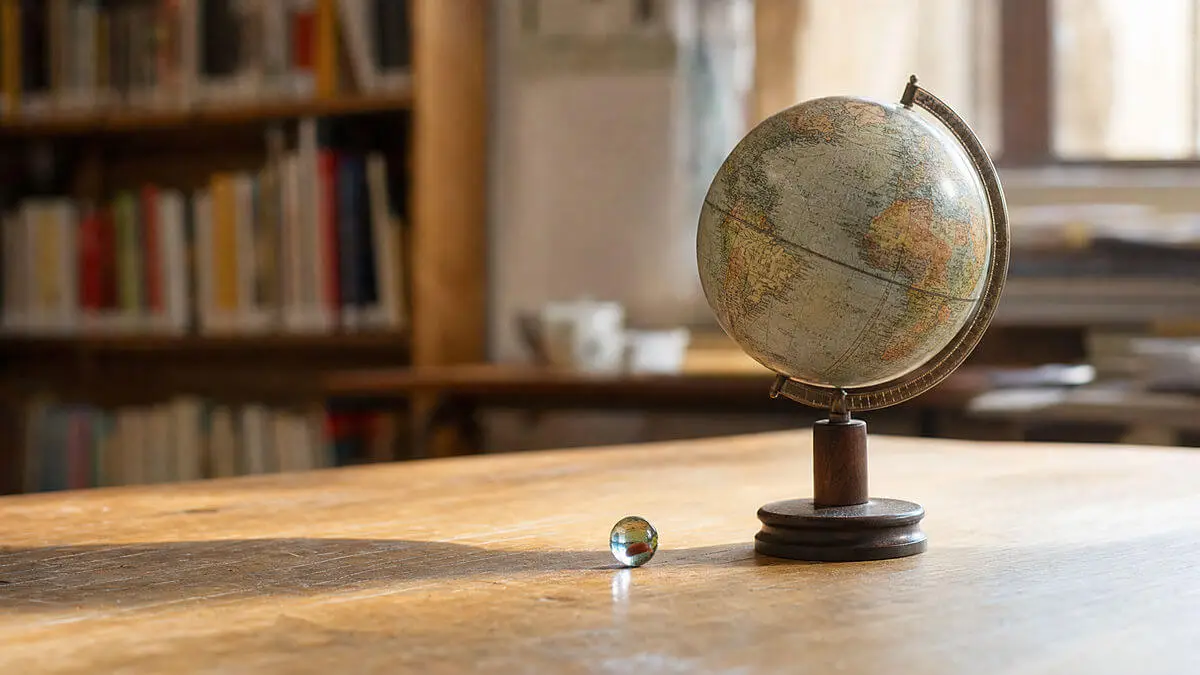
The magnitude of the squeeze is difficult to conceive. Earth’s Schwarzschild radius is about 720 million times smaller than the planet’s current radius. It’s like taking everything you step on, breathe, and see to the horizon, and confine it to something that would fit between two fingers. What would happen to the rocks, water and iron during such a brutal compression is beyond the physics that we handle daily: pressures, temperatures and states of matter that are impossible to reproduce would appear. The prediction of the final result, the black hole, is what general relativity does allow us to affirm.
The myth of the cosmic vacuum cleaner
At this point the obvious fear arises: if the Earth became a black hole, would it swallow the Sun, the Moon and everything in its path? The answer is no, and understanding it helps correct one of the most widespread misunderstandings about these objects.
A black hole is not a cosmic vacuum cleaner that sucks up everything around it. Gravity depends on mass and distance, not on whether or not there is an event horizon. If the Earth kept its mass exactly, its gravitational effect seen from afar would be practically identical to today’s. The Moon would continue orbiting almost the same, and the marble-Earth itself would continue to revolve around the Sun in an orbit very similar to the one it does now.
Where would the difference be then? Very close to the object. Without a solid surface to land on and with all the mass concentrated in millimeters, the gravity in the vicinity of the horizon would be extreme. But a distant body would only fall inward if it lost the energy or momentum that keeps it on its path. In other words: what was already orbiting safely would continue to orbit safely.
There is another idea that this thought experiment makes clear. We usually associate the expression “black hole” with a giant star that collapses at the end of its life. And it is true that this is how those we know in the universe are formed. But the concept is more general: any mass confined below its Schwarzschild radius would form an event horizon, even if it were the mass of a planet. The decisive thing is not the origin, but the concentration.
What an Earth the size of a marble teaches us
The answer to the headline’s question is, therefore, affirmative and precise: compressing the entire mass of the Earth within a radius of 8.87 mm – a diameter of 1.77 cm – would transform it into a black hole. A marble slightly larger than that figure would still have no event horizon; a somewhat smaller one, yes. The border is astonishingly sharp.
Beyond the mental game, the exercise illuminates three ideas that are often confused. That what turns a body into a black hole is not gaining mass, but concentrating it. That the Schwarzschild radius is just the radius, not the total size. And that the gravity of a black hole, seen from afar, is no more voracious than that of any other object of the same mass. The next time you hold a marble between your fingers, think about this: it would contain the same gravitational pull that keeps you glued to the planet today. Only, this time, not even the light could come out of it.