
The scene is repeated in millions of homes: The cat stands in front of its empty bowl, stares and lets out a meow. It seems like a clear order. But do we really know what he is telling us, or do we just think we know? Science has begun to answer, and the conclusion is more nuanced than any headline promising a feline translator suggests.
The idea that each meow has a fixed meaning—hunger, boredom, anger—is tempting, but the available studies do not support it. What they show is something else: the meow attracts attention and adjusts to the social context, although by itself it does not reveal what the animal needs. To understand it you need to read the entire situation, not just the sound.
They meow more when eating, but the nuance is in the look
A recent study, published in the journal Journal of Comparative Psychologyworked with 48 caregivers and his cats. The design compared the animal’s reaction when it could see and smell food out of reach versus when the same occurred with a toy during play.
The main result was only half predictable. The cats They meowed significantly more when the frustrated resource was food than when it was a toy. Furthermore, in the food condition they spent more time looking at their caregiver and more often looked at him or her just as they vocalized.
This combination—sound plus gaze directed at a person—is compatible with a signal directed at an interlocutor: the meow seems to be directed at someone capable of resolving the situation. Even so, it is advisable to stop here. That a behavior be compatible with intentional communication it does not demonstrate that the animal is formulating a request with a specific meaning, as a human word would do. The study documents what cats do when faced with relevant and frustrated motivation, not what they think they are saying.
When the game replaces meowing with another strategy
The design of the experiment itself provides a nuance that is often lost. He was not comparing a generic “hunger meow” with a “play meow”: he kept a visible and sniffable stimulus inaccessible. And there appeared a difference in repertoire. When the toy was out of reach, the cats more frequently resorted to physical contact behaviors with the object or the play environment; When faced with food, they vocalized and looked more at the caregiver.
This suggests that the cat does not repeat a single, identical demand for everything. Adjust your tactics to the type of resource and the motivation of the moment. An inaccessible toy invites you to try to reach it; an inaccessible food, to demand the intervention of whoever controls access. The meow is, in that sense, another tool within a flexible repertoire, not a button with a single function.
What we don’t hear: the test of the 225 listeners
If cats adjust their signals, are we people good at deciphering them? A work led by Emanuela Prato-Previde tested exactly that: she recruited 225 adults and asked them to listen to six isolated meows and associate them with one of three contexts: waiting for food, isolation or brushing.
The recordings came from domestic cats, with one acoustically typical meow and one atypical meow selected for each context. The result dismantles much of our confidence: overall, less than half of the participants correctly identified the context of the six sounds. The easiest to recognize was waiting for food, probably the most familiar situation for anyone who lives with a cat, although even there the success was limited.

There is an asymmetry here that is worth highlighting. People could perceive that a sound was negative or intense without being able to determine its cause: capturing the emotional tone is not equivalent to deciphering the context. And an important caveat about what this study measured: it tested the human ability to classify already recorded sounds from unfamiliar cats. It did not determine what each animal intended to communicate or whether the cats had meowed with the intention of conveying a specific category.
Why does a meow seem “urgent” to us?
In 2002, researcher Nicholas Nicastro analyzed 100 vocalizations from 12 domestic cats to study what acoustic features influence how we perceive a meow. Different groups of listeners rated, on the one hand, how pleasant each sound was and, on the other, its urgency.
Meows perceived as more urgent tended to be longer and concentrate more energy in the low frequencies. The analysis also related this sense of urgency to other acoustic measures of sound. But the approach itself marks the limit: the study measured the perception human urgency, not a literal meaning. It does not state that longer duration or lower frequencies mean “I need food” or “open the door.” Identify what makes a meow sound urgent to us, which is not the same as knowing what the cat wants.
Interlocutors who train each other
The three works, with different samples and objectives, converge on a common idea: context, motivational situation, listener experience and other body signals are necessary to interpret a meow. Isolated vocalization contains information, but it is not enough to confidently identify a specific need.
From there arises a more honest reading of coexistence. We are not the natural “technical service” for our cats, nor are they born with a dictionary that we can consult. Chances are we’ll both learn as we go. If a meow opens a door, advances a meal, or starts a game, that response can reinforce the repetition of the sound. This behavioral interpretation is plausible, although it should be said with caution: the studies cited did not directly measure a mutual training process over time, which would require longitudinal experiments.
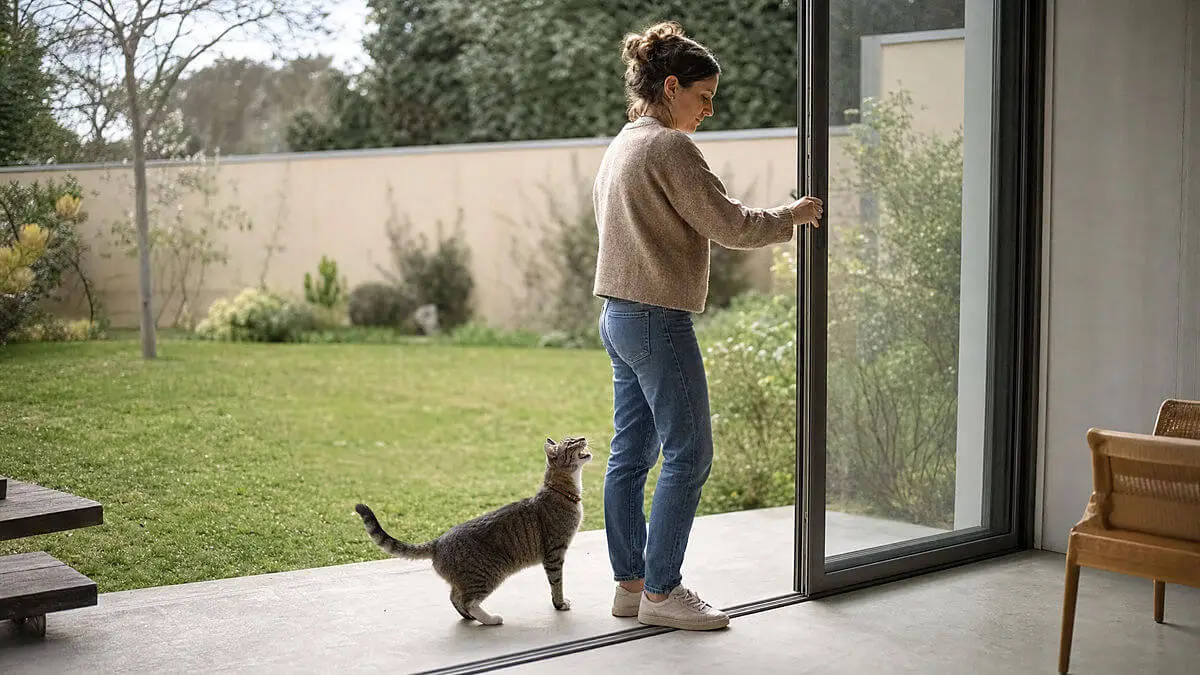
Nor does experience make anyone a universal translator. Coexistence can teach how to respond to the signals of a specific cat, but it does not guarantee a valid code for all felines. It is also worth remembering that none of these tests serve to rule out health problems: a new meow, persistent or accompanied by changes in appetite, mobility or routine justifies a veterinary consultation.
So, the next time your cat meows next to the bowl, perhaps it’s best to pay attention to what’s happening around him—where he’s looking, what he’s doing with his body, what he changed a while ago—rather than what word he said. The meow opens the conversation; the rest of the scene completes it. And a good part of that language, in the end, you have invented between the two of you.
References: Naila Fukimoto et al., The social use of meow in the interaction between cats and humans, Animal Behavior (2026). DOI: 10.1016/j.anbehav.2026.123756