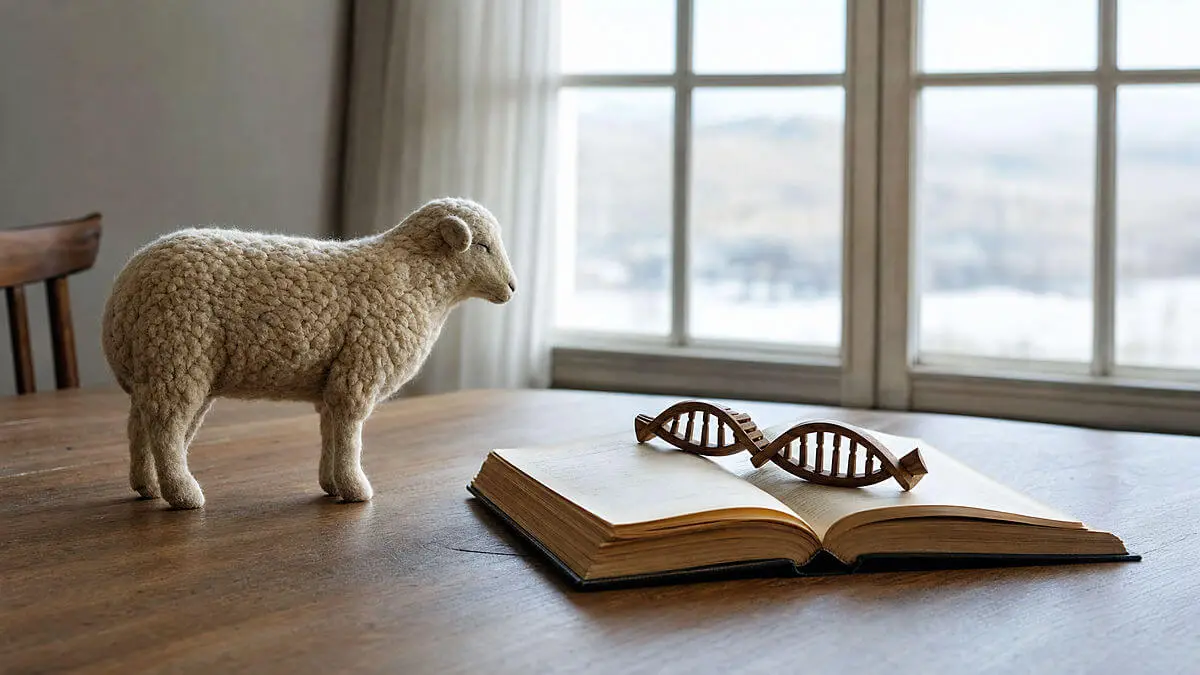
Dolly was born in 1996 as the first mammal cloned from an adult cell. Its DNA was, letter for letter, identical to that of the sheep that donated the cell. And yet, over time he developed problems that we did not expect in a “perfect” clone: overweight, osteoarthritis and signs of aging. If the instruction manual was the same, why was the result different? The answer forces us to look beyond our own DNA.
The alphabet was complete, but the spelling was missing
It is convenient to start with a distinction that is often confused. The genetics is the sequence of chemical letters (the bases A, T, C and G) that make up the genome. Imagine that it is a complete alphabet: all the letters are there, in the correct order. Dolly had that alphabet intact, copied from her mother’s cell.
But an alphabet is not a text. The same letters can form different words, sentences with or without meaning, depending on how they are ordered and stressed. That layer that gives meaning to the text is the epigenetics: the set of chemical marks that are deposited on the DNA and that decide which genes are read, which are silenced and with what intensity. Following the analogy, epigenetics would be the spelling, grammar, punctuation and even bolding that highlights a word. It doesn’t change the letters, but it changes the meaning.
These brands have names that are not very pleasant to the ear: DNA methylation (chemical groups that are added to certain areas and usually turn off the reading of a gene) and histone acetylation (modifications in the proteins around which the DNA is wound, which make it more or less accessible). They are not part of the sequence, but they regulate how it is expressed. They are, in essence, the spelling of the genome.
What we knew and what changed with Dolly
Before cloning, much of the focus was on the sequence: if you copied the DNA, you copied the individual. Dolly forced me to qualify that idea. To create it, the nuclear transfer technique, now widely documented, was used: the nucleus of an adult mammary gland cell was taken and introduced into an egg from which its own nucleus had been removed. The problem is that an adult cell is not a blank page: it has had its epigenetic marks in place for years, fine-tuned to do its specific job.
To make a new animal, those marks would have to be “erased” and rewritten from scratch, as happens naturally in reproduction. And there was the difficulty. The genetic sequence was transferred well, but the epigenetic reset was incomplete or imperfect. Dicho de otro modo: The alphabet traveled in its entirety, but the spelling arrived with errors. That difference helps understand why a clone with identical DNA is not necessarily a functionally identical copy.
Here it is advisable to be cautious. That epigenetics is a plausible explanation for some of the problems observed in cloning does not mean that each of Dolly’s specific ailments is proven to be a direct consequence of a specific epigenetic failure. It is an interpretation consistent with what we know, not a closed sentence. The osteoarthritis that he presented, for example, also appears in non-cloned sheep, and distinguishing what part is due to cloning and what part is due to chance or age is difficult with a single animal.
Why the same DNA can give different results
Dolly’s case is not a laboratory oddity: it illustrates a general principle. Two organisms with the same sequence can express their genes differently because they carry different epigenetic marks. The most common example is identical twins: they share practically all of their DNA and, even so, over the years they develop differences in health, weight or susceptibility to certain diseases. Part of these differences is attributed to how the environment, diet or the passage of time modify that layer of regulation.
Epigenetics also explains something that pure sequence does not: why all the cells in your body have the same DNA and yet a neuron is nothing like a liver cell. The difference is not in the letters, but in which parts of the text each cell reads. Epigenetic marks are what keep a neuron being a neuron and not something else.
Brands that are put on, taken off and sometimes inherited
One characteristic that makes epigenetics so interesting is that it is not fixed. Unlike the DNA sequence, which remains stable except for mutations, epigenetic marks can be added and removed throughout life. This makes them a bridge between the genome and the environment: what we eat, stress, exposure to certain factors or simple aging can leave their mark on this level of regulation.
This plasticity has a double face. On the one hand, it allows the body to adapt. On the other hand, it means that errors in the placement of these marks can have consequences. In the case of cloning, the technical challenge is precisely to achieve correct epigenetic reprogramming, so that the adult cell “forgets” its specialized past and once again behaves like a cell capable of generating a complete organism. When this process fails, alterations appear that DNA, by itself, does not predict.
Even so, it is advisable not to exaggerate. Epigenetics has become a widely cited term and is sometimes attributed powers that are not well established. It is one thing for these marks to regulate gene expression, something solidly accepted, and quite another to assert that any habit rewrites our biological destiny in a permanent and heritable way. Epigenetic inheritance between generations is an active field of research, with suggestive but still disputed findings.
What Dolly left us beyond the headline
Dolly died in 2003 and her legacy was not only to demonstrate that cloning an adult mammal was possible. His story helped popularize an idea that today underpins much of modern biology: The genome is not a destiny written in stone, but a text that needs to be readand that reading depends on a layer of regulation as important as the letters themselves.
Next time we talk about identical DNA, it’s worth remembering this sheep. He had the same alphabet as his mother, but the spelling was faulty. And in biology, as in writing, the same poorly accented letters can tell a different story. The question that Dolly left open lives on in the laboratories: how much of who we are is written in the letters and how much in how those letters are read?