
A transparent sheet, without a single pigment, is covered in green, violet and gold swirls that never stop moving. The question is not only why those colors appear, but to what extent they can reveal something that the eye does not see: how long that film is inside.
The color that is not in the soap
When you blow a bubble, its surface fills with bright bands that spin and move. It is tempting to imagine that the soap contains some dye, or that the sphere functions as a prism that decomposes light. Neither idea is correct. Soapy water is transparent and the colors are born from the light itself as it bounces off a sheet of just a few hundred nanometers.a thousand times finer than a hair.
The phenomenon is called thin-film interference, and the University of Colorado Boulder uses it as a classic optics demonstration. The key is that the film has two sides, one exterior and one interior, and the light interacts with both before reaching your eyes. Understanding this double rebound is understanding why the pomp seems painted without being so.
Two reflections that meet
Imagine a light wave reaching the surface of the bubble. A part is immediately reflected on the outer face and returns to you. Another part passes through the liquid, is reflected on the inner side and comes out again, but having traveled a somewhat longer path. The two waves overlap. Depending on how their crests and valleys are aligned, they are reinforced or nullified.
When two waves of the same color coincide in phase, they add their brightness, which physicists call constructive interference. When they are out of phase, they cancel each other, in destructive interference. White light contains all colors at once, with wavelengths ranging from approximately 400 nanometers for violet to 700 for red. At each point of the pomp, the thickness of the film decides which color is strengthened and which is dulled. That’s where bands are born.
There is a detail that refines the explanation. In a soap film surrounded by air, the reflection on the first surface undergoes a 180 degree rotation in its phase, while that of the second surface does not. This asymmetry is the reason for a counterintuitive fact: an extremely thin film does not shine, but rather looks black, because the visible reflections are almost completely canceled before reaching the observer. Transparency and darkness coexist in the same sheet.
Gravity draws moving stripes
If the colors depend on thickness, and the thickness changes, the colors have to move. And boy do they do it. From the moment you form the bubble, gravity begins to pull the liquid downward. The solution drains, the upper part becomes thinner and the lower part thickens. This continuous distribution moves the stripes as if they were contour lines on a topographic map that redraws itself.
Watching a bubble is, in a sense, watching a layer of water flow in slow motion. The bands of color are not decorations: they are the visible signature of a physical process that would otherwise remain hidden, the same type of reading of patterns that plays so much in the scientific dissemination of everyday physics. When a black area appears at the top, it usually indicates that the film there has become so thin that it is entering a limit regime, the usual prelude that the bubble is about to break.

Here the temptation arises. If each color corresponds to a thickness, wouldn’t it be enough to look at the bubble to measure it? The answer forces us to curb our enthusiasm.
Color is deceiving if context is missing
The problem is that a color is not a fixed thickness label. The interference condition also depends on the angle at which you look, because the light that enters at an angle travels a different path within the film. Turn your head slightly and the same area changes tone without its thickness having changed a single nanometer. Added to this are the refractive index of the liquid, close to 1.33 for water, and the specific way in which the bubble is illuminated.
Lighting is not a neutral detail. A work published in Journal of Applied Physics in 2023, signed by Navraj S. Lalli and Andrea Giusti, analyzed how the coherence of light, that is, the phase relationship between the source waves, modifies the interference colors observed in a soap film. In other words, the pattern you see depends not only on the pomp, but on how you illuminate it. Two different light sources can paint the same sheet with different colors.
That is why the eye, by itself, cannot translate a hue into a thickness figure. Too much information is missing. And yet, with the right team and model, that translation begins to be possible.
From pomp to optical rule
In 2025, a team formed by Marcello Carlà, Giuseppe Molesini and Samuele Straulino published in American Journal of Physics a method for estimating the thickness of a soap film from digital images. It is worth highlighting what it does and what it does not: it does not discover why colors appear, a mechanism known for more than a century, but rather it converts that iridescence into an approximate measurement.
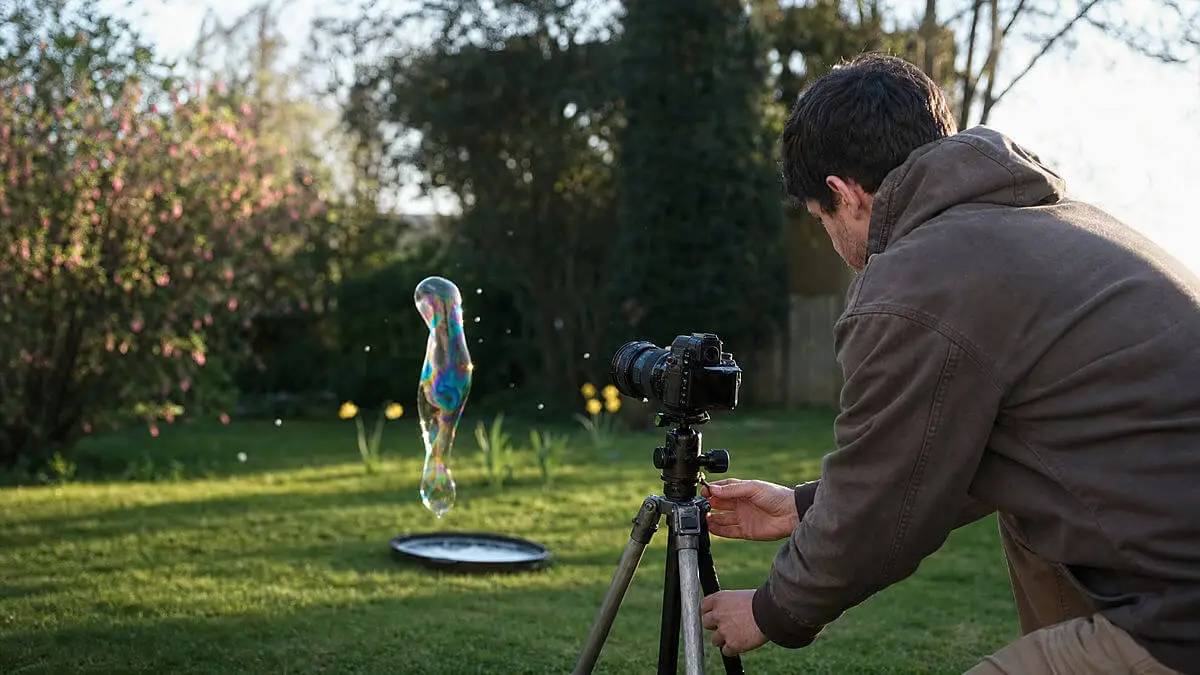
The procedure starts from a vertical film illuminated by a large source and photographed with a camera. The authors then separate each image into its color channels, red, green, and blue, locate the positions of the light and dark fringes, and relate those maxima and minima to the interference orders to reconstruct a thickness profile. All three channels provided consistent profiles, with an estimated accuracy of around 3% or better. within their experimental conditions.
The useful range they describe is approximately 100 to 2,000 nanometers. Below about 100 nanometers, their simplified model of an aqueous layer is no longer adequate, right where film noir territory begins. With images separated by about 15 seconds, They were able to follow how the sheet thinned over time, transforming a visual sequence into a measurable drainage curve.
What the pomp still doesn’t tell
Interference accounts for colors robustly, and imaging measurements show that those colors contain quantifiable information about thickness. But that information is only released when the illumination, angle, refractive index, and response of the sensor recording the scene are controlled. Color, by itself, is ambiguous: the same shade can correspond to different thicknesses depending on the order of interference in which it is found.
And the most elusive section remains. In the black band, where the film is thinner and the bubble is closer to bursting, the simple model of a layer of water falls short and visible reflections are extinguished. Reliably measuring this limit regime, which decides when the bubble breaks, requires leaving the color and looking for other optical signals. It is precisely there, on the border of what the eye can no longer distinguish, where the pomp still keeps an open question.