
A fossil bone from northeastern Brazil harbors cell-sized structures and chemical traces linked to what could be dinosaur blood. The question is not whether they have survived intact, but what really remains of them.
It’s not blood, but it’s not just any stain either.
Can something as fragile as a red blood cell leave a trace after 115 million years? The short answer is that what has appeared is not blood in the sense we imagine, but neither is it an irrelevant curiosity. An international team has detected structures compatible with mineralized red blood cells and chemical remains of heme in a Brazilian dinosaur bonealthough he has not recovered living cells, complete hemoglobin or DNA.
The work, published in Proceedings of the National Academy of Sciencesanalyzes bone remains of the extremities attributed to Aratasaurus museunationalione of Brazil’s dinosaur fossils from the northeast of the country, about 115 million years old. The original title of the study already marks the distance from any exaggerated headline: it talks about heme signatures in mineralized red blood cells, not preserved blood.
That difference, which may seem like a nuance, is actually the heart of the entire story. It is one thing for a tissue to freeze in time and quite another for its molecules to transform and become trapped in a mineral framework.
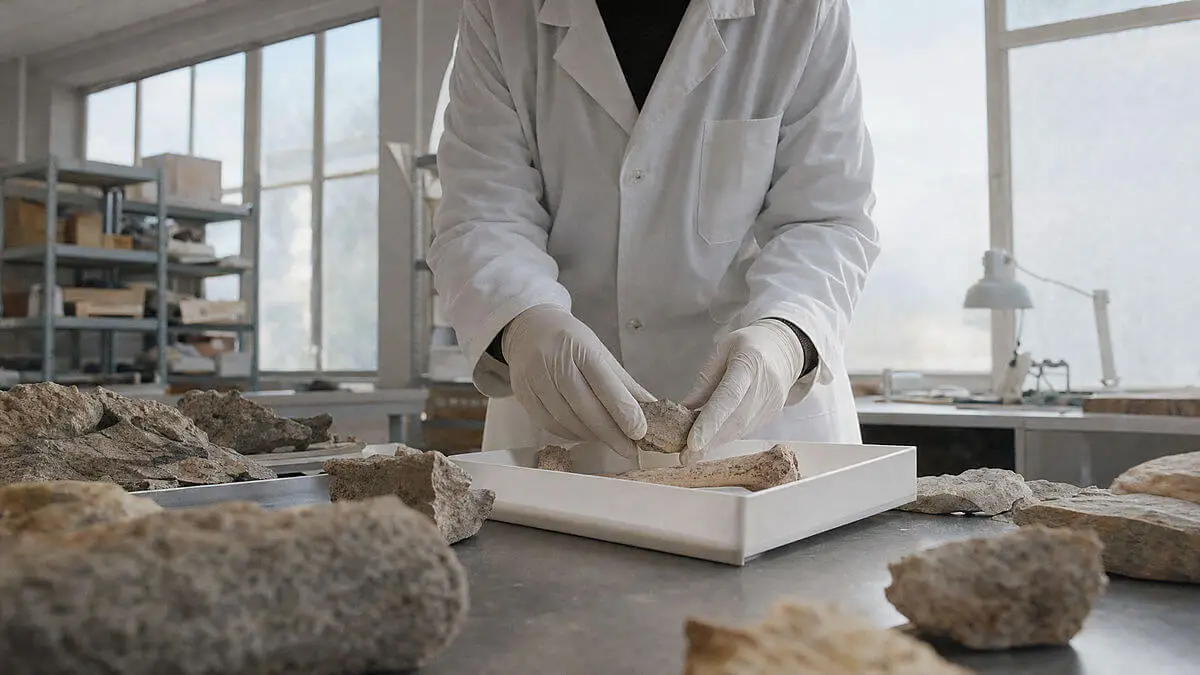
Image 1: Mineralized structures observed in a dinosaur fossil bone, interpreted by the research team as possible preserved red blood cells.
What is seen and what is measured, separately
The finding rests on two lines of evidence that should not be mixed. The first is morphological, that is, shape. Within the vascular channels of the bone, the conduits through which blood circulated in life, the team observed ellipsoidal structures of the size and silhouette that would be expected of a red blood cell. They appear right where one would expect to find remains related to circulation.
The second line is chemistry. Extracts from the bone reveal the presence of fossil heme B and altered forms of that same molecule. It is important to clarify the term, because that is where most misunderstandings are concentrated. Heme is the iron-containing component within hemoglobin, the protein that carries oxygen in the blood. Detecting heme is not equivalent to recovering hemoglobin, in the same way that finding a part does not mean having the entire machine.
The team combined three techniques to reach that conclusionand each one provides a different type of information. High-performance liquid chromatography coupled with mass spectrometry, or HPLC-MS, identified heme B and its derivatives in the bone extracts. Raman spectroscopy, which reads the chemical signature of a particular spot, detected signals from heme-related porphyrins within the ellipsoidal structures themselves. And transmission electron microscopy mapped iron, nitrogen and carbon in those same forms.
Taken alone, neither of those tests would prove much. An oval silhouette can be misleading, and a chemical signal in an extract doesn’t say where exactly that molecule was. What gives strength to the argument is that the three coincide in the same place.
The trick is in the matrix
How to distinguish an authentic dinosaur signal from the chemical noise of the environment? Here comes one of the finest decisions of the job. The team not only analyzed the bone, but also the rock surrounding it. And there he found something revealing: the sedimentary matrix presented signatures associated with chlorophyll and bacteriochlorophyll, that is, the chemical trace of plants and microbes, while heme B appeared linked to the bone.
This contrast is an argument in favor of the biological signal coming from the animal and not from environmental contamination. If everything came from outside, you would expect the same molecules inside and outside the fossil. It is not a definitive test, but it is a control that many previous studies did not include. In the study of molecular evolution in the fossil record, Knowing where a molecule comes from is as important as identifying it.
Even so, fossilization is a long and chemically aggressive process. The alteration of molecules over millions of years and the possible contribution of microbes remain factors that force any ancient organic signal to be interpreted with caution.
A manganese mineral as a possible template
If something so delicate came to us, what protected it? The answer proposed by the team has a name: hausmannite, a manganese mineral with the formula Mn₃O₄. Electron microscopy detected it associated with ellipsoidal structures, and the authors propose that it could have favored mineralization and the preservation of both the shapes and the chemical signals.
The idea is that manganese would have contributed to creating a kind of chemical mold around degraded organic matter, fixing its outline and part of its composition before it disappeared completely. It is a plausible and, above all, concrete mechanism, something that does not always accompany this type of findings.
It is advisable to underline the verb. The study proposes hausmannite as a conservation hypothesis, not as a definitively demonstrated process. The fact that the mineral appears next to the structures does not prove that it is the sole or sufficient cause of their survival. Confirming this causal role will require more fossils and more analysis.
The objections that keep the debate open
This is where the story stops being a headline and becomes a real scientific problem. The main caution has to do with the location of the heme. The techniques detect the molecule in the bone and signals of porphyrins in the structures, but specialists outside the work have pointed out that it has not been conclusively demonstrated that heme is specifically concentrated within these oval shapes. If it were distributed throughout the fabric, the argument would lose much of its force.
The second objection is anatomical. The shape and size of the structures differ from the red blood cells of modern birds and reptiles, the closest living relatives of dinosaurs. And there is an important biological detail: unlike mammals, birds and reptiles retain red blood cells with a nucleus. Therefore, identifying a dinosaur red blood cell should not be based only on an ellipsoidal silhouette, but on features compatible with a nucleated cell.
The environment doesn’t help either. Minerals can also form within a vascular channel or microbial remains with deceptive shapes can accumulate. Being in the right place does not automatically turn a structure into a cell. For those who are dedicated to scientific dissemination, separating what is observed from what is interpreted is precisely what distinguishes a solid finding from a well-told illusion.

Why does it matter even if there is no blood?
There is a point that is often lost in the media noise: this work does not bring dinosaur cloning one step closer. No liquid blood, no intact cells, no complete hemoglobin, and no usable DNA was recovered. DNA tests were negative, and the collagen-associated traces described in these contexts are amino acid residues, not an entire protein. The scene of Jurassic Park It’s still fiction.
And yet, the value of the finding does not depend on whether the cell identification survives scrutiny. The association between altered heme, iron, nitrogen, carbon and manganese minerals offers a window into a profound problem: how soft tissues degrade and mineralize over geological time. Understanding that process helps you know what to look for, where, and with what realistic expectations.
The real obstacle that comes now is twofold. First, confirm if these ellipsoidal structures are really cells and not mineral artifacts. And second, demonstrate that the heme is concentrated within them and not distributed throughout the bone. As long as those two questions remain open, The correct thing is to talk about possible mineralized red blood cells, and not about dinosaur blood.