
The possibility of bringing animals that disappeared thousands of years ago back to life is no longer a simple cinematic fantasy. Advances in genetics have made it possible to recover information from ancient DNA, modify cells of current species and even obtain animals with characteristics typical of creatures that ceased to exist long before our time. However, new research raises an uncomfortable question: Are we really resurrecting extinct species or creating animals that only look like them?
The debate has gained strength after the American company Colossal Biosciences announced the recovery of the giant wolf in 2025 (Aenocyon dirus), a predator that inhabited America during the Pleistocene and disappeared approximately 10,000 years ago. That news aroused enormous international expectation and seemed to anticipate a time when mammoths, dodos and other missing animals could return.
But not all scientists share that interpretation. Andrew Davinack and Charlotte K. Danielsresearchers at Wheaton College in Massachusetts, have published in the journal Biology Letters a scientific article that questions the biological foundations of these projects. Their conclusion is that reproducing certain characteristics of an extinct animal is not equivalent to recovering the original species.
And the explanation goes far beyond the difficulties in reconstructing their DNA.
The problem hidden in the resurrection of the giant wolf
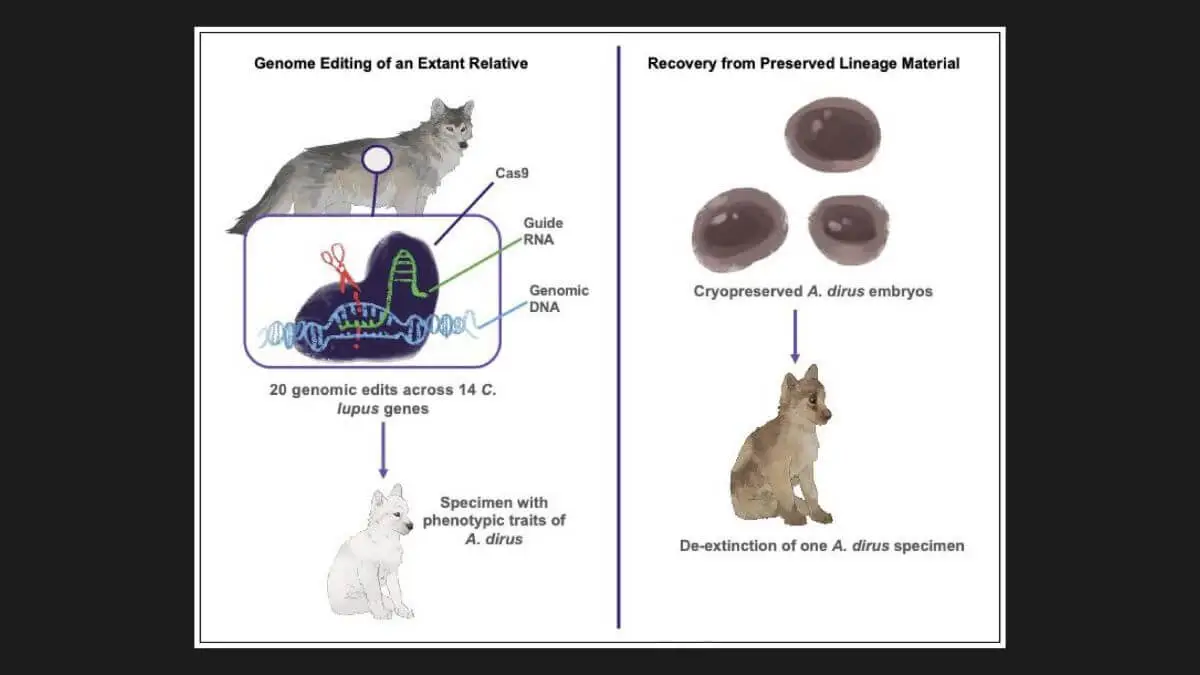
To understand this controversy, we must examine what really happened in the laboratories of Colossal Biosciences. The company did not recover live cells from a giant wolf nor was it able to fully reconstruct its genetic material. Their procedure consisted of comparing ancient DNA sequences with the genomes of current canids.
From that information, The researchers made 20 genetic modifications distributed in 14 genes of gray wolf cells (Canis lupus). Later, they used these modified cells to produce animals through cloning techniques and surrogate mothers.
The result was specimens with certain characteristics associated with the ancient predator. However, the procedure did not alter an essential fact: the animals came biologically from the gray wolf, a species whose evolutionary history is different.
In fact, Previous genetic research had established that giant wolf It belonged to a lineage that separated from the ancestors of today’s canids approximately 5.7 million years ago. This divergence is essential to understand why genetic modifications are not enough to recover a disappeared species.
The authors of the new work identify an important confusion here: consider that reconstructing certain components of the genome is equivalent to restoring the original evolutionary lineage. A species, they explain, cannot be defined solely by its appearance or a particular combination of genes.
Why copying DNA does not mean recovering a species
Let’s think about an animal population that has inhabited a territory for thousands of generations. Their individuals do not have exactly the same DNA. Each generation incorporates mutations, undergoes natural selection processes and transmits a different combination of genetic variants.
Added to this are migrations, geographical isolation, environmental changes and relationships with other populations. All these events build an evolutionary history that cannot be stored entirely in the genome of a single individual.
Here appears one of the central arguments of the study. Even if one day it were possible to reconstruct with extraordinary precision the complete DNA of a missing animal, much of the genetic diversity that characterized its species would still be missing.
Nor would it be possible to exactly reproduce the ecological conditions in which it evolved. A hypothetical giant wolf created today would encounter prey, competitors, diseases, and climatic conditions different from those that existed in Pleistocene America.
Therefore, obtaining an animal physically similar to an extinct one would not prove that its species has been recovered. In evolutionary terms, it would be necessary to distinguish between recreating biological characteristics and reestablishing the continuity of a historical population.
There is an exception that changes the debate
However, Davinack and Daniels introduce an important nuance. Not all techniques grouped under the concept of de-extinction present the same limitations.
Cloning from preserved cells of a disappeared animal poses a different situation. In that case, the resulting organism would retain a direct biological connection to the original population, although recovering all of its genetic diversity would continue to be extremely difficult.
Something similar would happen with a frozen embryo belonging to an extinct species. If it could be developed, we would not be facing an animal built through modifications of a different species, but rather an individual coming directly from the historical lineage.
There is even precedent related to this possibility. In 2003, a bucardo was born through cloning, the subspecies of Pyrenean ibex that disappeared in 2000. The animal died soon after, but the experiment showed that the preserved cells could maintain a biological link to an extinct population.
The researchers consider that these differences force each procedure to be evaluated separately. Creating an organism with ancient traits, recovering preserved biological material and restoring an evolutionary population are different objectives, although they are frequently presented under the same name.
The true usefulness of these technologies could be in the animals that still exist
The study does not question the scientific interest of genetic engineering. On the contrary, its authors recognize that these tools can contribute to understanding the relationship between genes and the physical characteristics of organisms.
They could also play an important role in conservation. The DNA recovered from historical specimens stored in museums makes it possible to identify genetic variants that some current species have lost as a result of the reduction in their populations.
In certain circumstances, these technologies could help recover part of this variability, reduce the problems derived from inbreeding and improve the adaptive capacity of threatened species. These are applications that still require specific evaluations, but offer a different perspective on the future of biotechnology.
The research, published in 2026, does not present new animals or laboratory experiments. This is a scientific analysis of the biological limits of de-extinction and how the results of these projects should be interpreted.
Its main contribution is to remember that extinction does not simply mean the disappearance of a certain DNA sequence. It also represents the end of an evolutionary trajectory built over thousands or millions of years. And that history, unlike some of your genetic traits, cannot be reconstructed by a few modifications in a laboratory.
References: Andrew Davinack et al., Reconstructing traits, not restoring lineages: the biological limits of de-extinction, Biology Letters (2026). DOI: 10.1098/rsbl.2026.0315