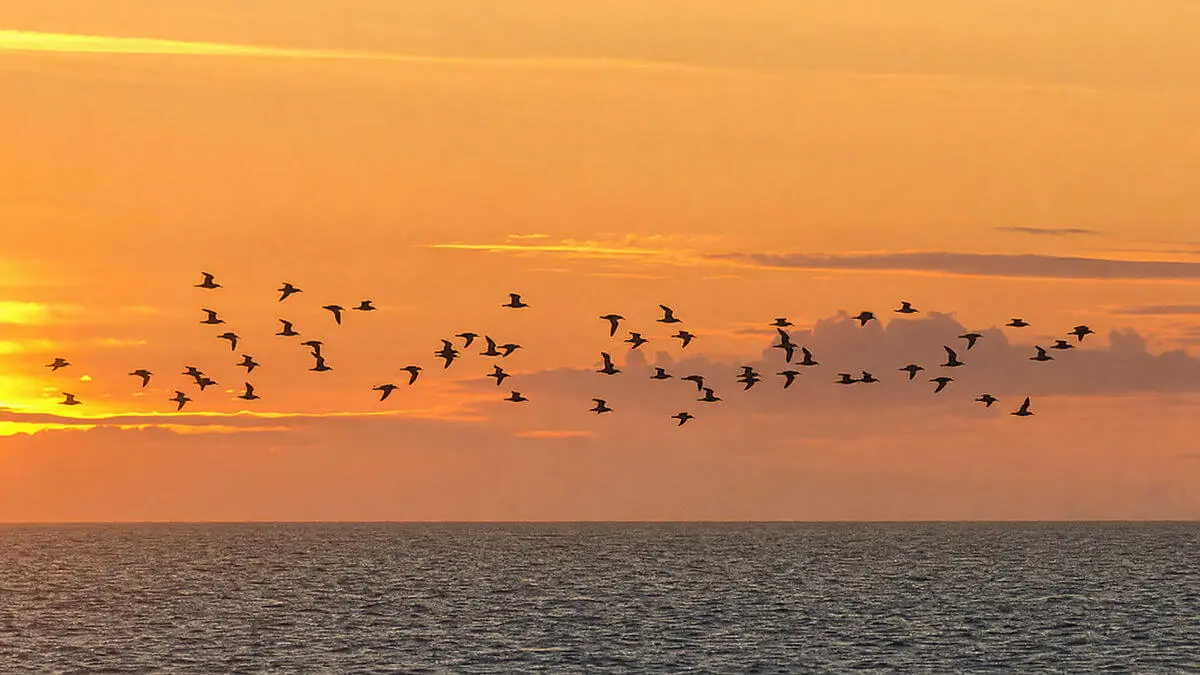
A bird crossing thousands of kilometers faces the same problem as a long-distance traveler: its internal clock does not always coincide with the time of the place it arrives at. The question is whether that is enough to talk about jet lag.
Is it possible for a bird to feel something similar to what a person experiences after a transoceanic flight? The short answer is that there is a measurable effect on your orientation, but it is not equivalent to the human symptoms we associate with jet lag. A recent analysis of shearwaters has detected that, when dawn comes earlier than their biological clock, these birds make small errors in direction. However, this imbalance does not show fatigue, drowsiness or sleep disorders, but rather a time lag that affects how they read the position of the Sun.
The Sun as a compass, the watch as a gauge
To understand the discovery, it is first necessary to understand how a bird flying over the ocean orients itself, without references in the water. Many species use a solar compass, that is, they deduce direction from the position of the Sun in the sky. The problem is that the Sun is not still: it moves throughout the day. A point of light 30 degrees above the horizon does not mean the same thing first thing in the morning as it does at noon.
This is where the internal clock comes in, the circadian rhythm, that mechanism that marks the passing of the hours in the body of almost any living being. For the solar compass to work, the animal needs to know what time it is. Only by combining the height and direction of the Sun with the internal time can you translate that image into a reliable heading. It is the same principle that we would use with a sundial: the shadow only indicates the time if we know how to correct it according to the time of year and the place.
The balance is broken when the internal clock and the sky stop matching. If a bird flies quickly to the east, dawn comes sooner than its body expects. The Sun appears in a position that your watch has not yet registered, and the compass reading becomes out of adjustment. It is exactly the situation that people experience when flying between time zones, although in the bird the visible effect is not sleep, but direction.
Two decades following the shearwaters
The evidence comes from work published at the end of October 2026 by a team that has put together a rare window into animal behavior in the open sea. The researchers analyzed 20 years of GPS data from 1,045 shearwaters, totaling 3,688 feeding trips between the sea and its breeding colonies.
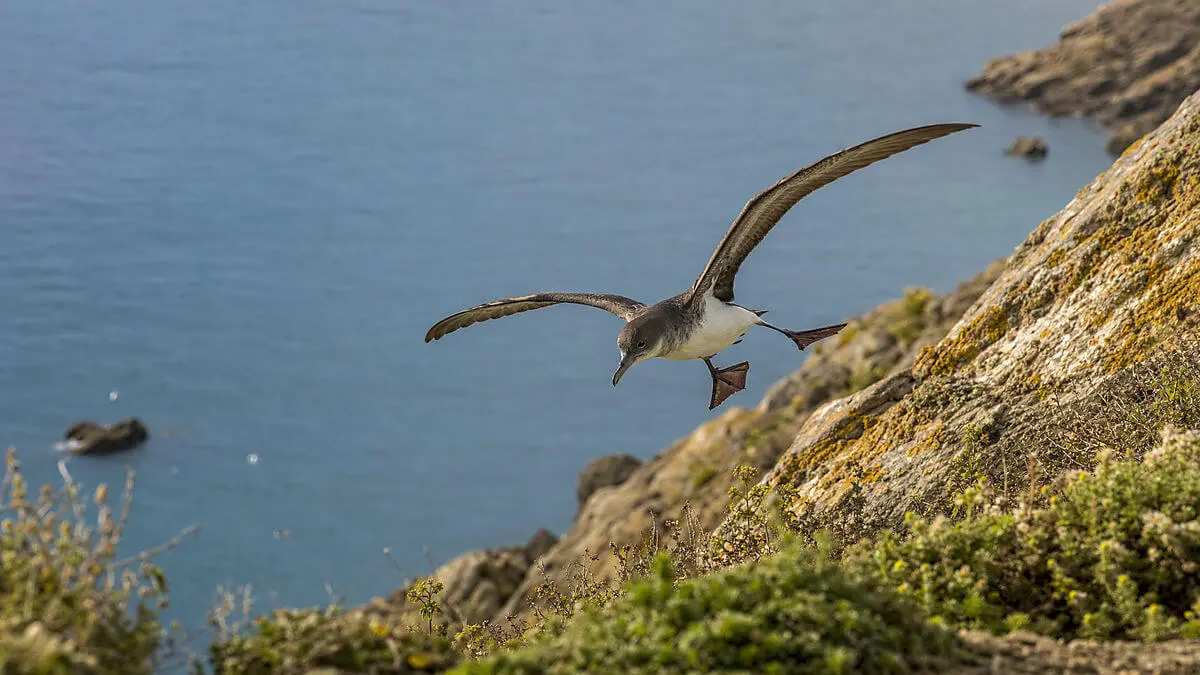
The Little Shearwater (Puffinus puffinus) is a seabird that travels long distances to search for food and then returns to land to tend to the nest. Those round trips, recorded over two decades, provided a catalog of routes large enough to search for a fine pattern in heading. The advantage of studying the biology of these birds in such detail is that it allows thousands of navigation decisions to be compared in very different conditions.
The interesting fact appears upon return. When these birds return to their colonies, they do so by flying towards the east. Due to the geometry of the trip, sunrise can come earlier than your internal clock, with delays that can reach up to an hour. That temporary gap, apparently small, is enough to leave a mark on the trajectory.
Fifteen degrees of difference
The analysis associated this gap with heading errors of up to about 15 degrees. In other words, the bird is not pointing exactly where it should, but deviates at an angle consistent with the idea that your sun compass is miscalibrated due to time lag. It is not a random error: it fits the direction and magnitude that would be expected if the internal clock lags behind the sky.
Here it is advisable to stop the interpretation. Fifteen degrees sounds like a lot on paper, but adult birds seem to correct this deviation and reach their colonies with little accumulated deviation at the end of the journey. The initial drift does not translate into getting lost. The bird adjusts on the fly, probably recalibrating its clock as the day progresses and the Sun rises, reducing the error as it approaches land.
That ability to correct is, perhaps, the most revealing. The imbalance exists and is measurable, but the navigation system has room to absorb it. The question stops being whether the birds get lost and becomes how they get back on track before the error matters.
A food trip is not a migration
At this point it is tempting to extend the conclusion to any bird that crosses a continent. It is advisable not to do so. The study did not analyze a seasonal migration between continents, but rather foraging trips: trips to the sea to search for prey and returns to the colony. They are long journeys, but they are not equivalent to the displacement of thousands of kilometers that a species makes when it changes hemispheres with the seasons.
The difference is not minor. In a migration between continents, other variables intervene, such as the duration of the trip, the pace of progress, the use of magnetic or stellar references and the time available for the internal clock to readjust. The work on shearwaters describes a plausible mechanism, but plausible does not mean proven for all migratory birds or in all contexts.
Nor is it convenient to translate the phenomenon into human experience without nuances. When we talk about jet lag In a person we think of drowsiness, fatigue and sleep disturbances. The study didn’t measure any of that. It does not prove that shearwaters get tired, sleep worse or feel unwell: it documents a lag between their clock and solar time, and its effect on orientation. They are two related things, but not identical. Much of the popular science on animals stumbles precisely in that leap, by giving other species sensations that we have only measured in our own.
What the clock still doesn’t count
Therefore, an interesting field remains open. If a lag of close to an hour is enough to divert the course of an adult shearwater, what happens to young specimens, which have not yet mastered their navigation system? And what about much longer trips, where the imbalance could accumulate instead of being corrected in one morning?
The finding fits with everything we knew about the sun compass and circadian rhythms, and provides a concrete measure of the problem in real conditions. However, it leaves unresolved whether other species pay a greater price for that same lag, or whether some have developed ways to recalibrate their clock faster than we imagine. The relationship between internal time and the ability to find your way remains a territory with more questions than answers.