
Almost three thousand kilometers deep, the center of our planet burns at temperatures comparable to the surface of the Sun. It has been doing so, with nuances, for about 4.5 billion years. How is it possible that it hasn’t been turned off?
The question hides a mistake. The Earth’s core does not retain its original temperature intact: It does cool, but it does so slowly that it still maintains thousands of degrees.. The apparent paradox dissolves as soon as we stop seeing the earth’s interior as a closed container and begin to see it as a balance between the heat it stores and the heat it manages to escape. And escaping, for the core, is not easy at all.
An ember wrapped in 2,900 kilometers of rock
Near the center of the Earth, the estimated temperature is approximately between 5,000 and 6,000 °C. It is worth highlighting the verb: it is estimated, not measured. Nobody has placed a thermometer down there. That figure is inferred by combining high-pressure experiments, known material properties, and models of the deep interior, so the range reflects real uncertainty, not a rounding whim.
The decisive thing is that that heat is not in contact with spacebut trapped under a formidable barrier. Before reaching the surface, the energy of the core must cross the boundary that separates it from the mantle and then make its way through some 2,900 kilometers of rock that conducts heat extremely slowly. The mantle works, on a planetary scale, like the insulation of a thermos: it does not prevent the contents from cooling, but it stretches that process over billions of years.
That is why the core temperature, by itself, does not explain anything. What governs the rate of cooling is the entire thermal architecture of the planet, and that’s where all that heat came from comes into play.
The heat that comes from the cradle
Much of the energy of the Earth’s interior is, literally, an inheritance. During the formation of the planet, about 4.5 billion years ago, the accumulation of material and the sinking of iron towards the center released enormous amounts of heat that were stored in the depths. Added to this remaining heat is that provided by the disintegration of radioactive elements distributed throughout the interior.
The figure that is usually cited for this balance is striking and should be read carefully. The Earth loses about 44 to 47 terawatts of internal heat to space, a power equivalent to tens of thousands of large power plants running non-stop. But that number corresponds to the total thermal flux measured at the surface and mixes contributions from the mantle, the core and radioactivity. It is not the heat that comes out of the core.
The flow that actually leaves the core towards the mantle is much smaller and much more uncertain. Common estimates put it at around 15 terawatts, although the reasonable range is approximately 5 to 17 terawatts. Such a wide range is not carelessness, but rather the reflection that we are reconstructing with models what happens in an inaccessible place. And to tune it you have to look at a process that, paradoxically, heats while it cools.
When freezing releases energy
The Earth has two nested cores: an outer, liquid core and an inner, solid core. This distinction completely changes the story, because The age of the planet is not equivalent to the age of the inner core. The iron in the center was not always solid. As the whole cooled, the temperature dropped below the metal’s solidification point at the colossal pressures of the center, and the inner core began to crystallize long after the planet was born.
This process has a double and almost counterintuitive effect. When solidified, iron releases latent heat, the energy associated with the change of state from liquid to solid, and expels lighter elements towards the outer core. These light elements float and stir the molten metal, fueling the convection that sustains the Earth’s magnetic field, the geodynamo that protects us from the solar wind. It is comparable to adding both energy and buoyancy to a moving fluid.
Here is the nuance that undoes the misunderstanding. That released energy does not stop the cooling: it only slows it down. The core continues to lose more heat than these processes contribute, so progressive freezing is not a new source, but rather a way of gradually returning part of the accumulated heat. Understanding this fine accounting is an area where scientific dissemination crosses the limits of what is measurable, because each term of the balance sheet depends on properties that we have only just begun to quantify.
Measure the invisible with a metal tablet
How then is the rate of this cooling fine-tuned? One of the keys is the thermal conductivity of the core, that is, the ease with which heat travels through the metal. The better you drive, the faster the energy is evacuated and the sooner the inner core begins to freeze.
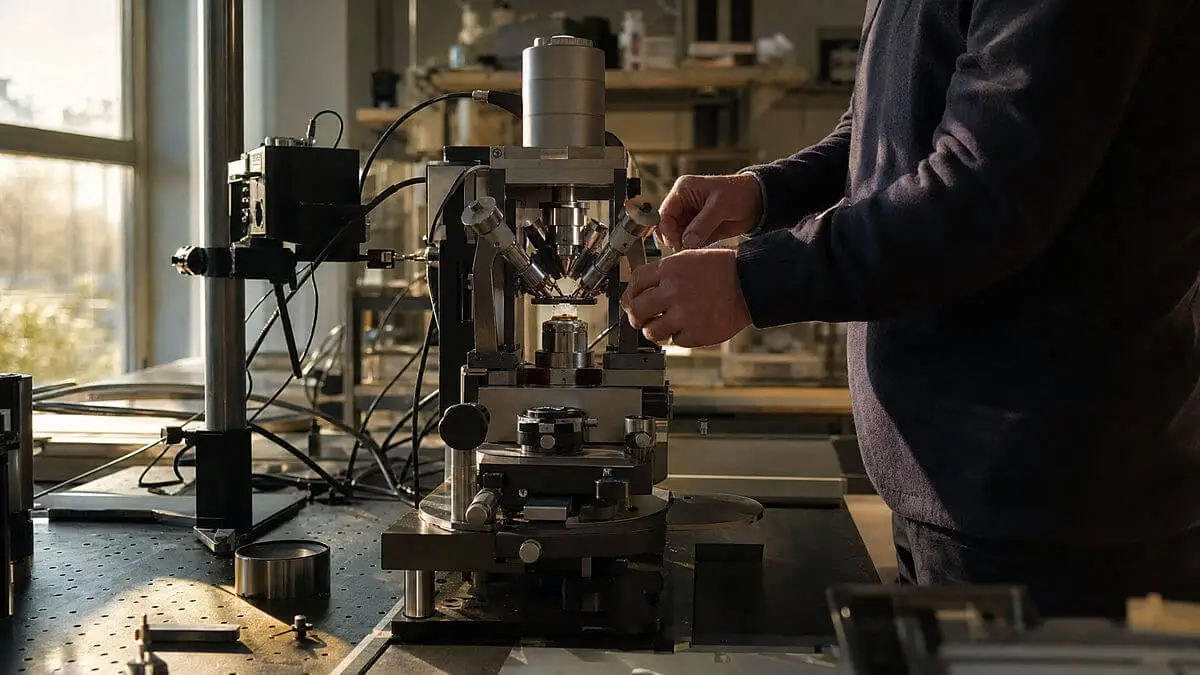
Wen-Pin Hsieh’s team addressed precisely that parameter in a work published in 2025. Instead of pure iron, they measured an alloy of iron, nickel and silicon closer to the actual composition of the core, subjecting it to pressures of up to 148 gigapascals and temperatures of 2,950 kelvin, conditions that recreate the environment of the upper part of the core in the laboratory.
For this solid alloy they obtained a thermal conductivity of 86 ± 13 watts per meter and kelvin. Extrapolating to the liquid material in the outer core, they estimated 73 ± 11 watts per meter and kelvin, assuming that the conductivity drops by about 15% upon melting. This second value is not a direct measurement of the liquid, but rather an inference, and this is what the authors themselves state.
The result is a moderate conductivity, neither too high nor too low, which has concrete consequences on the thermal history of the planet.
An inner core younger than it looks
Within the study’s thermal evolution model, this conductivity implies an adiabatic heat flux of approximately 11 ± 1.6 terawatts and a maximum age for the inner core of between 0.8 and 1.3 billion years. In other words: Earth’s solid core could be considerably younger than the planet itself.
Caution is essential. That age has not been observed, it has been calculated within a model that depends on hypotheses about the composition of the core and the behavior of the liquid metal at extreme pressures. The work reduces one source of uncertainty, the conductivity of a representative alloy, but does not turn the inference into a closed figure. It is still a ceiling, a “at most”, not a date of birth.
And that age matters beyond geology. If the inner core began to crystallize relatively recently, the energy released by its growth would have come into play late in the history of the magnetic field, forcing the question how the geodynamo was sustained before, when the core was still completely liquid. It is one of the open questions where geophysics looks at its own methodological evolution.
What the mantle decides for the core
Core cooling doesn’t just depend on the core. The bottleneck is in the mantle, which regulates how much heat can escape through its base. That is why the last frontier of this story is played at the limit between the core and the mantle, the most difficult point to reconstruct in the entire Earth’s interior.
A work published in 2026, signed by Jiaxin Zhang’s team, modeled the mantle circulation in three dimensions during the last 1.8 billion years. Their simulations indicate that, by incorporating the progressive cooling of the mantle, the heat flow calculated at that limit drops by more than 30% compared to the scenarios that keep internal heating constant. In parallel, the mantle plumes cool at an average rate of close to 110 °C per 1,000 million years, according to these same models.
It is worth remembering that these are simulation results, not readings taken at a depth of 2,900 kilometers. Reconstructing the flow of the core-mantle boundary requires chaining together hypotheses about deep convection, the structure of the mantle, and the properties of materials that no one has touched.
So the question in the video changes form. It’s not why the core is still hot, but how exactly it cooled and when its center began to solidify. And there, between an age range that goes from 0.8 to 1.3 billion years and a heat flow that ranges between 5 and 17 terawatts, the margin is still too wide to consider the thermal history of our planet closed.