
Imagine an engine that fits in one corner of your city, but whose smoke travels throughout the country and continues to advance far beyond the border. Something similar occurs in the center of certain galaxies: a compact central region drives black hole jets, flows of matter that extend beyond the galaxy that hosts them. Does that mean the black hole has grown to that colossal size? No. And understanding why is the key to this whole story.
The paradox of scales: from the compact “center” to the giant jet
In a popularization conference, an astronomer put it this way: these jets can reach 500,000 light years extension, but they come from the black hole located in the center of the galaxy, in a region of less than 30 light years. In other words: a very small central area, in cosmic terms, is capable of emitting energy that is projected much further than the entire galaxy where it resides.
It is worth clarifying something from the beginning. Those “hundreds of thousands of light years” describe how far the ejected material goes, not the physical size of the black hole. The figures come from that informative explanation; With the available material it is not possible to attribute them to a specific astronomical object, so we will treat them as an illustration of scales, not the technical sheet of an identified system.
“A black hole that is so small in the center of the galaxy is capable of emitting light that goes much further.”
Artist’s representation of relativistic jets ejected from the vicinity of a supermassive black hole.
First, what is (and what is not) a black hole
A black hole is a region of space-time where gravity is so intense that, starting from a boundary called event horizonnothing can escape, not even light. That definition explains why it is difficult to “see” one directly.
But here is the most common misunderstanding: jets No They come out from within the event horizon. They originate in its vicinity, in the environment where gas, plasma and magnetic fields accumulate. The black hole acts as an invisible engine; What we detect is the frenetic activity of what surrounds it. That is why an object that barely emits its own light can be revealed by the energy spectacle it unleashes around it.
Part of this ability to “focus” the jet comes precisely from the magnetic fields of a black hole, which wrap around the rotating accretion disk. The combination of intense field lines and the spin of the system acts as a kind of natural nozzle: the magnetic field channels the charged particles along the axis of rotation, preventing them from dispersing, while the energy of the spin helps accelerate them to speeds close to that of light.
The accretion disk: where gravity turns into radiation
Around many supermassive black holes revolves a accretion disk: gas that spirals down, is compressed and heated to extreme temperatures. This process transforms part of the gravitational energy into radiation. In simple terms: the gas, rubbing and compressing as it approaches, becomes so hot that it glows with enormous intensity.
That light is decisive for astronomy. Although the black hole itself is not observable, its disk can become a recognizable signature. When we see extraordinarily hot gas spinning and emitting radiation in the core of a galaxy, we have a strong hint that something very massive and compact is powering it. The brightness of the environment replaces, in practice, an impossible image of the central object.
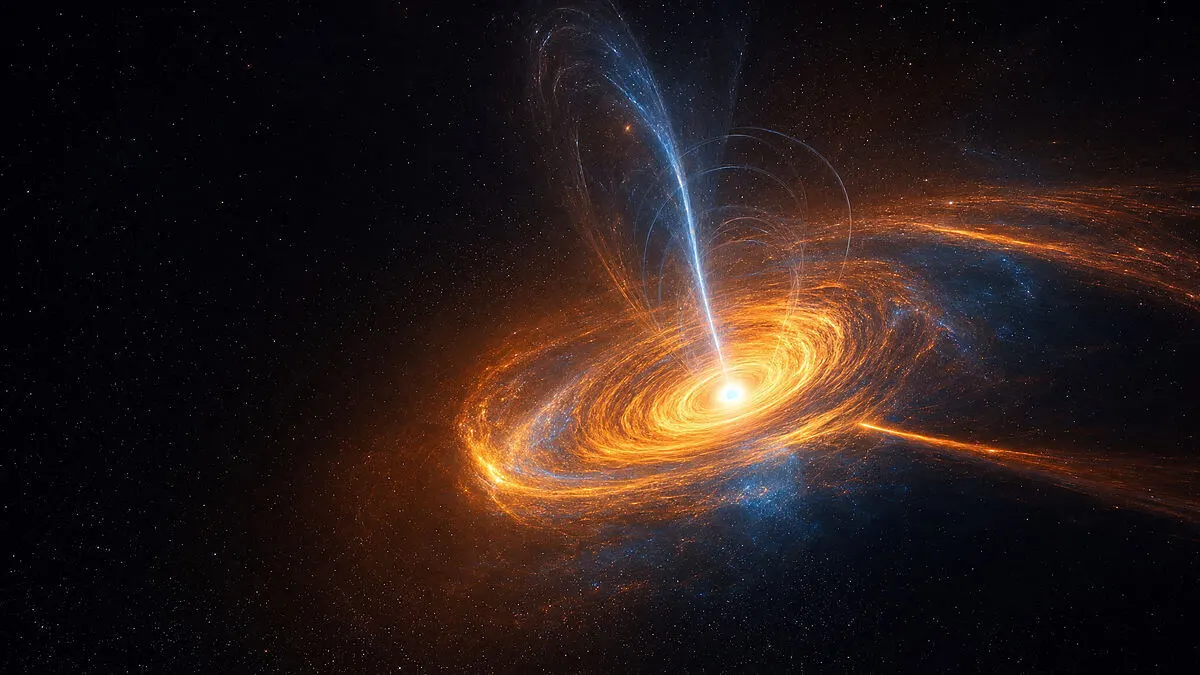
Accretion disk rotating around a supermassive black hole, the engine that powers the black hole jets observed in radio.
Black hole jets: why they go so far without the engine “growing”
Jets are flows of particles and magnetic fields launched, in a collimated manner, from the region close to the black hole. “Collimated” means that the energy is not dispersed in all directions, but is concentrated into two narrow, oriented beams. And therein lies the answer to the initial paradox.
An analogy helps, as long as we remember its limits: think of a mouthpiece. It can be small and still project a jet that travels an enormous distance. The range of the beam does not depend on the diameter of the nozzle, but on the energy injected, how well it stays focused, and how long it continues to operate. The analogy fails if we take it too far—there is no water or domestic pressure here, but relativistic plasma and magnetic fields—but it captures the essential point: a compact engine can support a gigantic structure.
That is why the extension of a jet is not equivalent to the size of the galaxy, much less the size of the black hole. It is, simply, the distance that the material has traveled since it was expelled. And that distance can easily exceed the diameter of the host galaxy.
Radio and light: the same phenomenon seen at different frequencies
The particles accelerated in these jets emit radio waves, making radio astronomy a privileged tool. Its great advantage is that the radio emission can continue to be detectable even if the visible light signal is weak or hidden. Observing a jet in radio, therefore, makes it possible to trace the trace of an active nucleus over enormous distances.
But here there is an important nuance. Detecting a jet shows that there is energetic activity associated with the nucleus; It is not enough, by itself, to measure the size of the event horizon or to accurately determine the mass of the black hole. They are different questions, requiring different observations and models. Seeing smoke confirms that there is fire; It does not measure the exact temperature of the boiler.
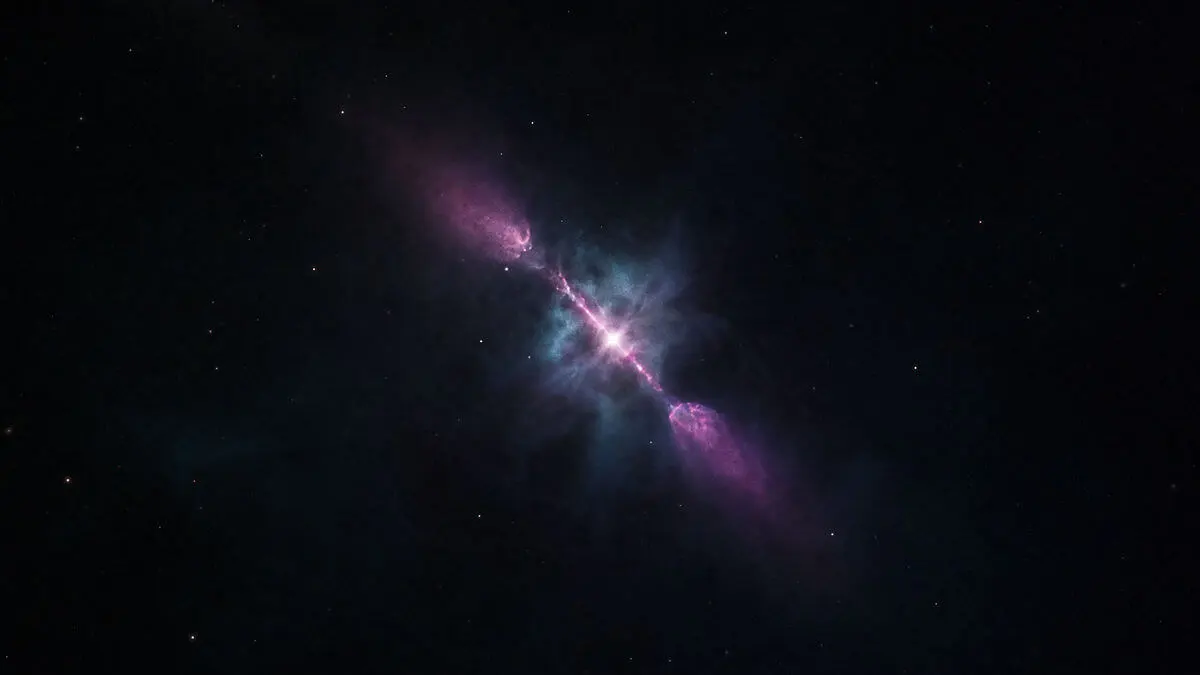
Archive image of an active galactic nucleus, whose radio emission reveals the presence of black hole jets on a cosmic scale.
Detecting black holes in the early universe: Webb and the chain of inferences
The same logic—detecting the environment to reveal the engine—is what allows us to search for black holes when the universe was very young. The James Webb Space Telescope has pushed that frontier by observing extraordinarily distant and, therefore, ancient galaxies, because looking far into space is equivalent to looking back in time.
A popular explanation suggests that black holes have been detected when the universe was about 280 million years. In any case, this data describes the era to which what was observed corresponds; it is not an automatic guarantee that a direct measurement of the black hole as an individual object has been confirmed.
The lesson is clear: detecting a very old galaxy, identifying an active nucleus and confirming a black hole are three different steps. The age of the galaxy, as measured by its redshift, is relatively robust. Confirmation of the black hole depends on models and the quality of the spectrum.
Test your intuition
Before continuing, check your understanding with these quick questions:
- What best describes “500,000 light years” in this context? A) the size of the black hole; B) the extent of the jet, that is, how far the material reaches; C) the distance to the telescope. (Answer: B).
- Where do jets generally come from? A) inside the event horizon; B) in the vicinity of the black hole, in the environment of the disk and the magnetic fields; C) from the surface of the galaxy. (Answer: B).
- What does radio astronomy demonstrate most strongly? A) that there is core activity related to jets; B) that the event horizon has a measurable size; C) that the black hole is visible as an object. (Answer: A).