
About 11 million years ago, in what is now northwest China, a huge carnivore lost one of its tusks. For an animal whose ability to feed depended, to a large extent, on the power of its jaws, this could have meant a death sentence. However, it survived long enough for bone to fill the space left by the tooth. Paleontologists have now found its skull and, with it, a possible clue to the social behavior of some of the large predators of the Miocene.
The animal in question belongs to a species unknown until now to science, named Dinocrocuta yingliangi. Its remains come from the Linxia basin, located at the northeastern end of the Tibetan plateau, where numerous vestiges of the fauna that inhabited Asia millions of years ago are preserved.
A team of researchers led by Qigao Jiangzuo, from the Chinese Academy of Sciences, has described the species in the scientific journal Palaeontology. The sediments in which the fossil appeared are between 9.8 and 11.2 million years old.
The discovery allows us to go back to the evolutionary origins of one of the most formidable carnivores that have ever existed: Dinocrocuta giganteaconsidered the largest bone-crushing hyena known to science. But the teeth of the newly identified specimen hide an even more curious story.
A set of teeth capable of crushing bones and tearing flesh
The image of the hyena as an animal that lives primarily off the remains left behind by other predators does not do justice to the capabilities of these mammals. It also doesn’t seem to fit too well with the eating habits of the large prehistoric hyenas that populated Asia during the Miocene.
Paleontologists examined 95 anatomical features of different extinct and extant species to determine where the Dinocrocuta yingliangi in the evolutionary tree of these carnivores. The results suggest that it could be a direct ancestor of Dinocrocuta giganteawhose skulls measured between 35 and 42 centimeters in length.
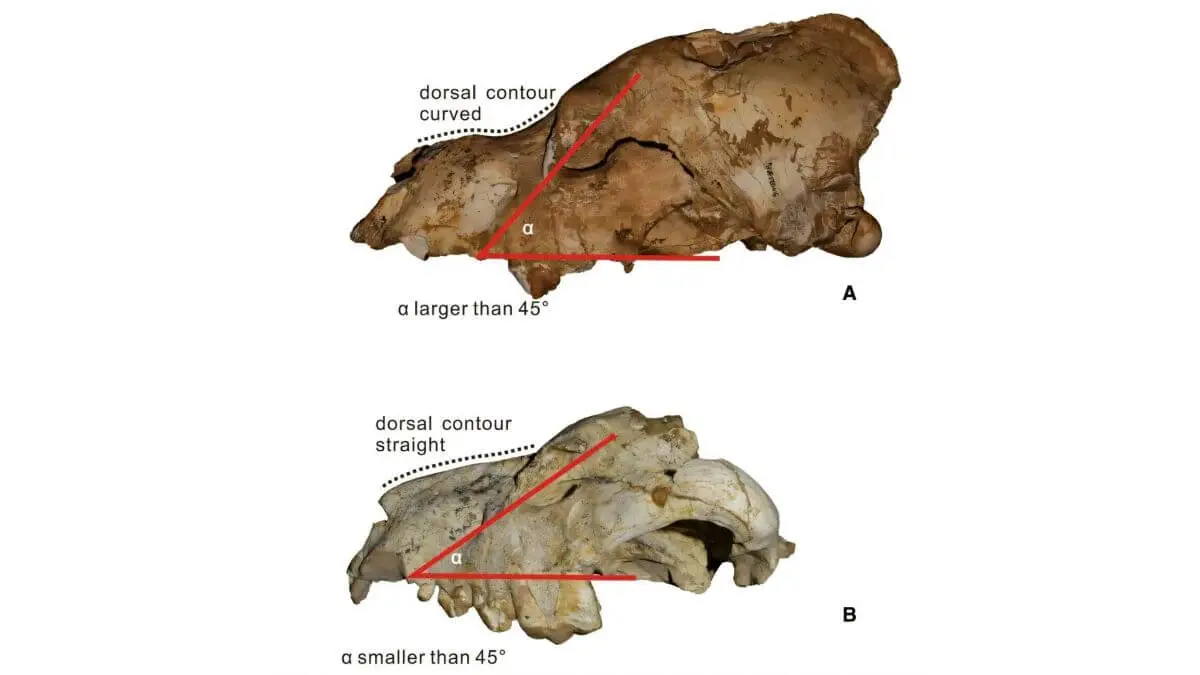
Although somewhat smaller than its later relative, the new species already had extraordinarily specialized teeth. Its anterior premolars have surfaces worn by the pressure exerted when fracturing hard materials, while the upper fourth premolar functioned as a powerful blade capable of cutting meat.
To this we must add the width of the snout and the development of the fangs and incisors. The researchers believe that these characteristics would have allowed the animal to hold prey of considerable size. It was, therefore, a carnivore prepared both to obtain its own food and to take advantage of the remains of other animals.
In fact, years ago a healed lesion was documented on the skull of a prehistoric rhinoceros that specialists attributed to a bite from Dinocrocuta gigantea. The rhino survived the attack, a circumstance that allows us to rule out that the bite occurred when the herbivore was already dead.
The mystery of the missing tusk
One of the details that most caught the attention of the researchers was the state of conservation of the cavity in which one of the canines was housed. If the tooth had been dislodged after the animal’s death, the gap would have remained open. However, the bone tissue had undergone considerable regeneration.
The paleontologists also observed that the premolars on the opposite side of the teeth were more worn, indicating that the specimen probably modified its way of chewing to compensate for the absence of the fang.
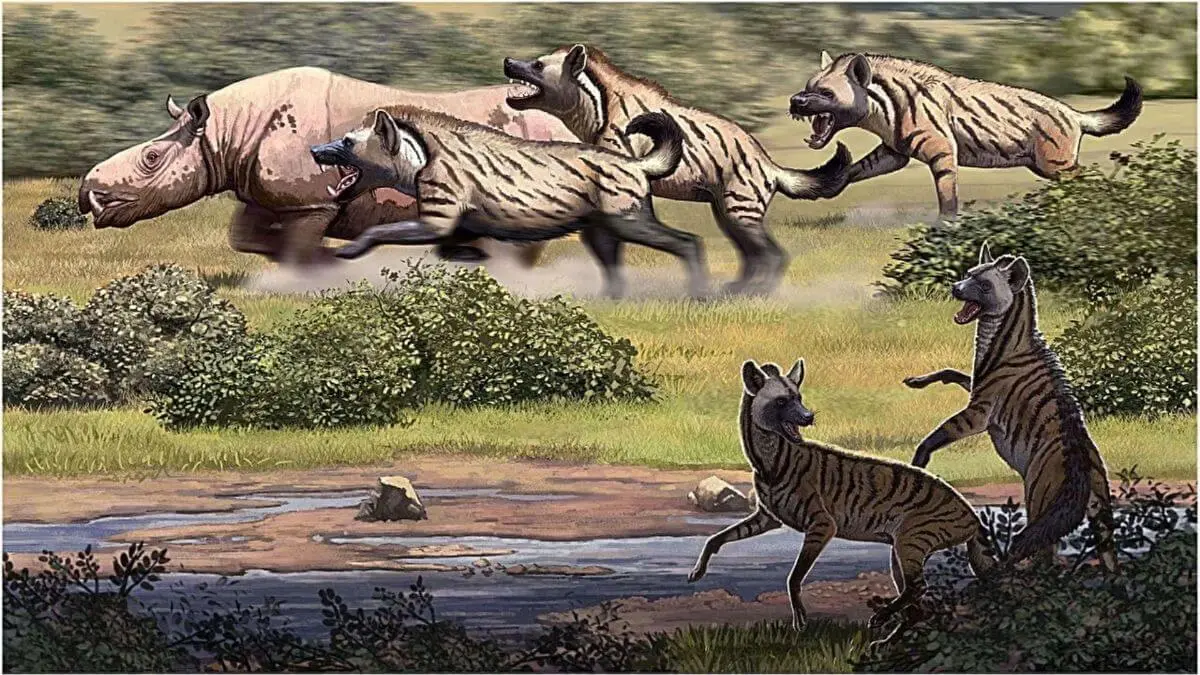
How did he get enough food then? One possibility is that it had been dedicated to consuming carrion or capturing smaller animals. However, the authors of the study lean towards another explanation that would have important implications for understanding the evolution of these mammals: the help of other members of their species.
Keeping a carnivore of such size fed was not an easy task, especially in a territory where other large predators were abundant. Fighting them for game with damaged teeth would have entailed considerable risk.
The possibility that these hyenas lived in groups and shared food would explain, at least in part, the survival of the specimen. The fossil, however, does not allow us to prove on its own that this collective behavior existed.
When Tibet changed the rules of survival
To understand the appearance of these giants we must go back to the geological transformations that Asia experienced during the Miocene. The elevation of the northern region of the Tibetan Plateau would have favored the expansion of open landscapes, altering the conditions under which large carnivorous mammals hunted.
In terrain with less vegetation, approaching prey without being discovered was more difficult. Difficulties in hiding food and defending it against possible competitors also increased. In these circumstances, cooperation between individuals could represent an important evolutionary advantage.
The scientists propose that these environmental conditions could have favored the development of more effective hunting strategies and, possibly, social behaviors among the first representatives of the genus. Dinocrocuta.
It is curious that much of this research revolves around a tooth that has not even survived to this day. Its absence, far from subtracting information from the fossil, has provided paleontologists with clues about the difficulties these animals faced and the resources they could have had to survive 11 million years ago.
References:
-
Qigao Jiangzuo et al., The largest bone‐cracking hyaenid evolved in the northeastern border of Tibet, Palaeontology (2026). DOI: 10.1111/pala.70091
Cover photo credits: Artistic recreation. Photo: ChatGPT-4o