About 66 million years ago, when tyrannosaurs dominated much of North America, a small dinosaur roamed the Cretaceous forests looking for food quite different from that of its large carnivorous relatives. He didn’t need sharp teeth or jaws capable of crushing bones. His specialty, according to new research, it could have been the fruit. And the truly surprising thing is that its mouth worked in a way reminiscent of that of some modern-day parrots.
The creature has received the scientific name of Infernogallus jamesi and its description has just been published in the magazine Nature Communications. The study, led by Gregory F. Funston of Stony Brook University, presents one of the most interesting findings on the diet of non-avian dinosaurs. Until now, paleontologists had difficulty determining whether these animals took advantage of the expansion of flowering plants during the Cretaceous.
The fossil comes from the Hell Creek formation, in Montana (United States), one of the most important paleontological sites in the world. It was recovered in 2011 and belongs to a dinosaur that weighed approximately 12 kilograms. Its appearance would have been reminiscent of a land bird, with an elongated neck, large eyes and a toothless beak. However, what has sparked the interest of researchers is not its appearance, but the extraordinary anatomy of its skull.
“There really is no such thing as Infernogallus“But if I had to choose, I would say a cassowary with a parrot’s head,” Funston explained. The comparison is especially revealing because some modern birds use similar jaw mechanisms to process soft fruits.
A tiny skull that hid a surprise
The new dinosaur belongs to the cenagnathids, a family of theropods related to other oviraptorosaurs. For decades, their diet has been the subject of debate. Some specialists argued that they consumed eggs, while others proposed diets based on small animals, seeds or different types of vegetation. The scarcity of complete skulls prevented many of these questions from being resolved.
The specimen studied preserves a good part of the skeleton and an exceptionally articulated skull for this group. Microscopic analyzes of his bones have also established that he had reached maturity when he died, probably at the age of six or seven. Therefore, its small dimensions cannot be explained because it was a baby.
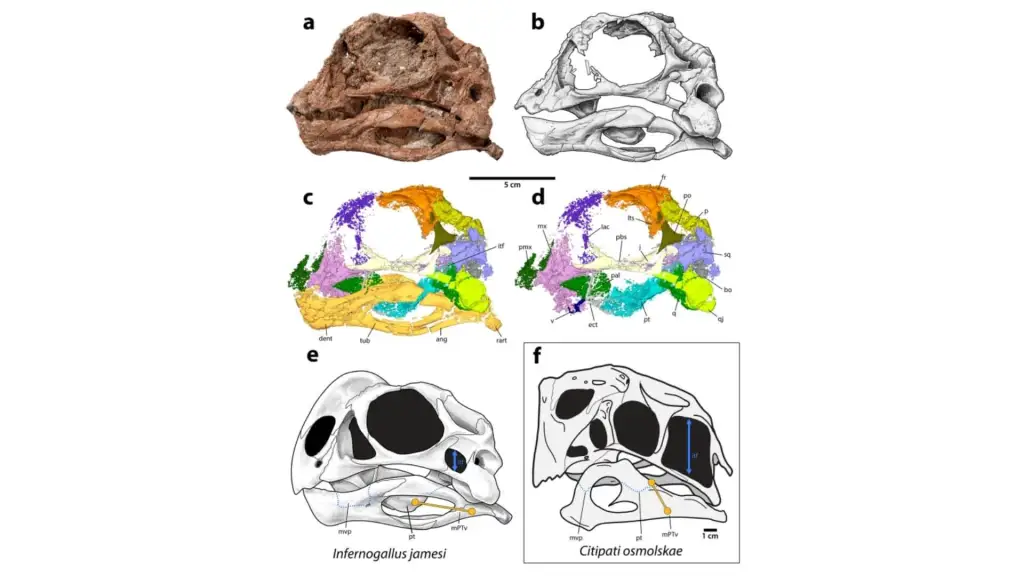
To examine its head, researchers used CT scans that allowed the bones deformed during fossilization to be digitally reconstructed. The images showed a highly developed palate and a muscular arrangement extraordinarily different from that observed in other theropod dinosaurs.
The main peculiarity was in the movement of the lower jaw. Instead of relying primarily on a powerful vertical bite, Infernogallus It had adaptations to move it forwards and backwards. Their oral surfaces had ridges and grooves that could act together to crush and manipulate food. It was a setup much more suitable for processing soft plant materials than for tearing flesh or breaking especially strong structures.
A dinosaur that ate fruit like parrots?
The most interesting clue appeared when comparing its anatomy with that of modern birds. The researchers found functional similarities with Psittrichas fulgidusknown as Pesquet’s parrot, a species from New Guinea whose diet is closely linked to the consumption of fruits.
This parrot uses its beak to manipulate the fruits and take advantage of their pulp. The research proposes that Infernogallus could develop a similar strategy, although that does not mean that both species consumed exactly the same foods or had identical behaviors.
«We can deduce from the skull of Infernogallusspecifically because of how their muscles are arranged to perform a front-to-back chewing motion, which would have been quite good at chewing their food,” Funston explained. The researcher related this ability to soft-fleshed fruits that contain a central stone, such as cherries.
The absence of gastroliths associated with the specimen is also significant. These small stones, used by some animals to crush food within the digestive system, would have provided another way to process hard materials. Taken together, the anatomical characteristics point to a specialized diet, although scientists recognize that the animal probably also consumed other soft parts of plants.
An unexpected connection with the appearance of fruits
The discovery takes on another dimension by placing it in the evolution of Cretaceous ecosystems. During this period, angiosperms, that is, flowering plants, experienced significant diversification. Among them, different lineages producing fleshy fruits appeared and spread.
The team compared the evolutionary history of oviraptorosaurs with fossil data on the size and diversity of those fruits. The results show an interesting temporal coincidence: while certain groups of dinosaurs developed specialized dietary adaptations, fleshy fruits increased their variety and, in some cases, their dimensions.
Scientists propose that cenagnathids were able to take advantage of these new food resources and become specialized consumers of fruits. However, evolutionary coincidence alone does not prove a causal relationship.
An especially important question still remains: Did these dinosaurs participate in seed dispersal? Many current frugivorous animals contribute to the spread of plants by transporting or ingesting their fruits. Infernogallus It could have been part of those ancient ecological relationships, but there is no direct evidence to confirm this.
The finding therefore offers a plausible explanation for one of the big questions about the diet of herbivorous dinosaurs. And also remember that, while some giants hunted enormous prey, others had developed extraordinarily sophisticated anatomy to take advantage of the fruits of prehistoric forests.