
The enormous skull of Triceratopswith its two long horns over the eyes, a third over the snout and a large bony ruff that extended behind the head, constitutes one of the most recognizable anatomies of the prehistoric world. However, for decades, paleontologists have argued about how these dinosaurs used such an arsenal. Do they charge their adversaries like modern rhinos do? Did they intertwine their antlers like deer? Now, research has managed to reconstruct some of the possible combat techniques of these animals without the need for a single dinosaur to come to life.
A team of paleontologists from the University of Bristol has subjected different dinosaur skulls to a series of virtual combats to find out to what extent their bone structures were prepared to withstand the forces of a confrontation. The results, published in the scientific journal PeerJsuggest that the diversity of horns that these animals developed during the Cretaceous was related to the appearance of different ways of fighting.
The protagonists of the study are the ceratopsians, a group of herbivorous dinosaurs that experienced extraordinary anatomical diversification. Its representatives ranged from relatively small animals, lacking large horns, to giants equipped with authentic cranial armor. And, interestingly, having a more intimidating head didn’t necessarily mean being prepared for any kind of fight.
An experiment with dinosaur skulls
How can you study the behavior of an animal that disappeared millions of years ago? In the fossil record of ceratopsians there are bone lesions located on the cheeks and cranial throats that could be the result of confrontations between specimens of the same species. The problem is that these injuries do not always allow us to reconstruct the movements that caused them.
To solve this mystery, researchers Eric Austin Ames, Andre J. Rowe and David John Button created three-dimensional models of six skulls belonging to five different species: Psittacosaurus, Protoceratops, Centrosaurus, Spiclypeus and Triceratops.
The scientists turned to finite element analysis, a technique commonly used in engineering to test the strength of materials and structures. Using this procedure it is possible to calculate how the mechanical stresses are distributed in an object when a force is exerted on it. In this case, the objects were the heads of prehistoric animals.
Paleontologists were able to modify the direction of the forces and the points on which they acted, reproducing everything from attacks with a single horn to struggles between two opponents. Thus they were able to identify which movements least compromised the integrity of the skull of each species.
The dinosaur that was not prepared to fight
About 125 million years ago there lived the Psittacosaurusa small dinosaur whose snout was reminiscent of a parrot’s beak. Their appearance was far from what some of their relatives would acquire millions of years later. It lacked the large cranial horns that would make ceratopsians popular, and, according to simulations, its head was also not particularly prepared to withstand the mechanical demands of a fight.
Something different happened with the Protoceratops. Although it did not have the spectacular horns of its better-known relatives, its cranial anatomy offered relatively favorable resistance to the forces associated with attacks.
Much more striking is the case of Centrosauruswhose prominent nasal horn gave it a certain resemblance to modern rhinoceroses. The experiments revealed that his skull responded well when forces acted vertically, but was less efficient when forces were exerted laterally.
This difference leads researchers to think that the Centrosaurus It may have developed a rather specialized form of combat, based on attacks with its nasal horn. A way of fighting very different from that of the famous three-horned dinosaur.
Triceratops: a multi-ton fighter
If there is an animal that seems to have all the characteristics of a prehistoric fighter, it is the Triceratops. For the experiments, the scientists took as reference an eight-ton specimen and calculated forces of up to 240,000 newtons distributed between its two large horns. This is an experimental estimate that allows us to compare the resistance of different skulls, not a measurement of the real strength of these dinosaurs.
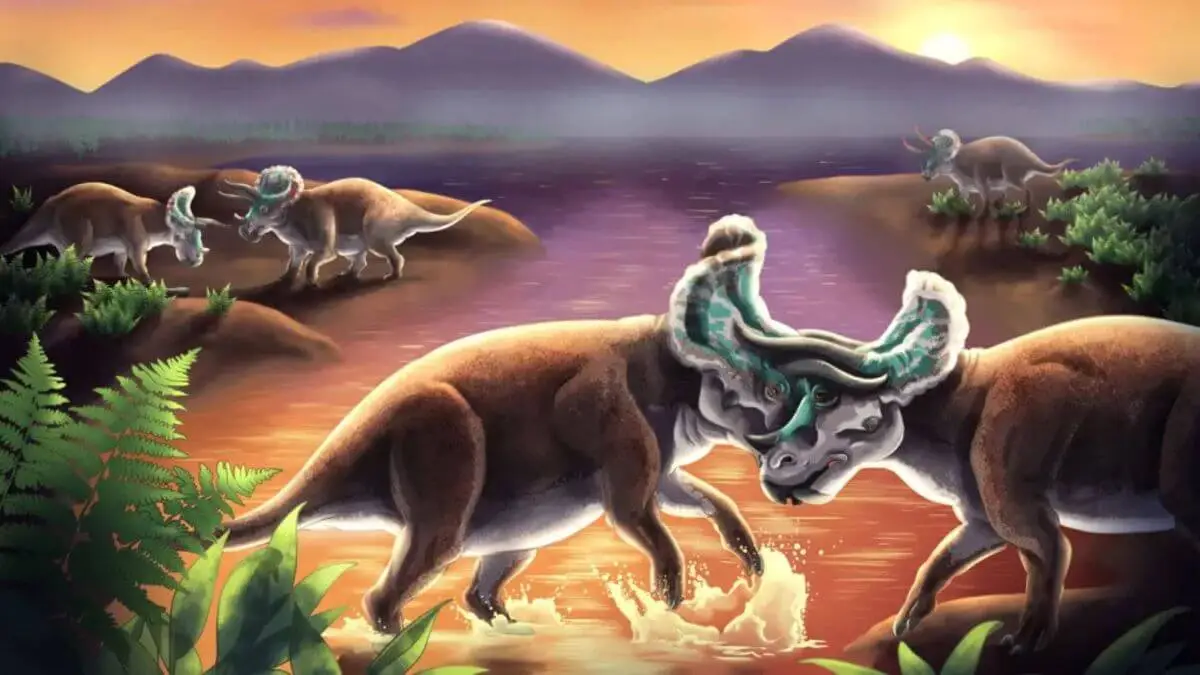
Both the Triceratops like him Spiclypeus They presented an anatomy favorable for confrontations in which two animals intertwined their horns and struggled. Their robust skulls would have allowed them to withstand a greater variety of movements during disputes.
But there is another interesting detail. The horns that we see in museums fundamentally represent their bone structure. In life, these appendages were probably covered in keratin, the same protein we find in our fingernails and in the horns of cattle. By incorporating this coating into the simulations, the scientists observed a reduction in mechanical stresses.
The original shape and thickness of these coverings remains difficult to determine, as keratin is rarely preserved in the fossil record. It is possible, therefore, that the appearance and strength of the horns were somewhat different from what we have traditionally imagined.
Why did they develop such weapons?
One of the hypotheses that paleontologists use is that cranial ornamentations initially appeared as elements of social and reproductive display. As generations passed, disputes between individuals could favor certain forms of horns over others.
Something similar happens among current herbivores. It is enough to observe the differences between the antlers of deer and the horns of antelope to understand to what extent anatomy determines the way of facing a rival.
This does not mean that ceratopsians did not use their horns to defend themselves against large carnivorous dinosaurs. However, competition between members of the same species could have had a much greater weight than previously thought in the evolution of these structures.
The researchers recognize that there are still many aspects to study, including the resistance of the cervical vertebrae during confrontations. And, no matter how resistant a dinosaur’s head was, its neck also had to withstand the consequences of such struggles.
References:
-
EA Ames, AJ Rowe, and DJ Button. Let them fight: using finite element analysis to determine combative evolutionary drivers of ceratopsian (Dinosauria: Ornithischia) horns. PeerJ. 2026. doi: 10.7717/peerj.21728
Cover photo credits: Artistic recreation. Photo: ChatGPT-4o