
Inverted drinking fountain: the physics that keeps water suspended
You turn the tank upside down, fit it into the cage like an inverted water bowl, and wait for the puddle that never comes. There is a hole at the base, but the upside down water comes out, stays there and doesn’t spill out. It seems that gravity has decided to rest for a while.
He hasn’t rested. **Gravity continues pulling the water downward with the same force as always, but that force encounters the air, which compensates it just in time.** The scene, so domestic that almost no one looks at it twice, hides a pulse between the weight of the liquid and the pressure of the atmosphere. And the referee of that pulse is a bubble.
The invisible push of the air
It is advisable to start with what is not seen. On every centimeter of surface, the atmosphere exerts considerable pressure, which we endure without noticing it because we also have it inside the body. That push not only goes downwards: it acts in all directions, even upwards.
When you rotate the tank, the water column is heavy and tends to fall through the opening. At the same time, the air pressure from outside pushes up against that same opening. As long as the thrust of the air equals the weight of the water, the liquid remains still.
Classic physics demonstrations teach it with a full bottle covered by cardboard: when you turn it over, the paper does not fall, because the atmospheric pressure supports it from below. The inverted bottle experiment has been repeated in laboratories for more than a century, and the birdbath is its everyday version, only with a permanent hole in the base.
That’s where the first tension appears. If there is an open hole, why not empty it like a watering can?
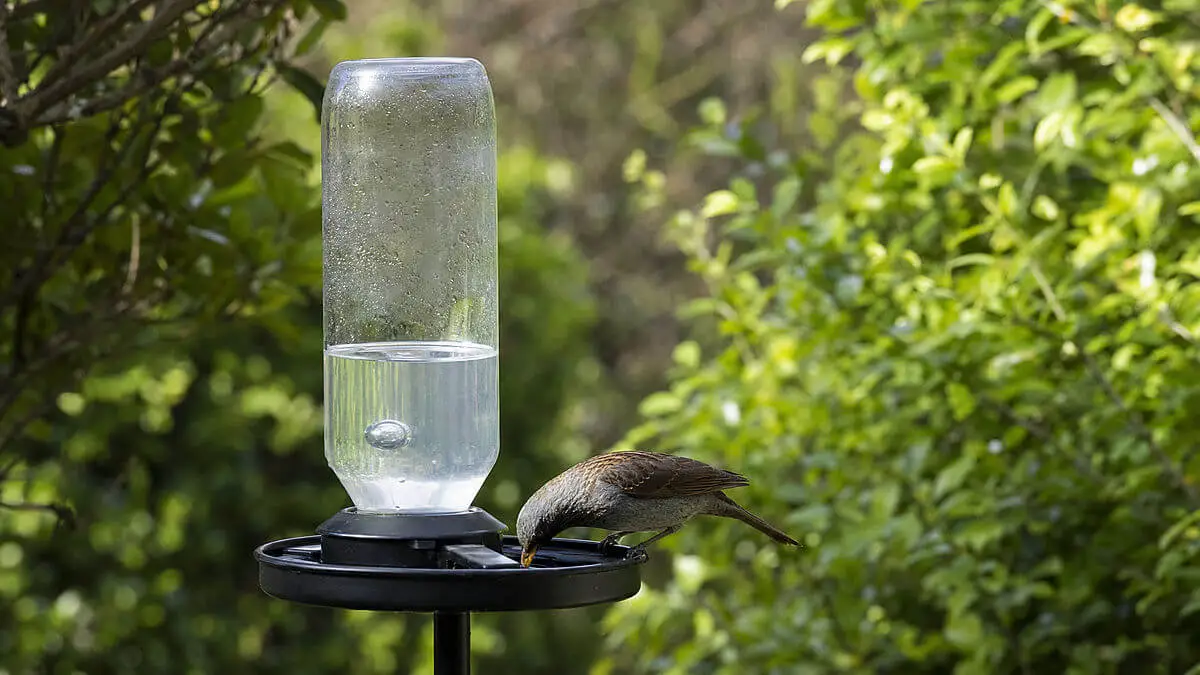
Inverted birdbath with water retained by atmospheric pressure.
A gap that air cannot cross
The answer lies in what happens during the first second. When you invert the tank, some water comes out, a little, until the liquid level in the tray rises and covers the opening. At that moment an unseen door closes.
For more water to come out, someone would have to occupy the space left inside the tank. That someone is the air. But air cannot enter if the opening is blocked by water: the liquid blocks its passage. **Without air to fill the gap, the remaining water remains suspended, held by the push of the atmosphere against a sealed opening, as long as that opening remains covered by water.**
Air is trapped inside the container, and it is worth highlighting something that is often misunderstood: a perfect vacuum is not formed. The little air that is inside expands a point when the first drops come out and, as it expands, its pressure drops. The system stops when three things balance: the weight of the water column, the atmospheric pressure outside, and the reduced air pressure inside. Ultimately, the entire balance depends on that water coverage over the opening and the difference between the outside atmospheric pressure and the pressure of the air trapped inside.
The magnitude of that weight has a simple formula. The pressure difference generated by a column of liquid depends only on its density, gravity and height, and is written as ΔP = ρgh. That relationship, which experimental analyzes of flow in inverted bottles use as a starting point, explains why the height of the pending water matters so much in the balance: the larger the column, the greater the weight the atmospheric pressure and trapped air must compensate between the two.
Missing, however, is the piece that turns an immobile system into a dispenser.
The bubble that distributes the water
Here comes the bird. When you drink, you lower the water level in the tray and leave the opening partially exposed. As soon as the air finds a free space, it enters the tank in the form of a bubble.
That bubble changes everything. **When entering the container, the air occupies part of the upper space, increases the internal pressure and breaks the balance, so that a new batch of water comes out** and covers the opening again. Then the passage closes again and the system resets.
Seen slowly, the drinker does not retain the water: it administers it in small deliveries. Each swallow of the bird opens the door, lets a bubble through and causes a replenishment. The cycle repeats, water outlet and air entry alternating, until the tank is exhausted.
That swing has a familiar relative. It is the same gurgling mechanism that you hear when you empty a bottle suddenly: the water tries to get out, the air fights to enter through the same narrow neck and none of them gives in completely, so they take turns gushing. The analysis of the physics of inverted containers precisely describes this alternating sequence of liquid falling and bubbles rising. The drinker is that same dance, but domesticated and slow, measured by the animal’s thirst.
What Surface Tension Does and Doesn’t Do
At this point, it’s tempting to attribute it all to surface tension, that property that makes water droplets and some insects walk on a pond. The temptation is understandable, because at the edge of the opening the water forms a small curved film that seems to support everything.
Surface tension intervenes, but in a secondary role. It can help locally to keep the sheet of water stable in a very fine opening and to decide the exact moment at which the bubble manages to sneak in. What it does not do is support the entire column of water. Its strength is not enough for that, too weak compared to the weight of a full tank.
The protagonist continues to be the balance of pressures. **The atmosphere pushes upwards, the water weighs downwards and the trapped air acts as a shock absorber, and as long as these three forces compensate, the tank does not spill.** The surface tension only fine-tunes the moment of release. Anyone who observes the physics of fluids calmly immediately recognizes this distribution of roles.
There remains, however, one detail that is not completely closed.
The design commands at the exact moment
The general physics of the inverted sprue is clear, but the precise instant at which the bubble enters depends on the geometry. The size and shape of the opening changes when air gets through and, therefore, how much water is released in each cycle.
A narrow opening holds better and dispenses in small gulps. A wider one lets air in sooner and releases more liquid at once. There is no single number that applies to all models, because the amount of water that comes out in each round depends on the height of the liquid, the volume of the tank and the specific shape of the hole.
Precision is also necessary. The knowledge available about this mechanism does not come from the study of bird behavior, but from demonstrations of atmospheric pressure, inverted containers, and bubble flow. The bird does not do physical magic: it activates, with each sip, a pressure system that also appears in a domestic siphon or in a bottle that is poorly emptied.
So the next time you look at that still tank, think that it’s not really still. It’s waiting. And the question that remains open, the one that separates a drinking fountain that drips from one that dispenses well, is not why the water does not fall out, but what is the exact shape of the opening that decides, for each design, the moment in which the bubble can enter.