
Some sea slugs glow a green that is neither pigment nor camouflage, but rather cellular machinery ripped from the algae they eat. It is one of the few real examples of photosynthesis in animals, and the question of whether photosynthetic animals exist has an answer, but not the one usually imagined.
Are there animals that do photosynthesis? The answer depends entirely on what “do” means. If we understand it as manufacturing and possessing photosynthetic machinery just like a plant, no animal is known capable of achieving it. If we understand how to take advantage of that machinery, the panorama changes, and the Elysia sea slugs live in that area, which ingest algae and keep their chloroplasts functioning within their own body.
The green that betrays a theft
Chloroplasts are the organelles where photosynthesis occurs: they capture light, fix carbon and convert it into organic matter. In a plant they are part of its own cell. In these slugs, however, they come from the algae they devour. The animal digests a large part of the algae and keeps a specific piece of its infrastructure, a strategy that biology has named kleptoplasty, literally the retention of stolen plastids. It is advisable not to confuse this phenomenon with its own photosynthesis: the slug retains foreign chloroplasts, but it does not manufacture all the photosynthetic machinery or the rest of the cellular apparatus that the alga needs to produce them.
The image helps to order the phenomenon. It is not having algae living inside as tenants, nor is it simply eating plants. The slug dismantles the algae and keeps only the engine, the chloroplast, while discarding the rest of the vehicle. This engine continues to work for a while within the animal’s tissues, which thus acquires the characteristic green color and an additional, although limited, source of energy: the stolen chloroplasts do not multiply or renew themselves, so their contribution is depleted as they degrade.
What is interesting is not only that there is photosynthetic activity in an animal. The thing is that the chloroplast is not his innovation, but rather a foreign component that must be kept going. And maintaining something that is not manufactured poses a problem that science is beginning to describe in detail.
Green Elysia sea slug that preserves chloroplasts from algae.
A custom box for the stolen engine
For years it was possible to imagine that these chloroplasts remained loose in the digestive system, accumulated like someone storing provisions. A study published in 2025, signed by the team of Corey AH Allard and Nicholas W. Bellono, from Harvard University, together with researchers from the Scripps Institution of Oceanography and the University of Groningen, showed something different in Elysia crispata.
The team described membrane-bound compartments, derived from the slug’s own cell, which they called kleptosomesand that house each ingested chloroplast. They are not remains of digestion, but structures of the host. Inside they contain animal proteins, including an ATP-sensitive cellular channel called P2X4. In well-fed specimens, chloroplasts retained their internal membrane stacks and nucleoids, traits compatible with photosynthesis that remains operational.
The discovery displaces the question. It is no longer just a question of whether an animal can store chloroplasts, but how it incorporates and protects them within its own cells. The study observed that chloroplast gene expression was maintained for about four weeks in the animals analyzed, a sign that the machinery does not shut down immediately, although that period also marks the practical limit of the energy that the slug can extract from each stolen chloroplast before it stops working.
However, a well-built box does not mean that the slug controls everything that happens inside. To what extent it repairs, regulates or replaces the functions that the alga normally provides remains unresolved.
Follow the carbon trail
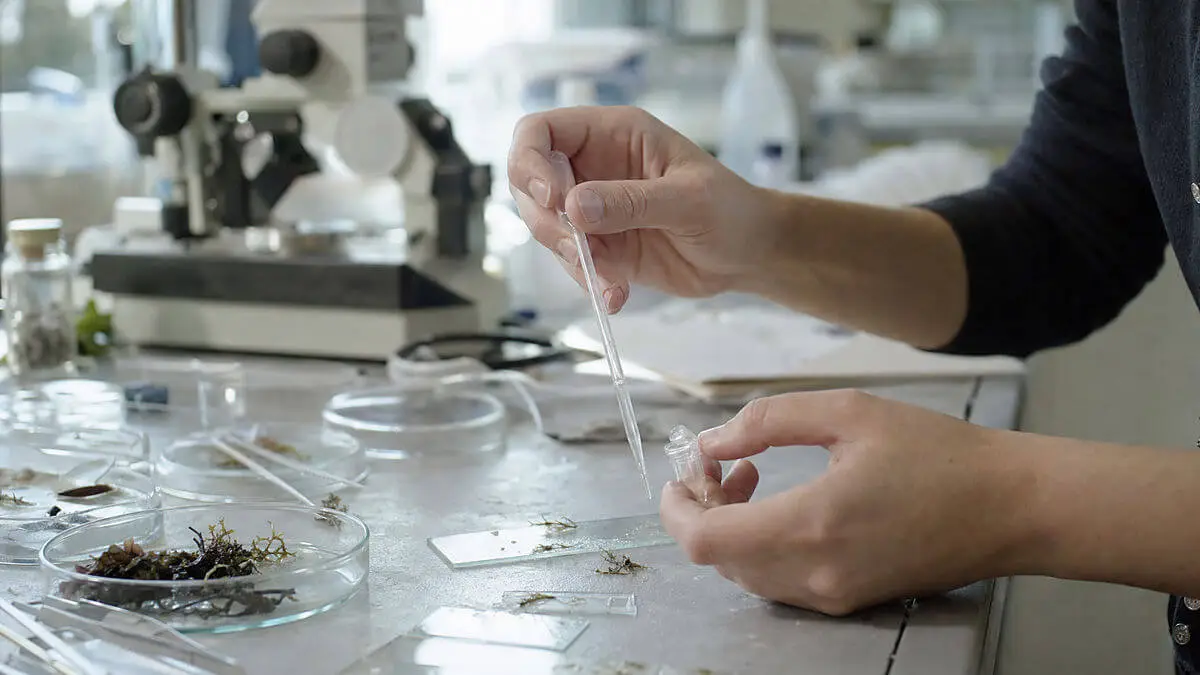
And what does that chloroplast really do inside the animal? To verify this you have to follow the matter, atom by atom. Sónia Cruz’s team, with researchers from Portugal, France, Denmark and Switzerland, did it in Elysia viridis in a 2020 job.
The design was precise. After acclimatizing the slugs, they were placed without food in closed one-liter bottles with artificial seawater containing bicarbonate labeled with carbon-13, enriched at around 99%, and ammonium labeled with nitrogen-15, at 98%, at concentrations of two millimoles per liter and 20 micromoles per liter respectively. They then compared illuminated animals with others kept in darkness and tracked these elements with a technique, NanoSIMS, capable of mapping them at a cellular scale.
After 12 hours of exposure, the labeled carbon and nitrogen appeared incorporated into the animal’s tissues, even outside the digestive area. The signal reached glands and follicles, a result compatible with the products derived from the activity of these chloroplasts, which are called kleptoplasts when they are inside the animal, being distributed throughout the organism.
Detecting labeled matter in places far from the intestine is a test of real transfer. But it is advisable not to read too much: the fact that photosynthetic carbon reaches the tissues does not prove that photosynthesis covers all the energy and nutritional needs of the slug. It is a contribution, not necessarily a complete support.
Why coral doesn’t count equally
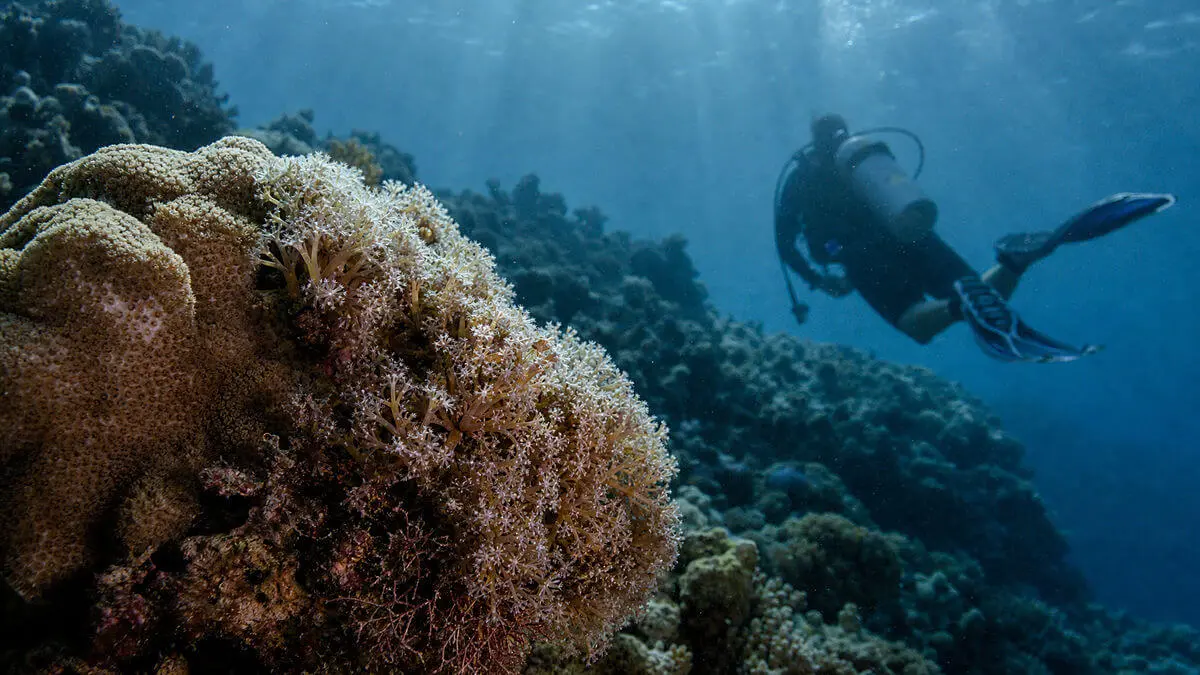
It is convenient to place a contrast to understand the uniqueness of Elysia. Corals also benefit from photosynthesis, and many owe their survival to microscopic algae that live in their tissues. In this relationship, called photosymbiosis, the algae carry out photosynthesis and give part of their products to the animal, while the coral offers them shelter and resources.
The difference is decisive. In the coral, the photosynthetic partner remains a relatively recognizable organism, a cellular tenant. In the slug there is no tenant: the alga has been digested and only one of its pieces survives, the chloroplast, integrated into the body of the host. The review on photosymbiosis in animals coordinated by Gregor Christa and Jenny Melo Clavijo distinguishes precisely between these associations with microorganisms and a hypothetical complete photosynthetic autonomy.
That border, between living with a partner, appropriating one of its structures or developing your own organelle, is more blurry than it seems. And that’s right there where the story connects with something much older than any slug.
A scale photo of the origin of plants
Plant chloroplasts did not appear out of nowhere. They come from ancient photosynthetic microorganisms that, hundreds of millions of years ago, were integrated into ancestral cells and ended up losing a good part of their autonomy until they became organelles. It is one of the decisive episodes of cellular evolution.
The slugs Elysia They have not followed that path until they become photosynthetic on their own. But they offer a small-scale snapshot of one of their first steps: an animal that temporarily acquires, preserves, and organizes a foreign photosynthetic structure. The study of kleptosomes even suggests a cellular architecture dedicated to this task, although interpreting it as an evolutionary stage towards an animal’s own chloroplast remains an open hypothesis.
Ancient experiments managed to maintain specimens of Elysia chlorotica for at least nine months with light and carbon dioxide, without giving them food of algal origin. This is a notable fact about the persistence of chloroplasts, but it does not describe an animal that lives indefinitely off the sun: the duration depends on the previous diet, light, temperature and condition of the animal, and there is nothing to indicate that photosynthesis completely replaces food.
The most difficult thing remains to be resolved: to what extent the slug really controls these borrowed engines, whether it can repair them when they fail, and what functions of the algae it is unable to supply. The answer to whether photosynthetic animals exist is not in a yes or no, but in the border, still not completely drawn, between stealing a machine and learning to build one.