
The climbers put on their crampons. In Rjukan, a small town located in the county of Telemark (south of Norway), stands a very popular spot in current mountaineers. Between November and March, several small groups massage there in a confused tangle of humans, harnesses and headsets in Kevlar. It is there, at the foot of the ice wall, that we take the time to hydrate, check your carabiners, sharpen your ice pins. Nothing should be left to chance when you undertake the ascent of Sabotørfossen, a crystallized cascade almost 150 meters high!
However, despite their level of preparation, few glacialists know the origin of its name, which literally means “cascade of saboteurs”. It was there, during the winter of 1942-1943, that Norwegian resistance fighters would have fled after destroying the installations of the neighboring vemork factory, then in the hands of the Nazis and located a few kilometers from the vertical and icy waterfall.
Heavy water … consequences
A stone’s throw from this wall of ice is held the old vemork hydroelectric power station, now converted into a tourist site, the Norwegian industrial workers’ museum. Seven floors of cold concrete framed on one side by the mountains, on the other by a ravine. It is in this remote place, lost in the forests of pine and birch, that one begins in 1934 to produce a chemical compound which will change the face of the world: deuterium oxide or heavy water.
Serving to moderate the nuclear fission process, heavy water makes it possible to convert uranium into military quality plutonium. It is therefore an essential ingredient for the development of … the atomic bomb. French physicists, Frédéric Joliot-Curie in mind, quickly measure the strategic importance of this chemical element. On May 4, 1939, the son -in -law of Pierre and Marie Curie filed a patent on the “improvement with explosive loads” in connection with his work on radioactivity. Its invention, classified as Secret-Defense, could serve “For mine work and for public works, but also for the constitution of war machines”he specifies.
Frédéric Joliot-Curie knows full well that German scientists, with whom he regularly corresponds, have reached the same conclusions. “The country which first makes use of the nuclear explosive will have an insurmountable advantage over others”writes the Austrian atomian Paul Hartck to the Minister of Armament of the Third Reich. This is why, Édouard Daladier, the president of the French Council of Ministers, ordered in February 1940 to secure the heavy water stock produced by Norsk Hydro – a Norwegian enterprise, but mainly owned by French capital – at the Vemork power station.
Countdown
You have to do it quickly. Blocked in the “funny war”, tricolor intelligence knows that the enemy also covets the twenty-six heavy water cans locked in the basements of the power station. From April 1939, the Germans established their atomic research program, theUranprojekt. The majority of uranium mines are under their control. They are now lancing on the central central on the planet that produces heavy water, that of Vemork, embedded on the mountainous plateau of Hardangervidda, between Bergen and Oslo, in the southern part of Norway.
Does Nazi Germany already have the project to design an overpowered weapon? On September 19, 1939, two weeks after the opening of hostilities, Adolf Hitler pronounced this alarming sentence in Dantzig: “The moment could soon come when we will use a weapon that is not yet known and against which no defense will be possible.” Fearing to be distant in the bomb race, the allies leave nothing to chance.
Francophile, the director of the Vemork power station agrees to entrust France with the entire stock of heavy water, up to 185 kilos, which represents all of the planetary reserves at the time. In the greatest secrecy, French agents repatriated in April 1940 the cans containing the “Z” to Oslo, then Perth (in Scotland), before returning to Paris. It was less one: a few weeks later, the Wehrmacht invaded Norway and took possession of its strategic facilities.
After the breakthrough of Sedan (Ardennes) in mid-May 1940, heavy water was transferred to a cell in Riom prison (Puy-de-Dôme), in Auvergne, then transported to Bordeaux, from where she will have to join the United Kingdom on a British coal. The SS Broompark leaves the Gironde estuary on June 19, with the Atomicians Hans Hans Halban and Lew Kowarski on board-two colleagues of Frédéric Joliot-Curie-with a mission order Intant to continue their research in England. This marks the first international atomic cooperation in history.
Saboted sabotage
The first “heavy water battle” turned in favor of the allies. However, the fight is far from over. The Nazis took possession of the Vemork hydroelectric power station and now devote all their efforts to increase its yield to 100 kilos per month. At this rate, they will not take them long to obtain the necessary fuel in order to relaunch their atomic program.
Informed by an employee of the factory, who also communicates to him plans and photographs of the site, British information is preparing an ultra secret operation in order to put the vemork factory upon stop. In October 1942, a recognition group of four Norwegian saboters reached the Hardangervidda plateau, 1,200 meters above sea level, where British paratroopers must join them. But the second mission, in November, failed miserably: the British gliders crash and their occupants are killed instantly or captured – then executed – by the Gestapo.
Demoralized, the four members of the initial squad that surround themselves at the bottom of a hunting cabin and survive winter by swallowing boiled foam and reindeer meat. In February 1943, finally, a new sabotage opportunity arose. Parachuted at five days of walking, six Norwegian agents increase the small group that remained on the spot and lead the Gunnerside operation.
But how to enter the power station? Since the failed attack in November 1942, the Wehrmacht has secured the complex, full the surroundings of mines and doubled the patrols. However, she believes this “natural fortress” inaccessible other than by the main bridge. Putting on this negligence, the squad undertakes to cross the mountain which supervises the site.
At the cost of great efforts, the saboteurs manage to infiltrate the factory by the basement, then distribute the explosive loads on the electrolysis chambers which produce heavy water. By leaving the scene, they voluntarily abandon a Thompson gunner pistol, of American bill. Proof of an allied operation should limit the risk of reprisals on the local population.
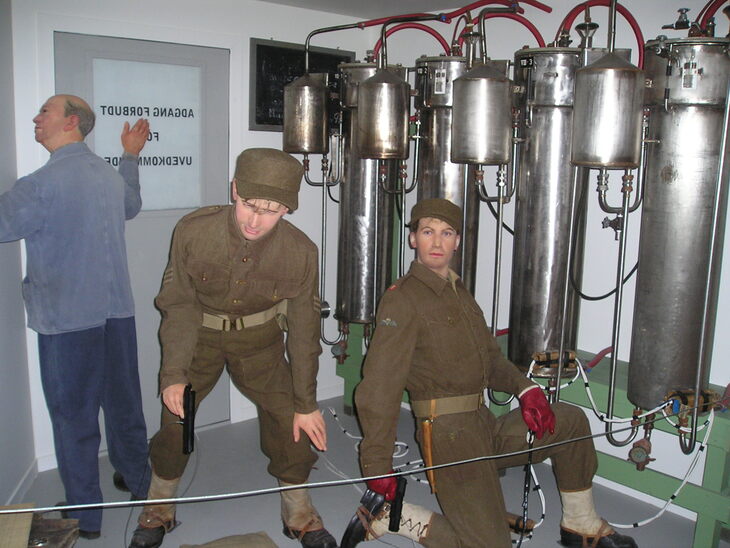
Mission accomplished
Shortly after, an explosion sounded, splitting the glacier’s cold air. As the machinists will note, the electrolysis rooms have been completely destroyed. “It was the most splendid blow of war”will sigh General Nikolaus von Falkenhorst, commander of the German forces in Norway, noting the extent of the damage. Better yet, none of the members of the equipped will have to crunch its cyanide capsule. Some will win Sweden at skis after a 300 -kilometer journey; Others will join the United Kingdom; Still others will vanish in the mountains.
To prevent the Nazi atomic program from being reborn from its ashes, nearly 140 American bombers’ planes pounded the vemork complex in November 1943, at the express demand of Leslie Groves, pilot of the Manhattan project, the United States Rival program for manufacturing atomic bomb. Many damage to the installation must be reported, but Norwegian bombing civilian victims are also to be deplored.
The final glance will take place in February 1944, when the Norwegian resistance managed to sink a ferry which repatriated in catastrophe some heavy water cans produced in Vemork. This time, nothing will save the atomic program of the third Reich. The Americans will make the first demonstration of the atomic bomb with the Trinity test of July 16, 1945, outclassing the whole competition.
A question remains: were the Germans close to the goal? No, say historians: the atomicians of theUranprojektit seems, were sorely lacking in means. Adolf Hitler had prioritized the development of long -range V1 and V2 missiles. From June 1942, by decision of the Minister of Armament Albert Speer, the physico-chemists of the Third Reich fell back on the construction of a moderate nuclear reactor with heavy water … which, for lack of fuel and sufficient resources, will never succeed. “They are fifty years ahead of us”said the German nuclear nuclear chemist Otto Hahn, owned by the British secret services, after hearing the announcement of the bombing of Hiroshima.
