
About 67 million years ago, in the territories that today make up the northern United States, there lived a small dinosaur that had developed a very particular way of feeding. It barely weighed 12 kilos, walked on two legs, had an elongated neck and no teeth. It shared territory with the fearsome Tyrannosaurus rexalthough their gastronomic preferences were radically different. The truly extraordinary thing about this animal was inside its mouth.
An international team of paleontologists has described in the scientific journal Nature Communications a new species of dinosaur named Infernogallus jamesi. The study of their cranial anatomy has made it possible to identify a series of adaptations related to feeding that have no known equivalent among the other non-avian dinosaurs studied.
The researchers suspect that a large part of their diet was composed of fleshy fruits, similar in structure to modern cherries or peaches. To consume them, this small dinosaur had a jaw mechanism surprisingly similar to that of some species of parrots that live today.
The discovery is especially interesting because it coincides with a decisive stage in the evolution of flowering plants. Until now, establishing a relationship between the proliferation of these plants and the anatomical changes experienced by dinosaurs had been tremendously complicated.
The dinosaur that hid a strangeness in its skull
In 2011, a fossil collector located the remains of a strange dinosaur in eastern Montana, in the Hell Creek geological formation, one of the most important paleontological sites in North America. In the following years, other specimens were recovered in Montana and North and South Dakota that facilitated the identification of this new species.
Its scientific name, Infernogallus jamesirefers to both the place where the fossils appeared and their resemblance to poultry. In fact, the name of the genus could be translated as hen from hellalthough their eating behavior was far from living up to such a name.
The animal belonged to the cenagnathids, a family of theropod dinosaurs that were characterized by their slender limbs, light skeletons, and toothless jaws. The problem for paleontologists was that, until now, the remains recovered from these animals were often too fragmented to accurately study their cranial musculature.
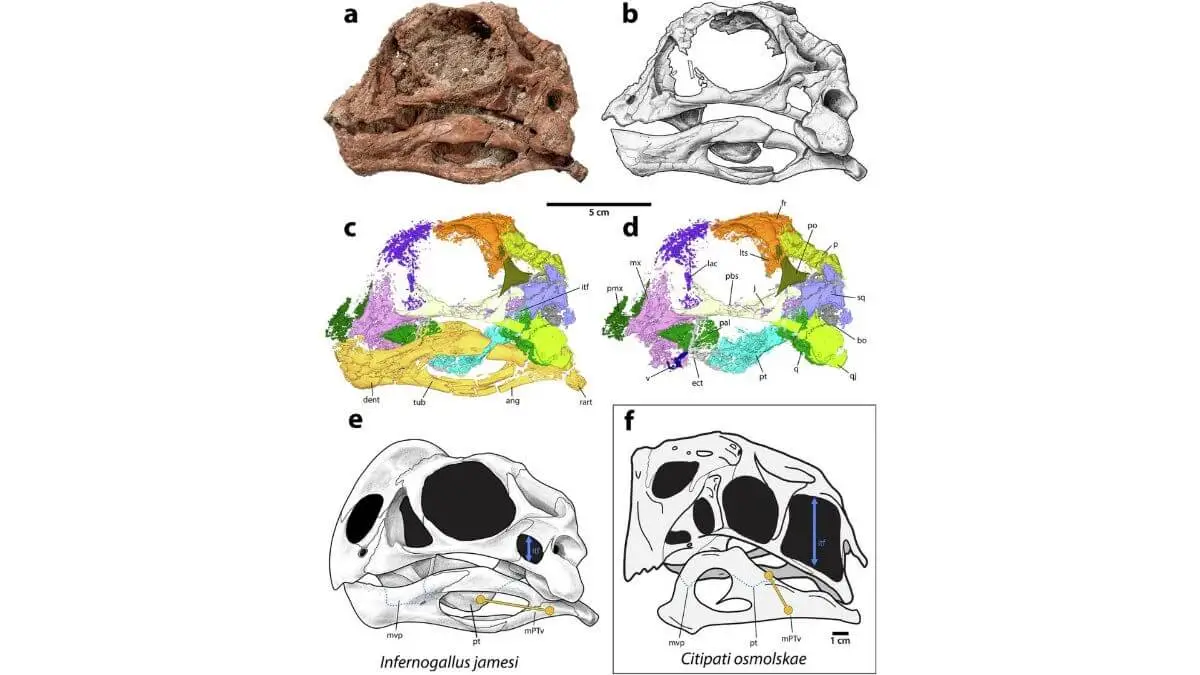
The new specimen preserves a practically complete and articulated skull, something exceptional within this family of dinosaurs. Additionally, through microscopic analysis of his bones, scientists determined that he had reached skeletal maturity and was at least six years old when he died, probably seven. Its small size was not due, therefore, to it being a baby.
A way of chewing never seen in other dinosaurs
The team, led by Gregory Funston, used micro-computed tomography techniques to digitally reconstruct the bones of the skull and find out how the muscles responsible for jaw movement were distributed.
One of the first peculiarities that caught the attention of researchers was the small size of a cranial opening located behind the eyes and related to the jaw muscles. Added to this was the arrangement of the bones of the palate and a joint that allowed the lower jaw to move forward and backward.
This last characteristic is essential to understand how the animal fed. Instead of developing a powerful vertical bite, Infernogallus jamesi he had sacrificed some of that strength in favor of much more pronounced horizontal movements. The ridges and grooves present on the inside of its beak would have made it easier to crush soft foods.
Interestingly, the researchers found an equivalent among today’s birds: the aquiline parrot (Psittrichas fulgidus), a species from New Guinea specialized in eating fruit. The anatomy of both animals presents functional similarities despite the millions of years of evolution that separate them.
The dinosaur would have been able to separate the pulp of the fruits from their seeds by movements of the jaw and, possibly, with the help of the tongue. An especially useful technique for taking advantage of foods that did not require a very powerful bite.
When dinosaurs started eating fruit
During the Cretaceous, angiosperms, that is, flowering plants, experienced an extraordinary expansion. The appearance and diversification of its fruits made food resources available to terrestrial animals that had been much less abundant in previous times.
The authors of the study compared the evolutionary history of oviraptorosaurs with the fossil record of these plants and found a very interesting temporal coincidence. The diversification of these dinosaurs during the Late Cretaceous coincided with an increase in the size of fleshy fruits, especially those we know as drupes, equipped with pulp surrounding a hard bone.
It is possible that the cenagnathids took advantage of this vegetation transformation to occupy a very specific ecological niche. It is even possible that they contributed to the dispersal of seeds, indirectly favoring the expansion of certain plant species.
However, scientists still do not have enough evidence to confirm this last assumption. Nor have they recovered remains of fruit in the dinosaur’s digestive system. The hypothesis is based mainly on the anatomical adaptations of the animal and its comparison with current species.
What is especially revealing is that, shortly before the extinction of 66 million years ago, there were dinosaurs with a much greater degree of dietary specialization than previously suspected. While the great tyrannosaurs dominated the North American food chain, some of their small and distant relatives had developed an extraordinary ability to take advantage of the fruits of prehistoric forests.
References:
-
G. F. Funston et al. Fruit-eating adaptations in a Late Cretaceous oviraptorosaur (Theropoda). Nature Communications. 2026. doi: 10.1038/s41467-026-78343-w
Cover photo credits: Danielle Dufault