
For decades, a small Scottish skeleton seemed to announce something extraordinary: the arrival of the first reptiles on dry land. It is about Westlothiana lizziaea fossil with four legs, five fingers and a vaguely lizard-like silhouette. But inside the rock, invisible to the eye, fossil bony gills were hidden, a feature of life linked to water that contradicts the image of a terrestrial reptile.
A fossil that seemed to announce terrestrial life
The protagonist is called Westlothiana lizziaealthough almost everyone knows him as Lizzie. It lived about 345 million years ago, during the early Carboniferous, and its almost complete skeleton appeared in 1984 in the East Kirkton quarry, near Bathgate, in West Lothian (Scotland). It was found by fossil collector Stan Wood, and the specimen was preserved crushed between two slabs of rock that fit together like the two sides of a mold: what is missing on one plate is printed on the other.
That elongated shape, four limbs and five-toed feet were enough for it to be discussed as one of the candidates for the “first reptile” or, at least, as a very close relative to the origin of amniotes, the large group that today brings together reptiles, birds and mammals. For an animal of that antiquity, it seemed a body surprisingly adapted to walking out of water.
The problem is that the skeleton was compressed and deformed. The most striking parts—the legs, the outline of the body—were read well. But many internal details were trapped in the stone, beyond the reach of any direct observation. The first interpretation was built, by necessity, on what was seen.
What changed when they looked inside the rock
This is where technology comes in. A study, signed by Ben Igielman, Xavier Jenkins and five other researchers from institutions in the United Kingdom, the United States and France, applied to the fossil a technique that did not exist when Lizzie left the quarry: synchrotron X-ray microtomography.
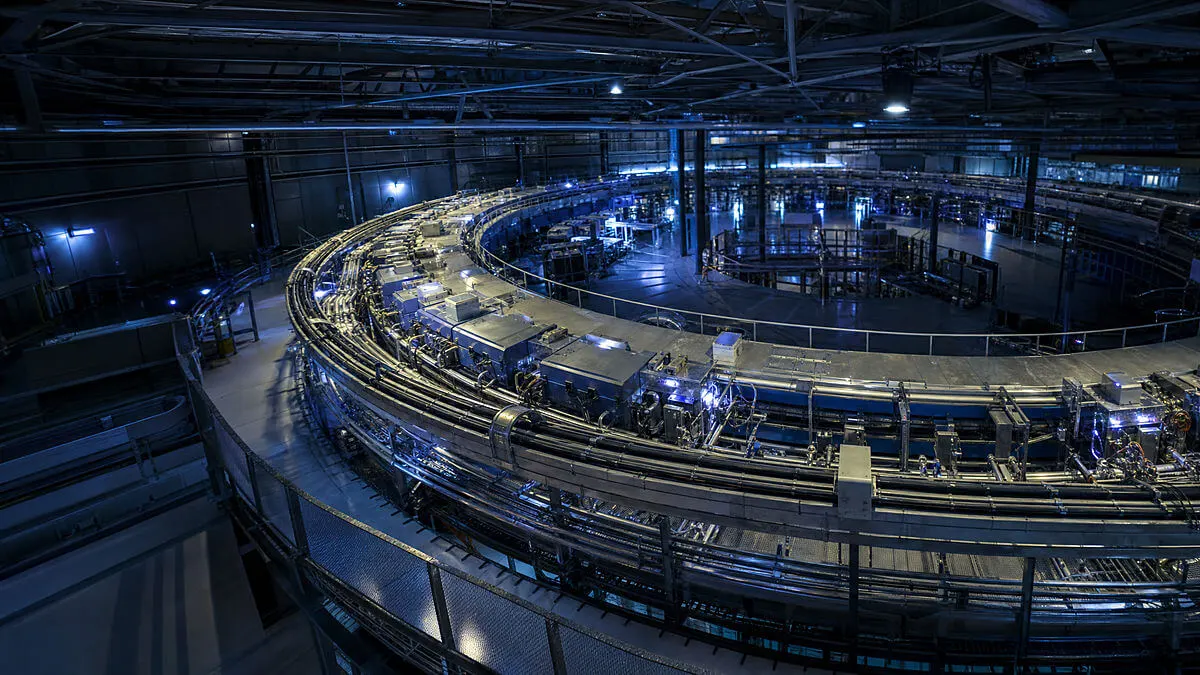
The idea is simpler than it sounds. A synchrotron is a particle accelerator that generates very intense beams of X-rays. By passing through the sample from many angles, these rays make it possible to reconstruct virtual sections and three-dimensional models of the interior without having to break the rock or physically separate the slabs. It is, in practice, a way to unearth the fossil from the inside while it is still intact.
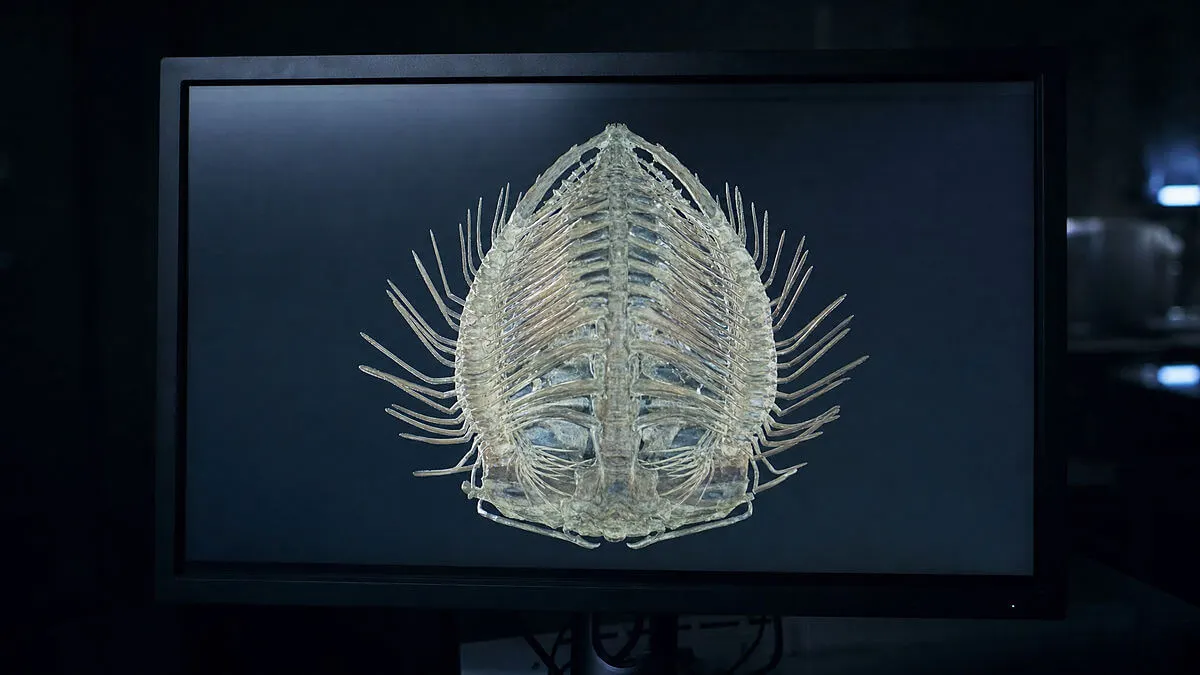
What appeared in those images rewrote history. The scans revealed an ossified internal gill skeleton: not preserved soft gills, but the mineralized parts that supported them. And, in addition, an abundant microscopic dentition – tiny denticles – spread across the palate and lower jaw. Two features that point, clearly, towards a life linked to water.
«These characteristics show that Westlothiana “It was not a reptile at all and it probably lived in or around water,” the paleontologist summarized. Xavier Jenkinsco-author of the study.
Why do bony gills cast doubt on whether it was a reptile? Reptiles, like all amniotes, breathe through lungs throughout their lives and do not retain functional gill structures into adulthood. That Westlothiana lizziae having an ossified gill skeleton implies that, at some point in its life, it depended on water to breathe, a trait incompatible with the definition of reptile and with the total independence of the aquatic environment that characterizes amniotes. That is why this discovery changes Lizzie’s label and forces us to review what combination of traits really marks the origin of amniotes: it is not enough to have legs and fingers, we must also lose dependence on water to breathe.
Why “tetrapod” does not mean “terrestrial animal”
Using this data, the team repositioned Lizzie on the evolutionary tree. Instead of being a primitive reptile or a very basal amniote, they classify it as a derived stem tetrapod. It is advisable to clarify the term, because a good part of the misunderstanding lies here.
A tetrapod is, in an anatomical sense, a vertebrate with four limbs and fingers. But having legs does not equal living out of water. Stem tetrapods are lineages that fall outside the group that leads to modern amphibians and amniotes, although closer to them than ancient lobe-finned fish. In other words: Lizzie belonged to a branch that had already developed limbs, but was still anchored, to a large extent, to aquatic environments.
The historical confusion is logical. The legs and general shape of the body were visible from the beginning; the gills and denticles, no. The first interpretation was based on the most spectacular and external features. The second could incorporate structures that had been hidden in the stone for forty years.
A conquest of the mainland made in pieces
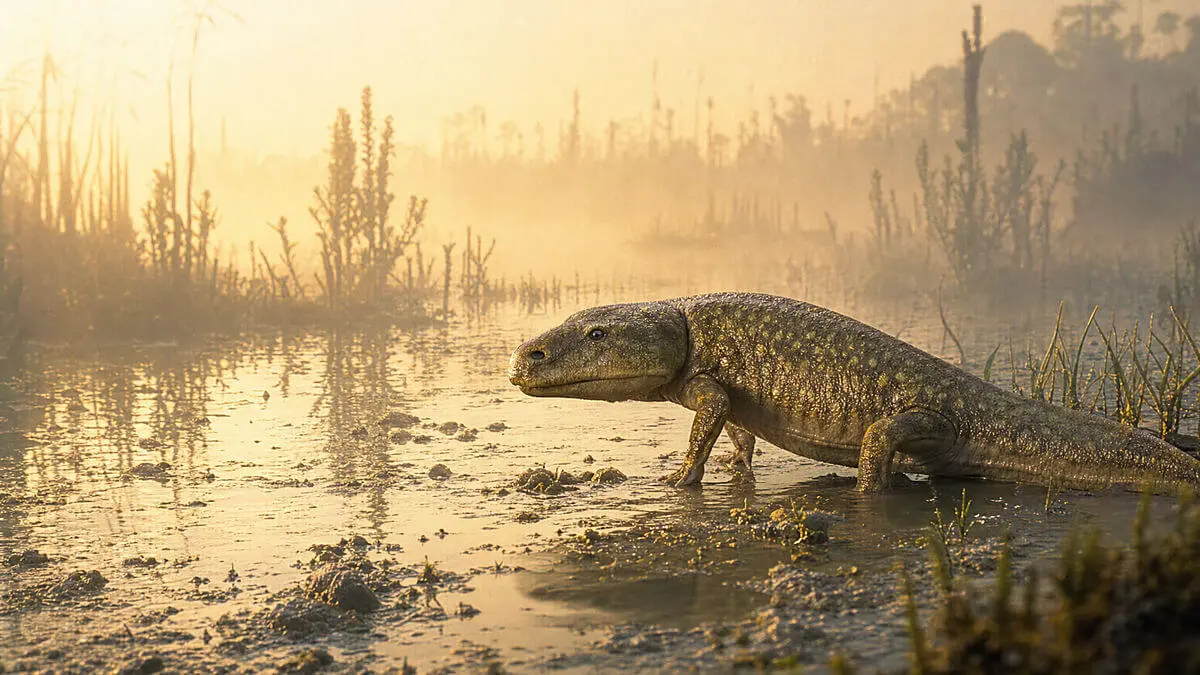
Beyond the label change, what is interesting is what the fossil says about how vertebrates left the water. Lizzie brings together limbs with features compatible with moving on firm surfaces and, at the same time, anatomy typical of aquatic respiration. This combination is a clue as to how the terrestrial and aquatic features were assembled separately.
The case fits with an increasingly accepted idea: the evolution did not advance through a single clean transition from water to land. Rather, it separately assembled different pieces—locomotion, respiration, reproduction—at different times and lineages. An animal could have legs capable of supporting part of its weight and, at the same time, continue to depend on water to breathe, feed or reproduce. This is what specialists mean when they talk about a “mosaic” evolution.
This has an important consequence: the presence of “land legs” in a fossil does not, by itself, demonstrate life completely independent of water. And, therefore, it does not allow setting a single date for the departure of vertebrates from the aquatic environment. There is no specific day or lineage to point to; There was a gradual process, with several stages and populations testing different combinations of traits.
What the fossil still cannot tell us
It is convenient to mark the limits of all this. The gill skeleton indicates a close relationship with water, but it is not enough to know how much time Lizzie spent submerged, or whether she was fully aquatic, amphibious, or capable of moving regularly on land. The exact capacity of their limbs—how much weight they supported, what type of gait they allowed—remains dependent on interpreting a crushed skeleton, which adds uncertainty.
Nor is it a definitive sentence. The position of Westlothiana on the evolutionary tree it could move with new fossils, future revisions or a different selection of anatomical characters. What the 2026 study offers is a solid reinterpretation, backed by data that no one had been able to see before, not closure to the debate over early tetrapod evolution.
Maybe that’s Lizzie’s most useful lesson. A fossil can spend four decades telling a story built on what appears on the surface. Just look inside the rock, with the right tool, to discover that the conquest of dry land was less of a leap and more of a slow puzzle. New scans on other stem tetrapods could specify in which species, and at what time, this independence from water was completed.
References:
-
Ben Igielman, Xavier Jenkins, Jason Head, Vincent Fernandez, Lucy Roberts, Timothy Smithson, Roger Benson. Evolution of terrestrial anatomy revealed by a derived stem tetrapod. Nature2026; 659 (8140): 402 DOI: 10.1038/s41586-026-11090-6