
There are extinct animals whose existence is difficult to explain taking as reference the species we know today. One of them lived 237 million years ago in the waters that covered part of what is now southwest China. It had a flattened body, eyes oriented upward, four limbs and a kind of armor made up of bone plates. Despite its appearance, it was not a fish or a marine reptile, but an amphibian related to primitive forms of this group of vertebrates.
Named as Gerrothorax maritimusthis animal would have achieved something unusual in the evolutionary history of amphibians: living permanently in the sea. Among the more than 8,000 current species of amphibians, there is none that has managed to establish itself exclusively in oceanic waters. Nor had such convincing evidence that any extinct species had achieved this been found until now.
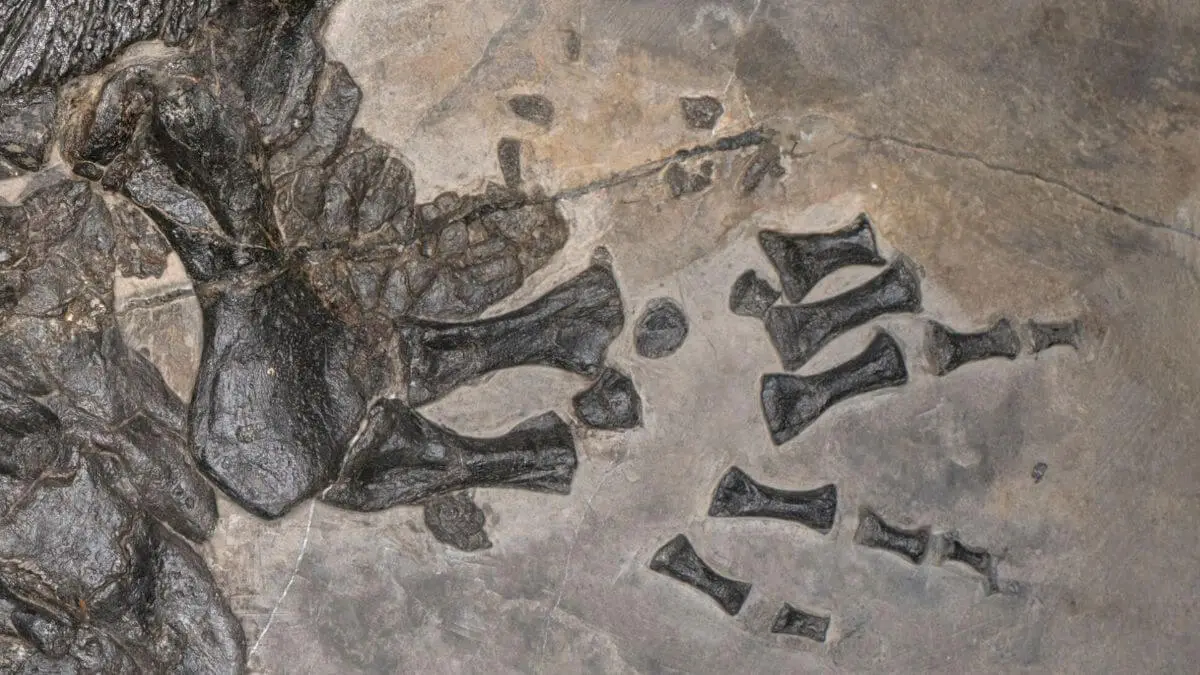
The discovery, published in the journal Nature Ecology & Evolutionis the result of research in which scientists from the University of California at Davis, Peking University and the Guizhou Geological Museum have participated. Specialists have studied two practically complete skeletons from this Chinese province.
The curious thing about the discovery is that the animal hardly had any anatomical differences with some of its freshwater relatives. How then did it become independent of a resource that amphibians have been depending on for millions of years?
An armor that ended up having an unexpected function
To understand the peculiarity of this animal you have to look at the skin of a modern frog or salamander. Unlike other vertebrates, many amphibians obtain water through their skin, an organ that is also involved in gas exchange and greatly affects the places in which they can live.
When an amphibian submerges in the sea, the difference in the concentration of salts between its body and the environment that surrounds it favors the loss of body water. Paradoxical as it may be, an animal surrounded by water can end up dehydrating.
Gerrothorax maritimusHowever, it had an anatomical characteristic that could free it from much of this problem. Its body was protected by numerous bone plates that, presumably, had appeared as a defense mechanism against predators. The researchers believe that this coating would also have helped limit water loss.
To this we must add another peculiarity: it retained a gill respiratory system during its adult life. According to the scientists’ hypothesis, the animal could have ingested water through its mouth and regulated excess salts through its gills, in a similar way to what happens with marine fish.
We would be facing a possible case of exaptation, an evolutionary phenomenon that occurs when a characteristic originally acquired to perform a certain function ends up being useful for a completely different one. Protection from predators could have facilitated, fortuitously, the conquest of a new habitat.
The evidence that he really lived in the ocean
Finding the bones of an amphibian in ancient marine sediments does not necessarily mean that the animal lived in the ocean. Currents can carry corpses from rivers and lakes to places considerably removed from their original habitat.
However, the specimens recovered in Guizhou even preserved the small finger bones. Their exceptional state of conservation indicates that they were buried near the place where they died, in an ecosystem in which marine reptiles such as ichthyosaurs also lived.
The most revealing evidence was in the chemical composition of the fossils. The scientists analyzed the proportions of isotopes of strontium, an element whose isotopic composition allows us to obtain information about the environment in which past organisms lived.
The results coincided with the characteristic values of ocean water at that time. Together with the geological and anatomical evidence, this data supports the hypothesis that both specimens developed their lives in a marine environment and did not arrive there accidentally after dying.
A predator that hunted without barely moving
With an approximate length of between 70 and 90 centimeters, Gerrothorax maritimus It had very different proportions from those of a giant salamander. Its body was wide and compact, an anatomy especially appropriate for functioning on the seabed.
The arrangement of the eyes and the structure of the skull suggest that it practiced hunting by ambush. Instead of actively pursuing its prey, it would have remained motionless on the ocean floor until a fish or other small animal passed close enough to its mouth.
By opening it quickly, it would generate a current of water capable of dragging its prey inside. A suction feeding technique still used by certain benthic fish and sharks.
The discovery now raises an interesting question for paleontologists. Traditionally, the search for prehistoric amphibians has focused on ancient continental and freshwater environments, precisely because of what we know about their current representatives.
One wonders how many other species were able to experiment with marine life during Earth’s remote past. Perhaps some of the answers are found in sites where, until recently, few specialists would have thought to look for an amphibian.
References:
-
A fully marine stem amphibian from the Late Triassic of China, Nature Ecology & Evolution (2026). DOI: 10.1038/s41559-026-03209-9
Cover photo credits: Chen Geng/Guizhou University